Feasting, fèves, fortifications and frescoes – everyday life in Entre-deux-Eaux – January-March 2016

To download a printable PDF version (no pictures)
click on this link 
E2E2016no1.pdf (six A4 pages)

Click here for the full set of Portugal photos

A week ago today we were in Strasbourg for the first time in six months, and not for routine medical appointments but for pleasure – lunch with friends. They had chosen one of their favourite venues, the Fink’Stuebel, a typical Alsace small restaurant alongside a canal, in the area of Marie Laure’s student days. Wherever we meet up, we seem to attract noisy diners at neighbouring tables – or is it just a sign of increasing age? After a congenial lunch with typically generous portions of choucroute for John and black sausage, apple and onions for Helen (Marie-Laure and Christian having chosen their favourite calf’s head in sauce), followed by an ice cream kougelhof, we were happy to walk off the excess and enjoy the relative silence in the streets of Petite France and the Grande Île. It was a lovely sunny day, despite the wind, and the atmosphere felt very relaxed, with people strolling by the river, browsing the second had bookstalls on Place Gutenberg, riding bikes and sitting with dogs in the sunshine of Place Kleber. We had forgotten how attractive the narrow, colourful pedestrian streets round the cathedral are, with their bakeries, restaurants and charcuteries. We lingered in a recently renovated boutique arcade, an excellent foreign language bookshop, and even an Oxfam shop. We saw only two armed soldiers during the whole afternoon. It was so good to feel that the security atmosphere was less tense than it had sounded over Christmas, and in February when Marie-Laure had written about a demonstration of 15,000 Kurds, the armed soldiers patrolling in groups of six, and of feeling dispossessed of their city. But now with the terrible news from Brussels and plots in Paris, that relaxed atmosphere we were lucky to experience will no doubt have evaporated again.

In our last newsletter, perhaps we underestimated the shock of villagers to the far-off events in Paris. After an enjoyable Christmas and New Year in Letchworth with family and friends, and having avoided catching nasty colds or ‘flu there this year, we returned to Entre-deux-Eaux on 7th January, in time to continue festivities here. The following evening Mayor Duhaut offered his voeux, or seasonal greetings, and those of the municipal council to the villagers in our spacious village hall. This is always well attended, with its tasty nibbles and crémant d’Alsace/kir (few people turn down good food and drink here, even if it means listening to the mayor’s speech first). We dutifully got round at least half the room kissing cheeks and shaking hands and muttering “Meilleurs voeux”, which is a record for us (especially as they only tell you after exchanging kisses that they’ve got a terrible cold). The mayor started his speech by remembering the events of Charlie Hebdo a year and a day ago, and the shootings in and around the Bataclan in November, and all who had died there. Usually it is only those who have died during the year in the village who are remembered, and in comparison the passing away of the oldest inhabitant, gentle Lena, in her nineties, seemed such a natural event. On a lighter note, the nibbles were so good and copious that afterwards we saved most of our planned dinner for another day.

Saturday was equally festive in Sainte Marguerite for the crémant d’Alsace and galette des rois. The dancing was in full swing by the time I got there, and there was much hilarity over a game involving a king, his queen, their coachman, their four-wheeled carriage and two horses participating in a story in which the nine “actors” have to get up and run round their chairs whenever their “character” (including each wheel) is mentioned.

And just in case the weekend felt quiet, there was a very convivial lunch the next day back in E2E for all the over 65 year-olds offered by the village council. There were about seventy eight participants at two long tables. The food was all cooked by a young man from the village and the music and entertainment was provided by two elderly villagers in tight jeans, joined occasionally by a man who’d annoyingly brought his castanets with him. The food was excellent, with the meal lasting from mid-day till nearly six when the coffee and chocolates were served. Each course was filling, but with all the wine and dancing between courses, everyone managed to eat their way through the menu without too much of a struggle. The highlight was a game involving a king, a queen, a coachman… it must be this year’s “in” French party entertainment. After so much wine we all had tears in our eyes as we watched the left rear wheel forgetting her part and the coachman falling off his chair. And then there was the stand up/sit down action song. Oh, such hours of innocent fun.

There was then a slight lull in January festivities, during which we were able to enjoy some snowy, but slippery walks, a local history talk on the military postcards of Adolphe Weick of Saint Dié during the first world war, and, with Scrabble in Sainte Marguerite starting to meet fortnightly rather than weekly, I bravely joined the Remue Meninges group which meets on alternate weeks. John translates it as Helen’s gaga group but it is usually translated as brainstorming, though it’s really word and number exercises like Countdown, word-search, crosswords etc. to keep the brain active. The group turned out to be very lively and welcoming and most solicitous that I should understand everything – I struggle more with the numbers than the words, oddly enough! At the end of that first session there was more galette des rois and cider or crémant!

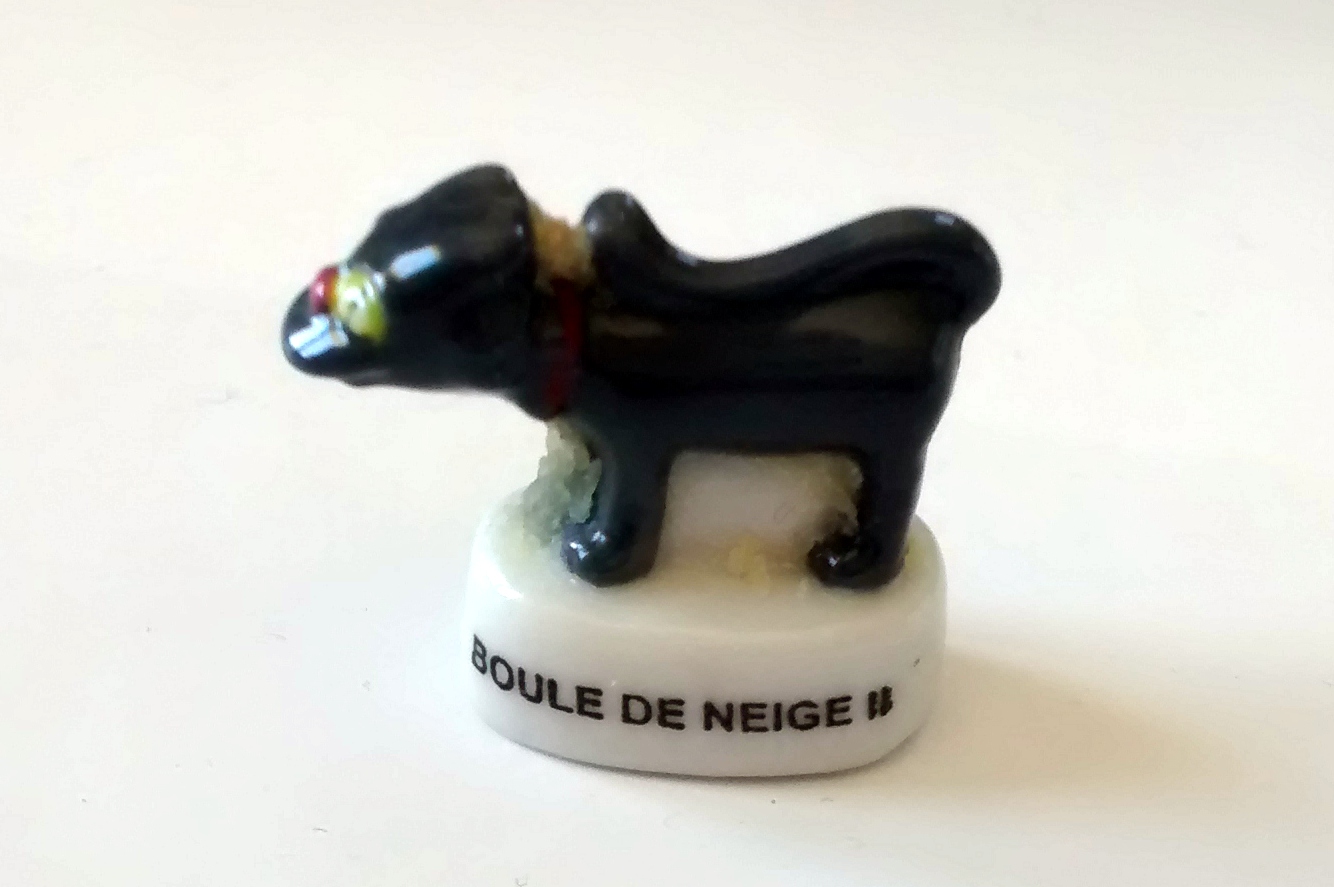
galette des rois fève

galette des rois fève

Then on 20th we reached the final seasonal lunch, prepared by the ex-fireman’s wife and her helpers for the E2E Oldies club. John nobly agreed to join in, and by the time the wine had flowed freely, thanks to the presence on our table of both present and former mayors, John even wore the cardboard crown presented to those who found the fève (once a bean but now a ceramic figure) in their galette, and agreed to submit to the challenge of three-sided dominoes. At the same time we heard animated discussions from the mayors former and present of current village plans, like that to build a smaller meeting room for groups like ours and some single-storey pavillons or detached houses, providing disabled access for elderly villagers. This sounds a very progressive scheme for the village, but with Mayor Duhaut’s mother Giselle (the elder sister of Madame Laine) having suffered many falls in her draughty old farmhouse, he is fully aware of the problems of the elderly (a polite translation of John’s comment, “guess who’ll get the first house”).

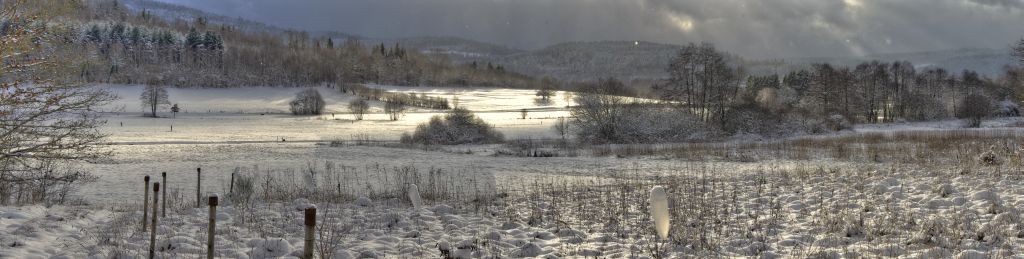
Nearly home after a snowy walk

Nearly home after a snowy walk

With the feasting over, it was back to snowy walks and the occasional cultural highlight, like a talk by author Philippe Claudel, organised by the Saint Dié bookshop and held in a room at the top of the interestingly sculptural Tour de Liberté. I hadn’t realised that one was expected to reserve a place, but was graciously allowed to join other improvident people perched on tables round the edge of the room. It was perfectly comfortable, but I must have looked decrepit as I was singled out just before the start for a vacant chair in the front row alongside the dignitaries. But from there the view through the long glass windows (which curl round in a huge semi-circle) to the high snow-covered hills round Saint Dié was lovely, and especially apt when the author described writing about mountains. His main theme, however, was death and who one writes for after the people for whom one has been writing die. It wasn’t a book which I felt the urge to buy, but the talk was stimulating, so when we found the Oxfam shop in Strasbourg (there are two in Lille and Paris and one in Strasbourg), I bought an earlier novel of Claudel’s. The following weekend, however, at the Philomatique’s AGM, I invested in a fascinating and surprisingly weighty book about civilian life in the Vosges during World War 1. As a result of the tables in it I can now tell you how many rabbits and chickens there were in E2E, and the level of war damage, but it will need some close scrutiny (the print is too small for comfortable reading) to tell you the effect locally of wartime textile strikes. Unsurprisingly, it started life as a thesis and is very thoroughly researched.

No newsletter is complete without a detailed food description. Once into February, and feeling the effects of the end of the feasting, we decided to cross the Vosges to try out a new restaurant in Ammerschwihr which had been opened by chef Julian Binz (who had one Michelin star at a Colmar restaurant). His décor of voluptuous Rubens-like ladies and the head waiter simpering “you’re welcome” at the end of every sentence were negatives, but the nibbles were good, the crab amuse-bouche exquisite, and the sea bream tartare in parsnip soup with lemon grass beautifully and delicately flavoured. After that the veal in a rather strongly-smoked bacon wrapping and artichoke was good though not as exciting and the pineapple dessert was pleasant but not memorable. Afterwards we wandered round the small walled town of Kientzheim before driving back. There were illuminated warning signs as the road started the climb to the Col de Bonhomme, and we passed a snow plough spreading salt or grit on the Alsace side, but our side had not been done and the van in front was going extremely slowly as the compacted new snow was slippery near the top.

Other February diversions included an antiques fair then the big Amnesty book sale in Saint Dié and the annual trip to the “theatre” in Saulxures. This year’s farce had just 3 local actors (including the baker) in a ménage à trois, and before performing they also waited at table, carved the giant smoked ham, poured the drinks and chatted to guests at the long tables, all of which get the audience in a very receptive mood for the comedy. They do a Saturday and a Sunday performance and meal right through winter from October. Such a hard slog on top of a working week!

Almendres cromlech near Evora

Almendres cromlech near Evora – click on image for a full 360º panorama

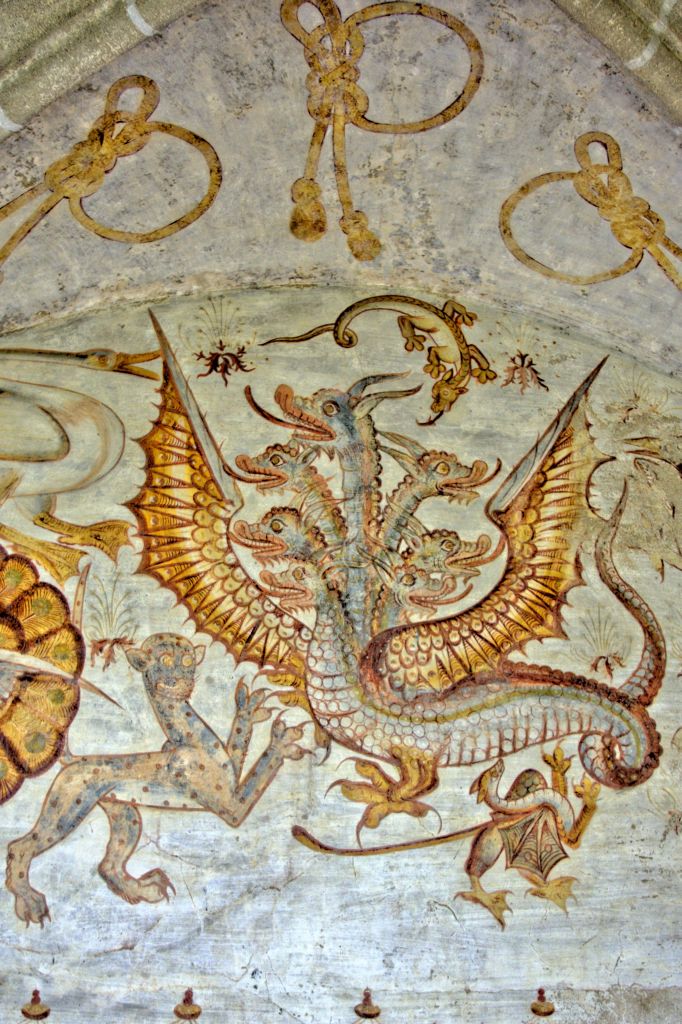
After that February began to seem a bit drab, and John searched the internet for a good combination of cheap flights and maximum winter sunshine and on 24th we flew from Basel to Lisbon, hired a car and meandered south and east. Many years ago (probably over thirty-five) we’d taken the train from Lisbon to Lagos in the south west for a few days at the end of a conference John was attending. The small fishing town had charmed us, as had our ride across the Tagus on the ferry and the train through the cork estates. This time, not wanting to see all the high rise hotels and flats that have since blighted that coastline, we decided to head south east, the car enabling us to visit more remote places and see ancient rural megaliths, as well as the rich layers of Iron age, Palaeo-Christian, Roman, Moorish and Christian sites in fortified hill towns. Evora was our first stop. We stayed just outside the town walls, but from the top floor bar we could see the town spread out above us, dominated by the stolid Romanesque/Gothic cathedral. Beyond, in the countryside we walked up earth tracks between cork and olive trees and grazing cattle to find early history’s atmospheric menhirs and dolmens. On a wet day we dashed with dripping umbrellas between the museum’s Iron age and Roman finds, the Roman temple and baths, and churches with blue and white tiled interiors, and then were intrigued by a small metallic notice on Vasco da Gama street about the ancient palace of the Silveira-Henriques with remains of a sixteenth century cloister with “frescos where the bizarre, the grotesque, the profane and the religious thematic enters in symbiosis in a marvellous allegorical set, enhancing an artistic manifestation unique in the country”.

Fresco in ancient palace of the Silveira-Henriques

Fresco in ancient palace of the Silveira-Henriques

There was nothing in the various guide books about this unique allegorical symbiosis. Who could resist the challenge? But there were no likely-looking palace doors. We walked uphill and into a square and enquired tentatively in the gallery of modern art. They said they could access the “garden”, but were more interested in showing us the current artists’ exhibitions. Eventually, escorted by a guard with keys and a silent custodian, we were ushered along a corridor, down stairs, through a crypt, up some more stairs and the gate into a small garden was unlocked for us. And there along one recessed wall of the garden were the most delicately painted enchanting creatures from a mediaeval bestiary, including a many headed dragon or hydra, a mermaid and a musician. We felt as excited as if we had discovered them ourselves, and on the way out smiled politely at the torn splattered bed-sheet modern artworks we were shown, whilst feeling, like old fogies, that art isn’t what used to be.

São Cucufate

São Cucufate

None of the frescoes we saw afterwards, amid the fortifications, would match the delicacy of what the hotel barman called “the painted garden”. On our way to the lakeside walled hill town of Mertola close to the Spanish border, we made a detour to a Roman villa marked on our map. São Cucufate (a Spanish saint said to have survived being roasted alive, covered with vinegar and pepper) in fact exhibits the remains of three very large Roman villas (the massive walls of the latest dating from the fourth century) and a ninth century convent. Sadly the Augustine canons, or the Benedictine monks or the solitary hermit who later occupied it were not as skilled at chapel wall-paintings as the “garden” painter.

 Santa Clara de Louredo fresco

Santa Clara de Louredo fresco

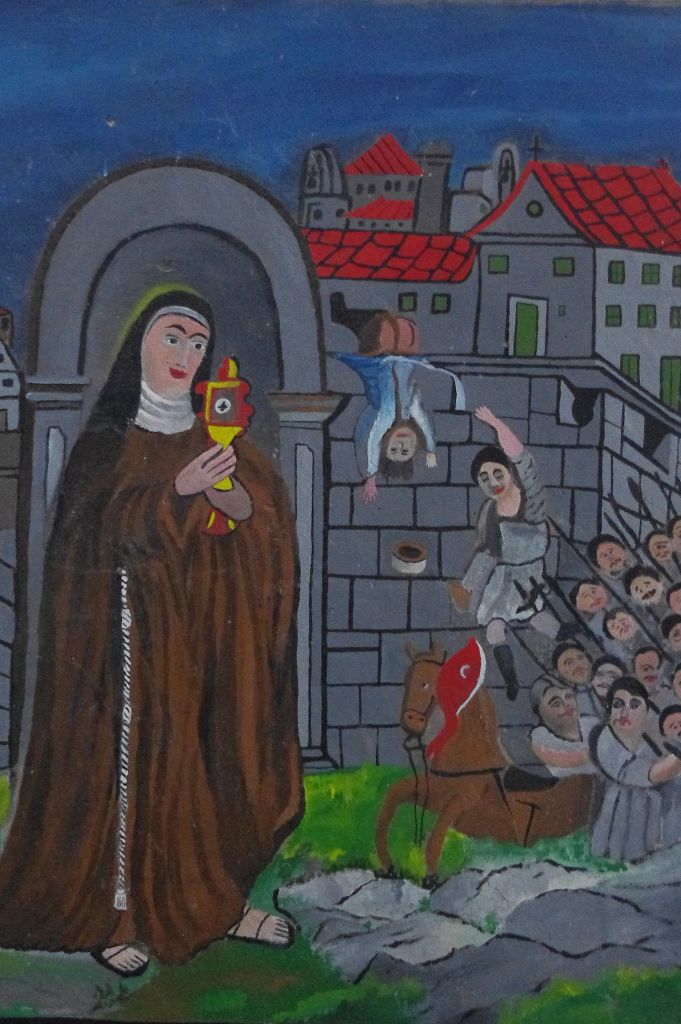
But nothing as sad as the frescoes at the tiny sixteenth century village church of Santa Clara de Louredo, where we stopped on our way between the walled town of Beja and the fortified hill village of Mertola, having read a passing reference to a legendary princess repelling the Moors. It is possible that the paintings on the walls round the altar were very crude to start with, but their “restoration”, apparently in the nineteen eighties, looks balder than a comic strip with black outlines and crude daubs of colour depicting Saint Clare, holding up the sacrament and saving her convent and the walled city behind from the Moors. We were cheered only by the sight of a troupe of the famous Iberian black pigs a bit further along the road rushing eagerly through the olive trees in the hope that we would feed them titbits through the roadside fence.

By the time we reached Mertola it was the hottest day so far as we climbed up the steps to the old walled town and sank into café chairs and waited for everything to open after lunch. This was probably our richest day as with an old river trading port through the ages there were all the afore-mentioned layers of history, with Phoenician and Greek artefacts thrown in. Below the castle walls were some fascinating recent excavations of Moorish houses built on the Roman forum, with an episcopal palace alongside. The simple adjacent church had been a mosque, the castle of the Swabians and Visigiths and Moors was taken by the Spanish Knights of the Order of Santiago, and there were fascinating little Islamic, Roman and Palaeo-Christian museums to visit. The impressive Roman house remains were to be found under the town hall, approached through a typically boring municipal waiting room. Even our modern hotel had a viewing shaft in reception down to the walls of the fishermen’s houses excavated during its construction.

Silves castle

Silves castle

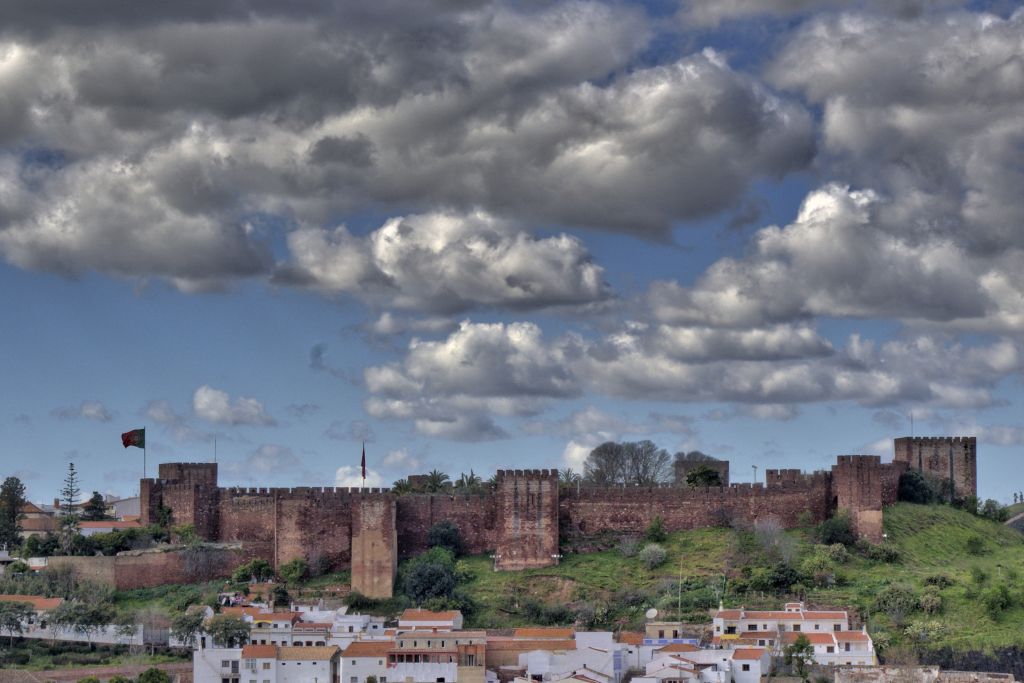
And when we reached the coast near Castro Marim and the Spanish border the next day, it was still hot enough to enjoy a paddle along the windy golden sands of the deserted beach. More energetic were the cyclists racing in over the Roman bridge in Tavira at the end of the Algarve bike race. Set back further from the coast we enjoyed the castle and cathedral at Silves, deciding that this was the Moorish fortification (formerly Roman and Visigothic) for us, with its ample water supply (a ten metre high vaulted and pillared cistern and sixty metre deep well) and its attractive modern sculpture garden.

Carrasqueira

Carrasqueira

Outside the castle gate there was live open-air music from a café and the cobbled streets leading up to the cathedral (built over the former mosque) were strewn with lavender for the pre-Easter procession later. When we reached the west coast we were enchanted by the small fishing hamlet of Carrasqueira in the evening sunlight with its simple spiky wooden jetties.

We stayed in a mix of rural guest-houses, modern urban hotels and posh historic Pousadas (including our last night in the old castle/convent at Alcacer do Sol, which of course had its own excellent subterranean museum of Iron age, Roman, and Moorish old walls and pottery fragments). And we ate a lot of good hearty pork (including those black pigs), cod, wild boar, and steak dishes (John had his best ever beef fillet in Evora, and on our last night near the west coast the riverside restaurant combined land and sea in a large plate of steak, prawns and chips). It was a great break.

Back in E2E, an agreeable spell of sunny weather has enable us to get on with weeding and pruning and fertilising the garden. Rejoicing in the improvement to his back, John has been heavily pruning trees, sawing and shredding all the orchard saplings branches he has cut down, only to discover he is very allergic to some – probably the flying golden pollen of the hazel catkins. The hellebore and snowdrops have been very pretty this year, and the cowslips, which I always associate with Easter, are stippling the orchard grass.

After Easter we shall be packing up again and heading for Letchworth, where we hope to see as many family and friends as possible before we return around 19th or 20th April. When we reached Calais on our last trip in December we saw a very large number of police in and around the makeshift migrants’ camp behind the grim wire fences shielding the approach road to the port. Then armed French police inspected our car boot as we checked in. Asked whether there had been an incident overnight, they shrugged and said it was routine now. All was quieter on the return journey, but police were still patrolling the gap between the two wire fences, which were uncomfortable reminders of prison camps. A report sixteen days later of fifty migrants breaking the barriers and boarding the P&O Ferry “Spirit of Britain” did not come as a surprise.

With that sombre thought, we wish you all a very happy Easter and hope to see you soon.

We visited many more towns, archaeological sites, castles, museums and galleries
in southern Portugal than are mentioned above
If you wish to see more photographs, click on the image below for the full set

Portugal photo index

Total lunar eclipse – 28 September 2015

lunar eclipse 28 Sept 2015

lunar eclipse 28 Sept 2015

We’d had bright days but cloudy evenings and misty mornings in the days before 27/28 September. So I hadn’t set my alarm, done any preparatory reading on how best to take moon eclipse photographs or got out a camera with appropriate lens and tripod. But I woke when the eclipse was about half over. Looking out, the sky was clear after all and the moon was not to the north where there is light pollution from the nearby towns.

I hurriedly found my Pentax DSLR which had a telephoto zoom lens already attached and my old tripod which has a slightly damaged camera mount (the new tripod was in the car boot!) So, not having really thought about aperture, exposure, etc. I started out with a 30 seconds exposure. But, after taking the camera memory card upstairs to the computer to check, discovered the moon/earth moved too much in that time. So, after wasting more time on a few similar exposure checks, I finally settled on 1/30-1/4 sec f8-f11 at 3200 ASA as OK. These are some cropped images from 5:00-5:35am. I wish I’d had time to get out a longer telephoto lens and also taken some photos at 800 ASA for better quality.

Unfortunately it will be some time before I can try again – but I’ll make sure I’m better prepared!

Photographing the International Space Station (ISS)

If you click on the images they will open full screen; it is then easier to see the ISS transits

There is also a later update The International Space Station (ISS) July 2020

As the third brightest object in the sky, after the sun and moon, the space station is easy to see if you know where and when to look for it! I signed up to get e-mail notifications of the visibility of the ISS from NASA-Spot the Station last November. The ISS observation web site gives more information than is contained in the Spot the Station e-mail.

But since then there have only been very limited opportunities to see it as we’d not had that many clear nights until earlier this spring! This week we’ve had clear night skies which have been dark as the moon is in the waning crescent phase so I’ve taken the opportunity to try to photograph the passage of ISS over Entre-deux-Eaux.

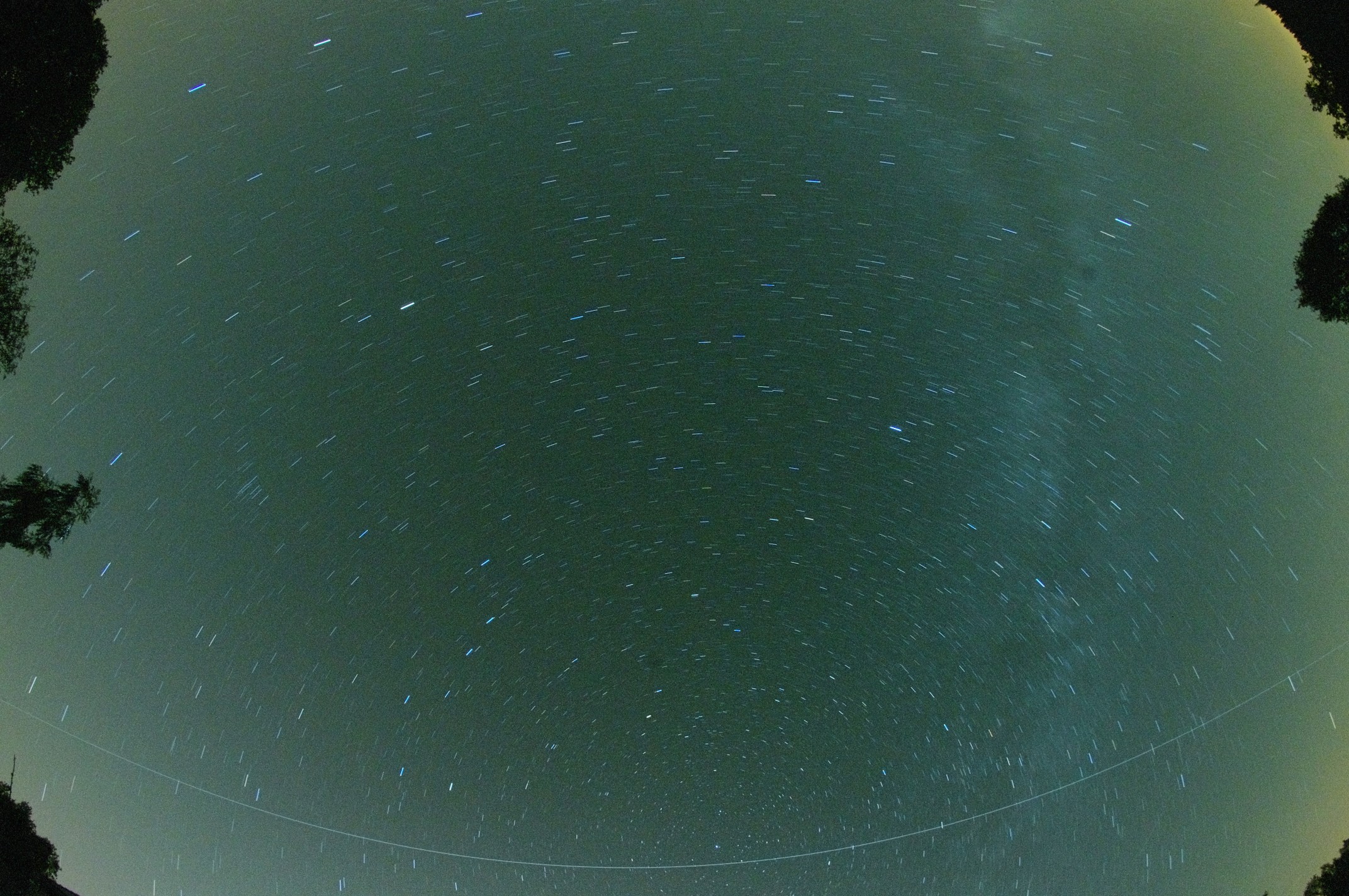
I decided to use a Pentax digital SLR with an 8mm fish-eye lens to get as much coverage of the sky as possible. The idea was to obtain the passage of the ISS as a continuous trail of light across the static background of the stars. The main problem has been in determining the exposure settings as not only can the ISS take over 6 minutes to go from horizon to horizon but for the earlier evening sightings the sky can still be lit by the last sunlight rather than night dark. There are not that many opportunities or much time to experiment! I opted to use the 100 ASA setting to reduce the noise (graininess) but for my first attempt I used an exposure of 30s @ f22 as I thought the image would be over-exposed with the very long exposure. That wasn’t the case. The attempt was when the sky was very dark and I was only able to see anything at all on the images by enhancing the images significantly. But even then the images were very poor and grainy.

Yesterday evening I tried again when the ISS was due to be visible (Time: Thu Jun 06 2013 10:57 PM, Visible: 6 min, Max Height: 77 degrees, Appears: WSW, Disappears: ENE). This time I decided to experiment with 100ASA at f8. But the sky still wasn’t completely black so I tried first with an approximately 2 minute exposure and then another with a 3 minute exposure to give images for further reference. These images both had good exposure and showed the partial track of the ISS clearly. However, the Pentax does a lot of processing when saving long exposures to try to eliminate random noise. So there was a gap of well over 2 minutes between the exposures. In addition, I was saving the images both as RAW and JPG files which added another few seconds to the delay between possible exposures. I had time before the next ISS pass to process the images and combined them into a single image using my usual Hugin panorama stitcher software to give a composite image which shows the west and east parts of the ISS path.

ISS 10.58pm 6 June 2013

ISS 10.58pm 6 June 2013 – composite image showing west and east trails

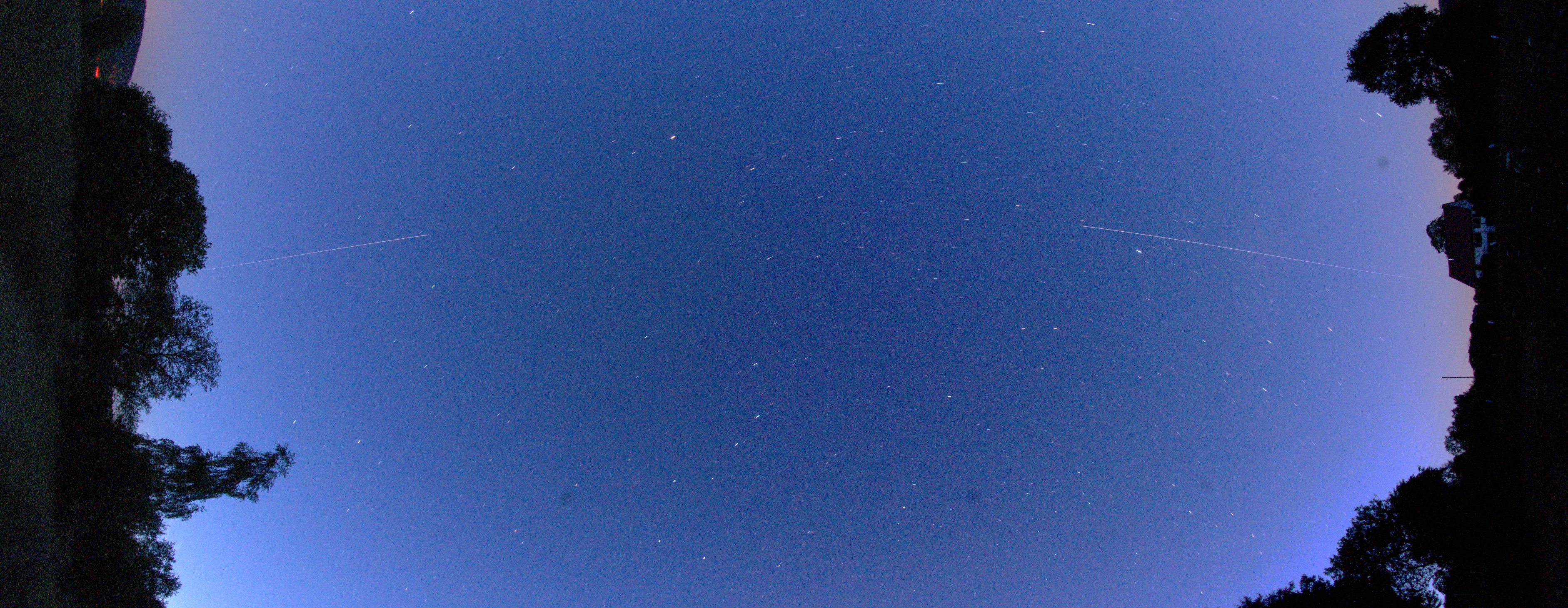
The ISS was due to pass again about 90 minutes later (Time: Fri Jun 07 2013 0:33 AM, Visible: 6 min, Max Height: 44 degrees, Appears: W, Disappears: ENE) and I decided to try to capture the total 6 minute overpass in a single shot. The sky was now completely dark so I chose to use the same aperture and ASA settings. However the ISS was lower in the sky this time and I failed to adjust the camera angle so the ISS passed through the centre of the image. Fortunately it was still totally within the frame! The arc of the path is due to the distortion by lens; had the camera been set for the ISS to pass through the centre of the image the path would have been captured as a straight line. The stars are blurred as the earth had rotated about 1.5º during the 6 minute exposure time.

ISS 00:33am 7 June 2013

ISS 00:33am 7 June 2013 – 100ASA 389s @ f8

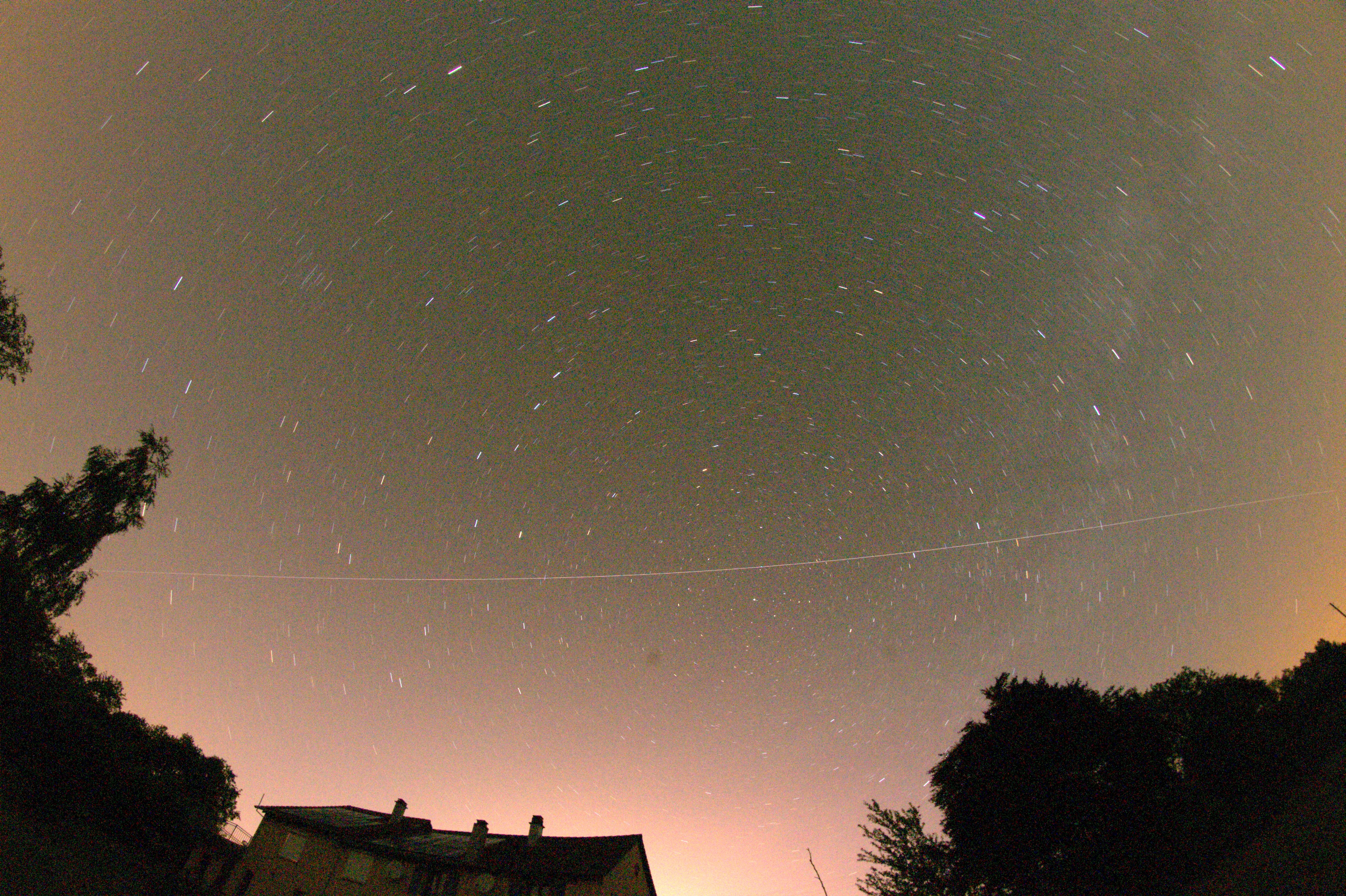
And this evening there was an overpass (Fri Jun 07 2013 10:08 PM, Visible: 6 min, Max Height: 51 degrees, Appears: SW, Disappears: ENE) but, although I could see the ISS, the sky background was too light to capture the ISS with the long exposure. The next pass was about 90 minutes later (Fri Jun 07 2013 11:44 PM, Visible: 6 min, Max Height: 49 degrees, Appears: W, Disappears: ENE) when the sky was dark. This time I set the camera angle to show the farmhouse. It was dark when looking south, east or west, but the ISS was to the north. So, although the passage was captured clearly the image shows the light pollution we get to the north from Saulcy-sur-Meurthe and Saint Dié des Vosges.

ISS 11:44pm 7 June 2013

ISS 11:44pm 7 June 2013 – 100ASA 357s @ f8

Tarmac and Trams and Tulips: January – April 2013 in Entre-deux- Eaux, Lisbon and Porto

To download a printable PDF version (no pictures) click on this link
E2E2013no1.pdf (five A4 pages)

There is a complete set of labelled photographs (950+) showing many more of the museums, galleries, street scenes, graffiti, etc. we saw during the Portugal trip. They are on eight web pages starting at https://blackmores-online.info/Portugal/index.html

Can you hear the rumble of a lorry coming up rue du Mont Davaux? No? False alarm. Just the EDF man in his blue van to read the meters. The only other activity outside is the steady chewing of the cows in one field, the galloping of two excitable horses in another, a pair of buzzards circling overhead and a flash of brown, possibly a hare, on the north field.

We have been getting slovenly over the protracted wet weeks of winter, often reading (books or computer screen) in bed till quite a late hour in the mornings. But today we were up and dressed soon after 7 o’clock, as French workmen can arrive at 8 o’clock to get in a solid chunk of work before the two-hour lunch break. We were looking forward to the latest (though it never turns out to be the last) of the outdoor house restoration projects. However it’s 10 o’clock and no Monsieur Pasquier and his tarmacing team. So now to relax, have a coffee and catch up on newsletters, the last one being a pre-Christmas one.

There was a chance that this newsletter could have come to you from India. However, after Christmas at Leila’s in Nottingham, we spent a longer than usual time in London (thank you again Jessica and Mark!). It was great to catch up with family and friends, especially seeing more of Jacob as he approached his second birthday. And then the hot season on the east coast of India was approaching too fast to get organised with injections, visas, etc. and still enjoy cooler weather throughout our travels. So our third Indian adventure is postponed till autumn.

Instead, we spent ten days at the end of February and start of March in Portugal. We arrived in Lisbon (by plane from Basel) and took the metro. With warnings about pickpockets circulating, I clutched my belongings possessively, but we emerged unscathed into a square at the foot of one of Lisbon’s steep hills. Our hotel was near the castle, which, like all castles, was on top of the hill, and we had just missed the clanking number 12 tram. The taxi at the head of the queue in the square was a decrepit Mercedes, long ago exhausted by the hills, and whenever it was brought to a halt in the steep, dark, narrow cobbled streets, we were uncertain whether it would lurch into rattling action once more. The light spilling out from the hotel’s glass door was very welcome, as was the news that they’d upgraded us to an enormous room, complete with sofa, armchairs, low table, writing desk, vast bed and a large terrace (the perfect room for relaxing in between sorties). Had we caught the tram, I doubt we’d have found the right stop to get off, let alone the hotel, in the dark, unlabelled streets.

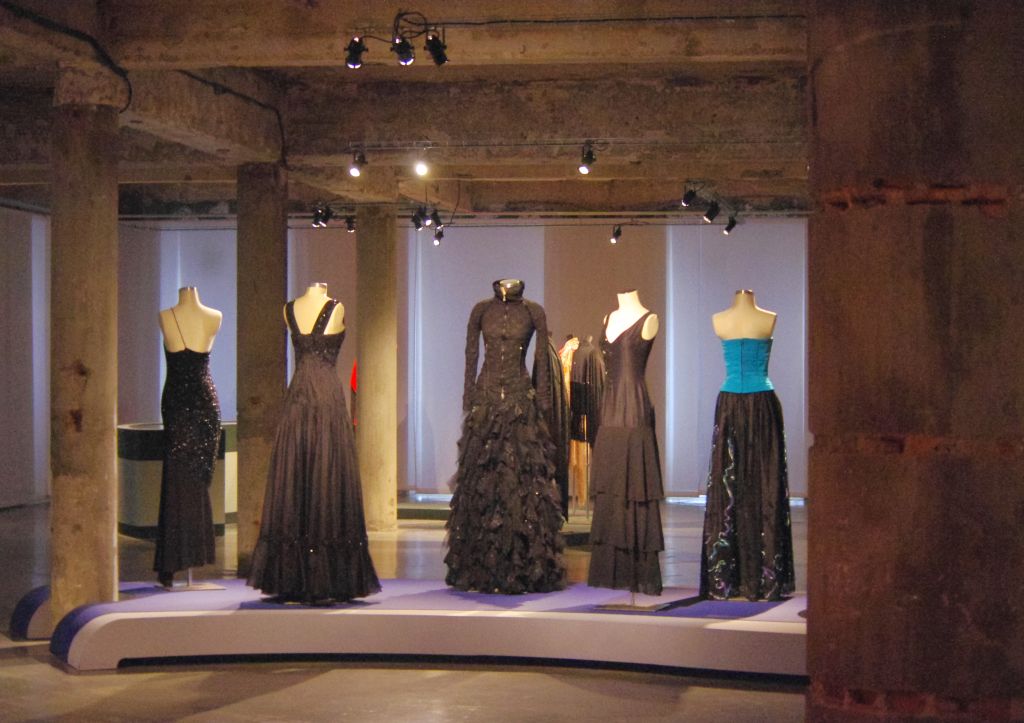
As so often, it was the unexpected things that were entrancing. On our first morning we paused at what looked like a bank to ask for directions, and the woman insisted on our exploring her building which had recently been converted into a design and fashion museum with fascinating exhibits.
MUDE-Lisbon

MUDE-Lisbon

MUDE had indeed once been a bank (Banco Nacional Ultramarino) before being gutted, apart from the bank director’s wooden-panelled room and some mosaic murals, then left unused. Another day we’d reached the old water pumping station and museum, hot and sticky after a boring walk by the railway line, and the small static equipment and photograph exhibition was rather dull. Then, as we pushed open a door, we were engulfed by the most wonderful sounds of early choral music. In the middle of the aromatic, highly polished (floors and brass) pumping station machine room a small choir was rehearsing. The acoustics were excellent as we scrambled up the wrought iron staircases and walkways above the choir and now-retired pumps. And to further revive us, the tile museum a bit further along the railway line was in a rambling convent with an unexpectedly good café.
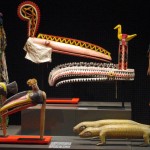
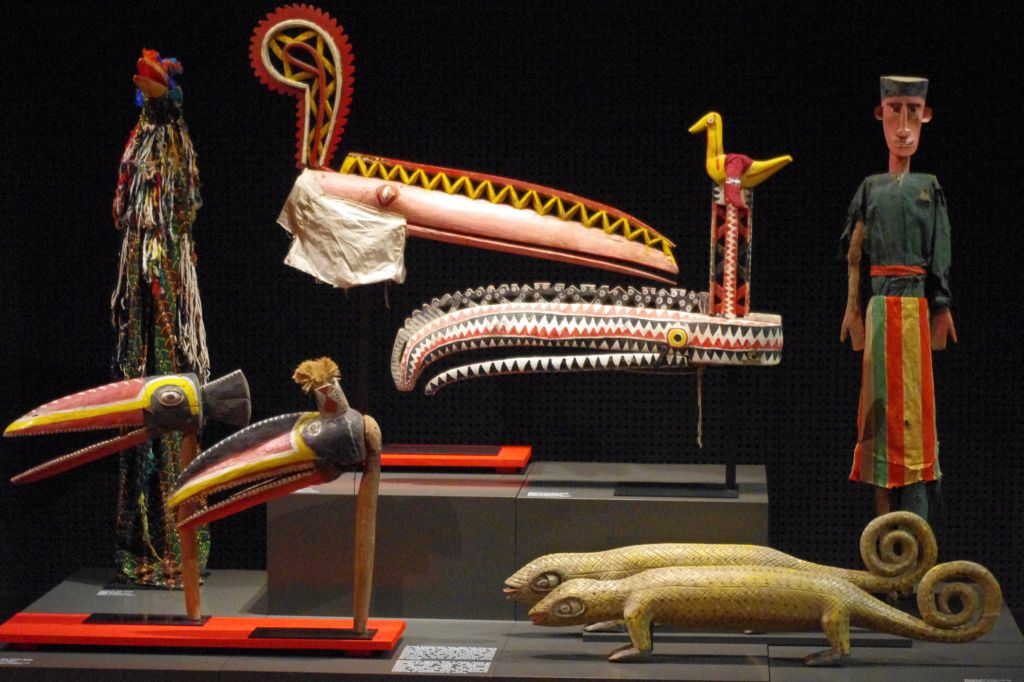
Lisbon-Ethnology Museum

Lisbon-Ethnology Museum

Another unexpected treat was the Ethnology Museum, now mainly just an archive, which recently had enough funding to display one room of exhibits; Mali puppets leered out of the darkness as individual showcases lit up at our approach. And a very informative young researcher conducted two fascinating store-room tours of Portugal’s everyday rural life implements and Amazonian artefacts.
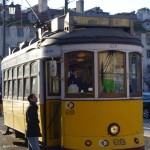
Lisbon tram

Lisbon tram

The trams were as much fun as we expected, and we enjoyed exploiting our three-day tourist ticket to the full by riding several to the end of their lines (although, for pensioners it is doubtful if the combined museum entrance/tram ticket is cheaper than the other museum discounts available). We also stopped at the enormous tram depot, where we had some difficulty in locating the small tram museum and rousing the staff; eventually they mustered one lady to sell tickets, one man to open the door at the far end to usher us and the solitary other visitor into a waiting tram, one man to drive said tram (a beautifully re-upholstered and curtained vehicle) to some far sheds, one man to open the small shop, and one man to man the small gallery. The tram driver sat and twiddled his thumbs till be were ready to be returned to the exit. As well as the trams themselves, it was interesting to see the safety posters, the tramway corporation’s brass band exhibits and the in-house ticket printing equipment.
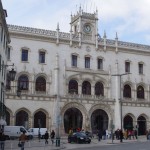
Lisbon-Rossio station

Lisbon-Rossio station

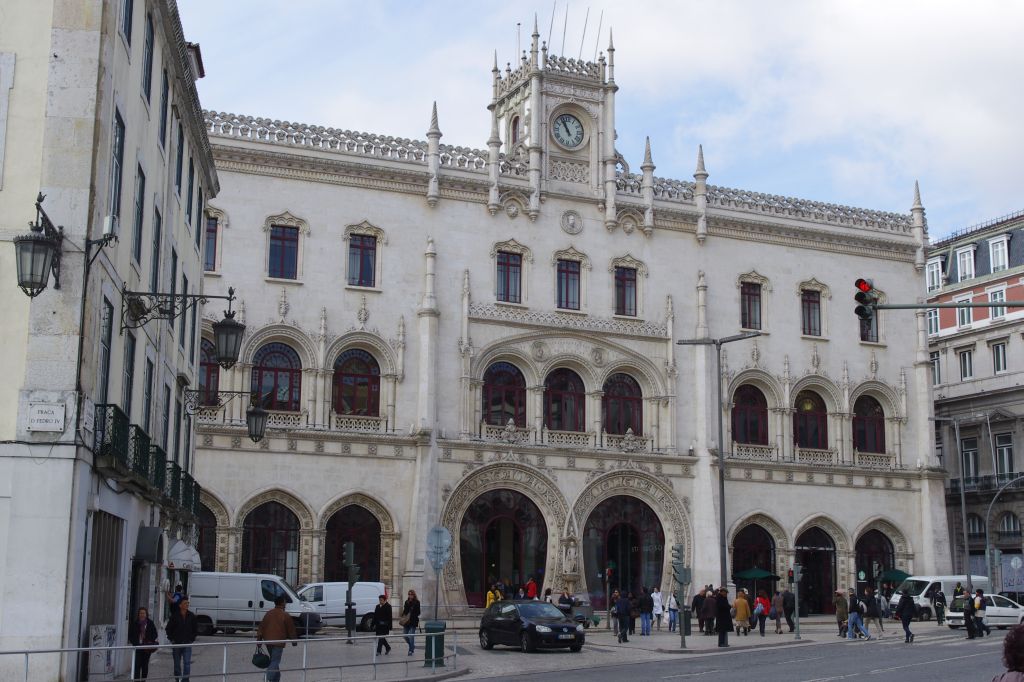
Our tourist ticket also entitled us to take the train out to Sintra. The railway station from which we left Lisbon was a stunning mixture of elaborate Manueline exterior, modern escalators and glass, and platform walls tiled with what looked like scenes from literary fantasies. Sintra’s railway station was more modest, unlike its palaces, over-priced tourist restaurants and cafés, and Moorish castle remains. But we enjoyed wonderful views from the Moorish walls and spotted an interesting-looking neo-gothic mansion, chapel and gardens.
Sintra-Quinta da Regaleira

Sintra-Quinta da Regaleira

Our map identified it as the Quinta da Regaleira, and on impulse we decided to find it. The terraced grounds contained the neo-gothic essentials of ferns, winding paths, follies, statuary, noisy waterfall and dank grottoes. Inside, amid hunting scenes, a pianist was rehearsing thunderously and his cascades resounded up the staircase, into the small library with its unnerving floating floor and out onto the ramparts with their gargoyles and sculpted snails. Again an unanticipated pleasure.

In Porto where, alas, our room was less lavish but the breakfasts superb, it was rainy, so we sheltered one afternoon in one of the lesser-known (to us, at least) port wine producers, Calem, near the more famous black silhouette of Sandeman; the tour and tasting was rather fun. We also took the metro about 30km to very nearly the end of the line and a small fishing village, Vila do Conde, with its dramatic aqueduct and narrow streets.
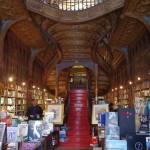
Porto-Lello bookshop

Porto-Lello bookshop

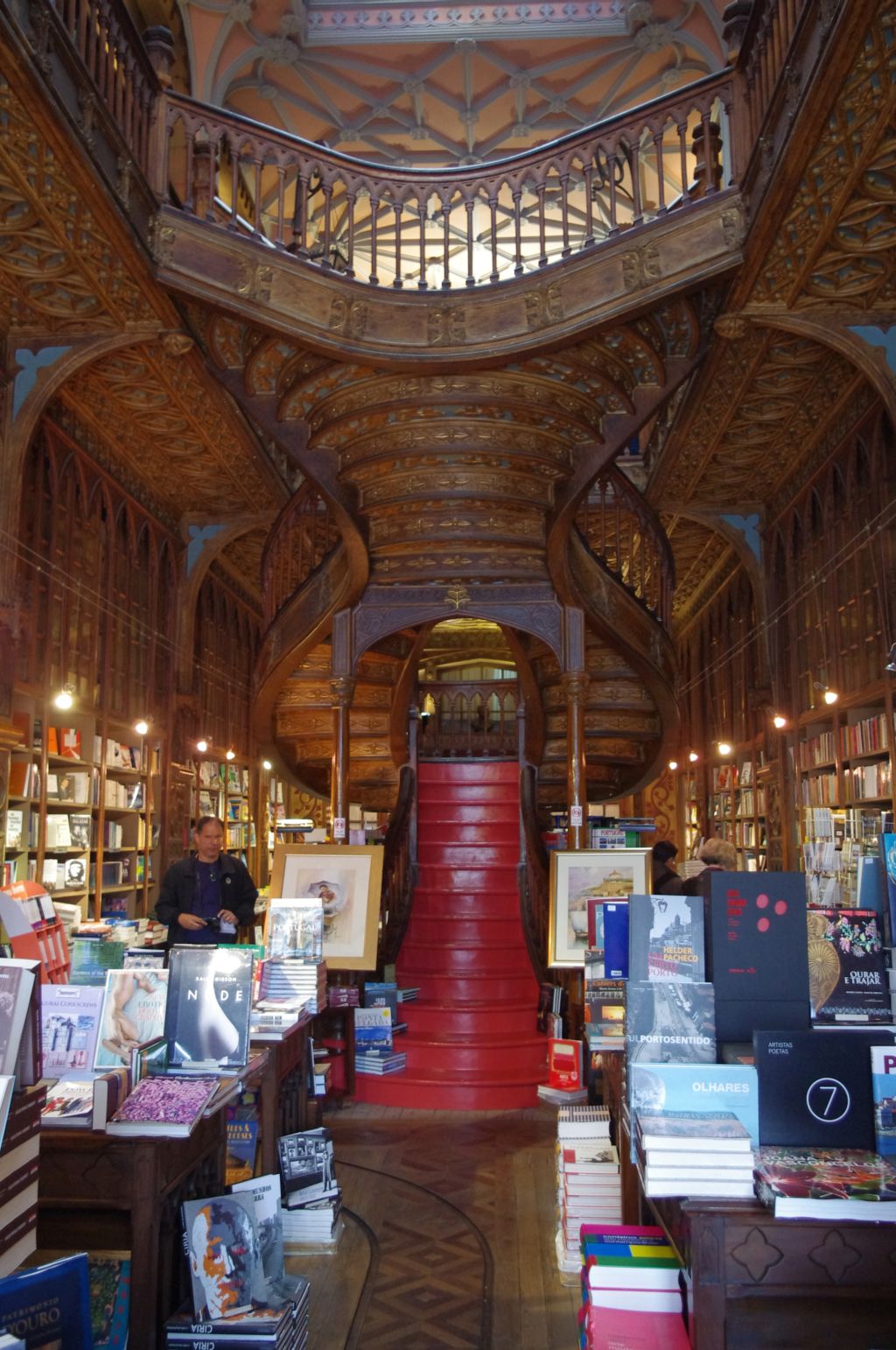
Porto also has my idea of the perfect-looking small bookshop, recently restored to neo-gothic splendour, a dairy serving great éclairs, and tall, decaying buildings, art-nouveau, tiled, and much in need of money and loving attention.

We were tourists, in cities, and at popular tourists sites, so were not seeing the dire economic situation of Portugal most of the time. And whilst there were very few people eating in the small fish restaurants on top of our hill in Lisbon, the café bars were busy with locals eating pastries and drinking coffees at all hours. However, one afternoon the trams came to a halt some distance from the main squares for the huge “Fuck the Troika” march, with protesters of all ages, classes and political beliefs united in protest against the austerity measures imposed by the IMF, EU and Central European Bank. We watched it file noisily past for some time, unable to pass through it, and sensing no end to the throng, retired to a café to put a few euros into the economy.

Before we went to Portugal we had indulged in the usual round of winter activities in and around Entre-deux-Eaux. At the mayor (and commune’s) lunch for the old folk, the food was good as ever and the wine flowed as freely as ever. The main course was described as “parmentier de canard, fondant, au beurre de Normandie, gratine, pousses de mesclun, copeaux de parmesan et tomates confites”, or, as John more succinctly translated, duck shepherd’s pie with salad. For the first time an accordionist from the village provided the music and banter, whilst the dancing between courses was as stylish as ever. The mayor sat quite near us and we realised that his lady friend is one of the delightful sisters who run the nearby La Soyotte farm museum. Later the same week the E2E monthly club for oldies had its AGM followed by lunch, – this time couscous, cooked by the retired fireman’s wife who’d gone to a lot of trouble on the desserts, making ice bowls with leaves and petals prettily encased between two layers of ice to hold the orange slices and ice cream. It was a real delight when Marcel was persuaded to go and get his accordion. He was the kindly shopkeeper back in the 1990s when we first bought our house, and has gone through a bad time since his wife died a few years ago. So it was really lovely to hear him play –he’d once recounted to us how he used to play when he was young at weddings and in their family café. Apparently he was also mayor some time before our present long-standing mayor. John sloped off after the lunch as the packs of cards and the Scrabble board came out. I always say that Scrabble-playing improves my French, though the idiosyncratic spelling of the charming and vivacious wife of one of the former Big Four Farmers doesn’t really help. We had no dictionary, so shrill appeals were made to the mayor who had once been a teacher. But, after a few glasses of wine, as her protests became shriller, it was easier to give her a free hand with spelling.

There was also the AGM of the Philomatique (which is not some tin-pot local history group, but self-styled “savants” with a good publication programme). It concluded with an interesting documentary film about St Dié at the end of the war. And, of course, there was the annual trip over the hills to the village of Saulxures, where a group of local actors feed their audience (with a kir aperitif, wine and coffee included, to get everyone in a good humour) before their performance. This year’s farce was set in an ecologically friendly house in the Vosges so had local references and some Vosgian dialect, which were much appreciated. One of the main characters was played by a local baker, who, apparently, does very good bread on other days!

One event we had not been aware of in previous years was an antiques fair in St Dié, this time held in the old police building. One dealer caught me returning to gaze at a couple of drawings, which were in fact limited lithographs of pencil drawings. He told us that the artist was Abel Pann, who worked in Paris from 1903-1913. He then went to Jerusalem, intending to settle there, but on his return to Paris to collect his things, was prevented by the first world war. He finally moved there in 1920. “My” drawings were part of a series of forty seven illustrations of the first five books of the Bible, done in 1930. Pann later did holocaust pictures and our salesman claimed he is usually bought by Parisian Jews with whom the exodus story resonates. A complete set of forty seven would command huge prices, but he would accept 200 euros for his two. Attractive as they were, we left them for any visiting Parisians to snap up.

On a more mundane note, John sampled the opticians as he had snapped the bridge of his glasses over Christmas, and his fetching epoxy resin glue repairs had not lasted.I still had a few remaining sessions with the St Dié orthoptist, prescribed by the Strasbourg ophthalmologist for eye exercises after I got my new glasses from the Ste Marguerite dispensing optician. These sessions were agreeably childish, looking from the red car to the red mushroom, or following the elephant on the stick! The highlight was when I had an exercise with a screen rabbit (like Peter Rabbit) loosing his tail and his bunch of flowers. It was clearly a treat as it wasn’t repeated. The subsequent screen fish tank and the kites were not as whimsical. We have not had nearly as much snow as the UK, but I did have to clear the garage exit several mornings before these appointments.

The snow was more of a problem on the day that ERDF (the company that owns the electricity infrastructure) were due to make the final connection for the photovoltaic panels. On arrival the man announced that he would be unable to test whether they were working with snow on the roof covering the panels, so made a second appointment to connect. That second morning he rang to confirm there was no snow. All was well. Then an hour before his arrival, the snow started to fall, covering the panels rapidly. John went out with a hose trying to wash the snow from the roof, and later got the ladders out on the snowy terrace to brush the bottom sections of the roof clear. Cold and slippery work, especially when some snow landed on his eye and went down the gap at the top of his anorak. The man said the roads were slippery too as it was new snow. Fortunately he was able to get enough minimal output to be able to check the connections and meters, but it definitely wasn’t the best of weathers for starting to produce solar energy!

We have, however had a few balmy days since our return from Portugal. One of those days we spent wandering round Colmar, seeing it with fresh eyes as we followed a tourist trail devoid of other tourists. We did, however, run into a couple we’d sat with at one of the E2E post-Christmas lunches but did not know well; although we recognised their faces, it took some time to really realise who they were. They were amazed to find two other villagers in the Bartholdi Museum courtyard! And another morning in Ribeauvillé was equally pleasant (again without many tourists despite the spring sunshine).
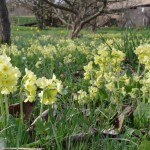
Cowslips

Cowslips

In a more recent outbreak of dry weather, John was able to get the potager rotavated and I dug in compost and started sowing vegetable seeds. Then the sun came out as Mark and Jessica arrived en route to Putney from Sienna (where they too had had cold and wet weather) so shared our enjoyment of the cowslips covering the orchard, and the windflowers, daffodils and first butterflies. After they left the following morning, we joined the Ste Marguerite group for a walk at the Col de Ste Marie. It was very pretty as it went down from the ridge through woods and fields, then slowly up through the woods to the Tree of Liberty, passing German bunkers, shelters, workshops, traces of the funicular, a mortar launching pit and an intriguing sign to a swimming pool (possibly to aid recovery, including from gas attacks, probably for officers), all from the first world war. However, Lucien, the leader for that day, who is a cyclist not historian, pursued his walk relentlessly, so no exploring. Somewhere to return to with a torch one day. It was the perfect day for a walk.
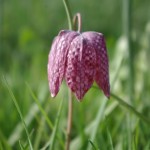
Snakes head fritillary

Snakeshead fritillary

In the latest precious trio of sunny days, the damson and plum
blossom frothed up, and we spotted more fritillaries in our meadow than we’ve ever seen before – silently colonising amid the more noticeable ladies smock. And so far two bold scarlet tulips and six fiery orange ones have survived the rodent winter feasting in the flower garden. A colourful small spring triumph.

But now the rain has set in again, the tulips look forlorn and the tarmac team have definitely not arrived. We hold our breath.

———————————————————————
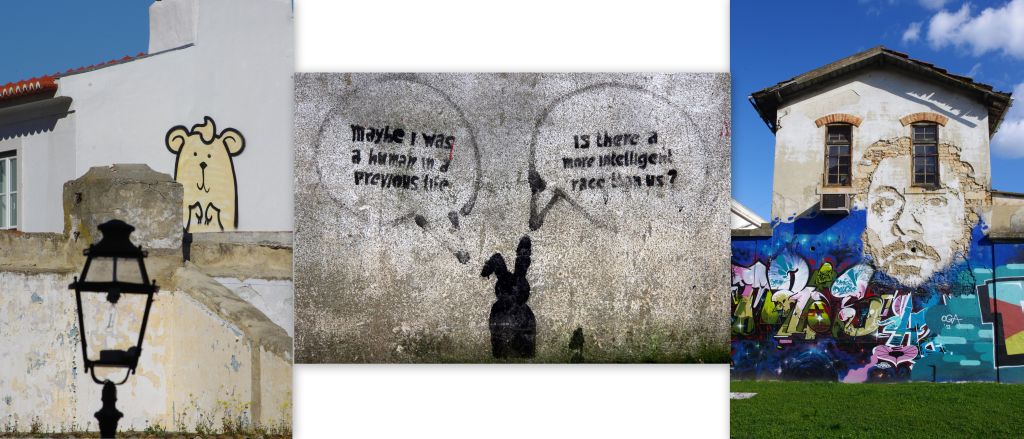
Lisbon street art
Lisbon street art

A week in Berlin, August 2012

To download a printable PDF version (no pictures) click on this link
E2E2012no3.pdf (five A4 pages)

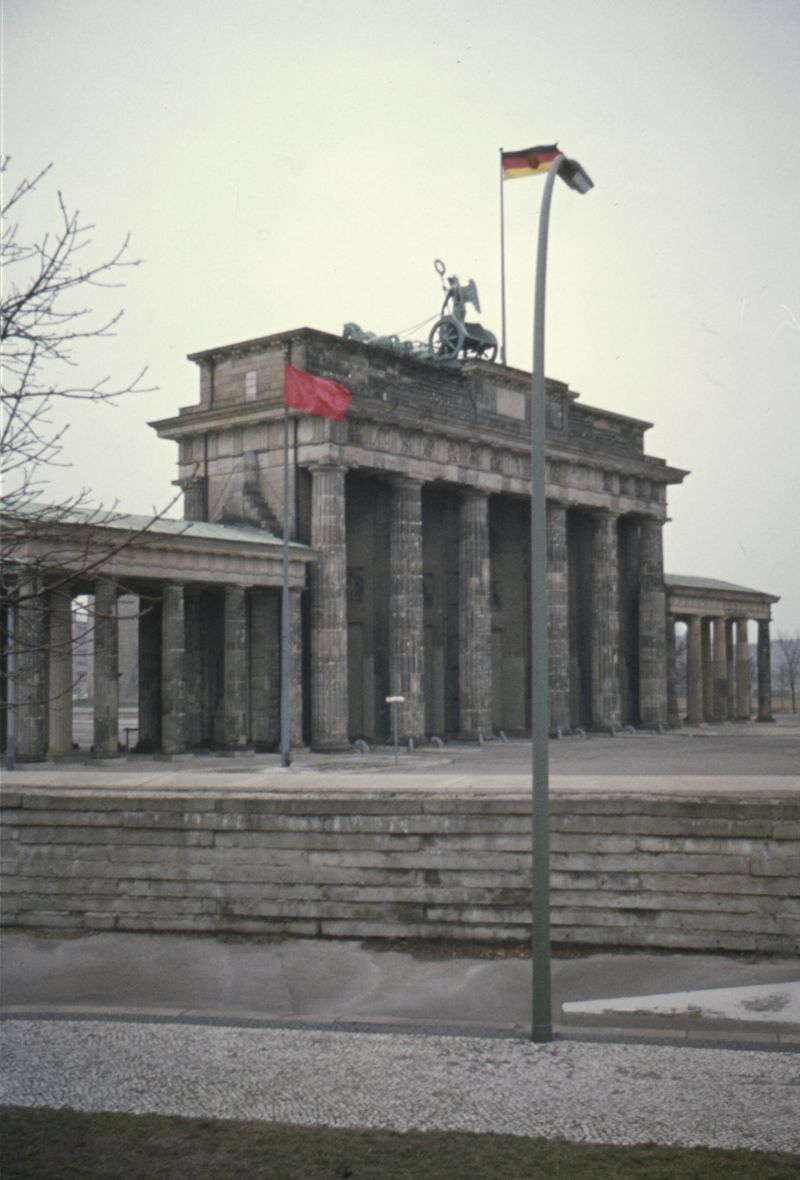
Brandenburg Gate c1975The triumphal Brandenburg Gate, topped with its chariot, horses and goddess of victory is a stirring image of Berlin. In John’ slides from the nineteen-seventies it stands grey and sullen behind the grey dividing wall. But on a sunny morning at the end of August, with the tour parties milling around and men with rickshaws zipping themselves into stifling brown bear suits (presumably for photos with tourists), it looked less impressive.

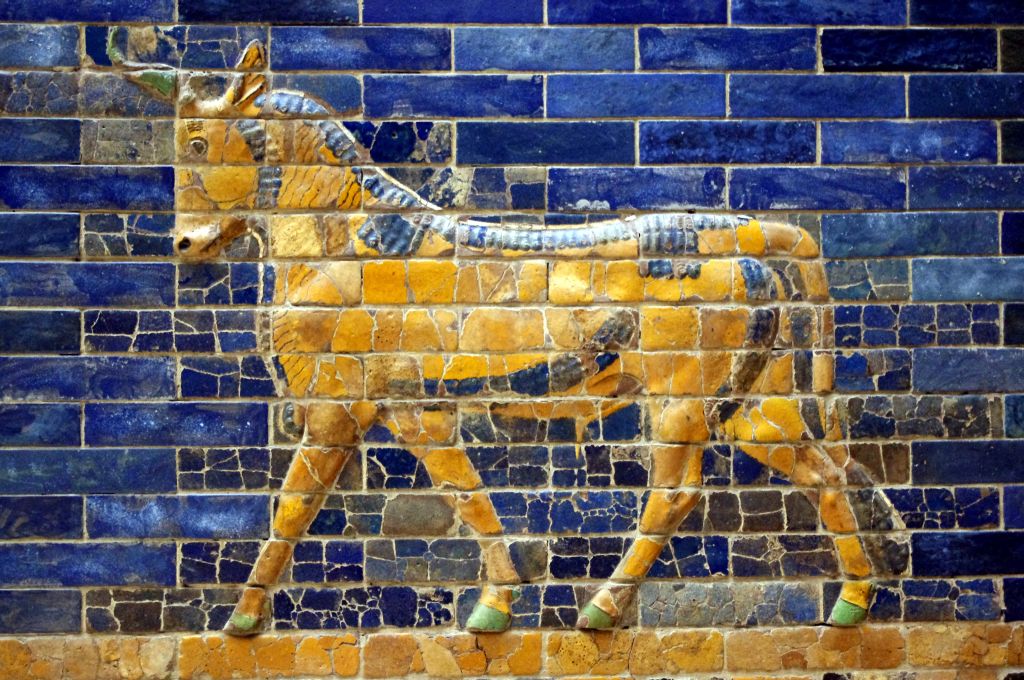
Three other gateways struck us as more stunning symbols of the magnificent but transient power of empire. Entering the first hall of Berlin’s Pergamon Museum, a broad flight of steps, twenty metres wide, sweeps dramatically up to the portico of the Pergamon Altar, excavated in the eighteen-seventies and -eighties in Turkey and reconstructed in the specially-designed museum. The sense of awe is enhanced as you climb the stairs, linger at the top, then pass between the columns to the inner court lined with friezes showing the life of Telephus, legendary founder of Pergamon. More splendour follows in the next room as you pass under the Market Gate from Miletus and encounter the blazing blue and golden yellow of the Ishtar Gate and processional way of Babylon; fragments of glazed tiles pieced together to show golden aurochs and dragons marching across the dark blue gateway while golden lions prowl the high blue processional way. The very height of this speculative and partial reconstruction made a more dramatic impact than their fellows, the dusty lions, bulls and dragons of Istanbul’s museum.

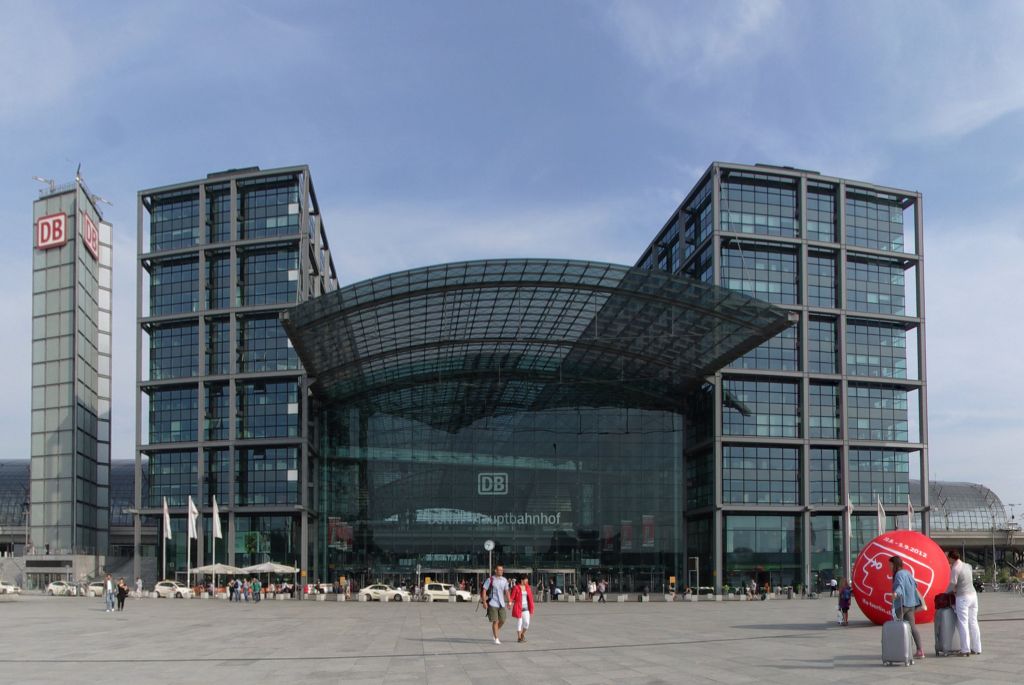
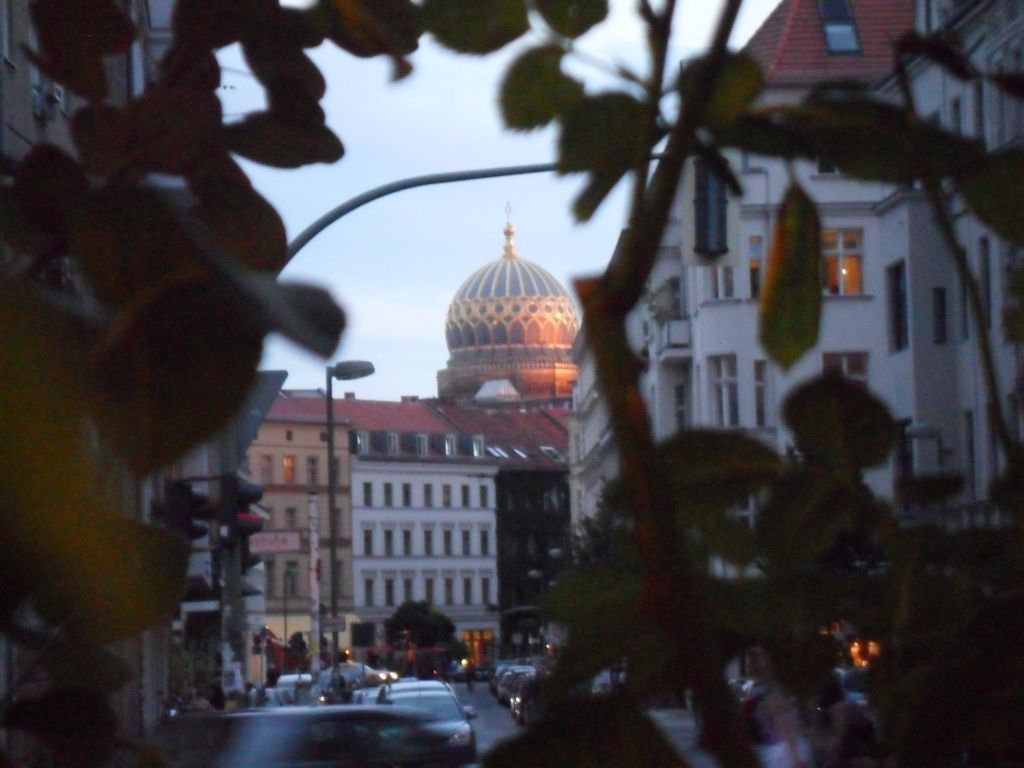
We had arrived at Berlin’s Hauptbahnhof late on Thursday afternoon, after setting out on the single-track railway line from St Dié to Strasbourg, then shuttling with bicycles, children and students on the busy little train which crosses the Rhine every hour to link with the efficient German network at Offenburg, where we picked up the sleek Interlaken-Berlin express. There had been a very good offer on first-class tickets, so we travelled this section in style, plied with free newspapers, small madeleine cakes and refreshing hand-wipes. Berlin station is now a stylish five-storey glass-sided edifice (even the trains run on two different levels) and it took a while to find the tourist office amongst all the shops and cafés; there a very helpful man (who retired from the fray, closing his position with a big sigh after answering all our requests) furnished us with a three-day museum pass, a booklet on museums, a couple of maps, advice on bus and train fares and where to catch the number 142 bus. Our hotel, the Adelante, was a recently-developed small block in a quiet street of flats, large kindergarten, evangelical church and corner bread-shop-cum-café in Mitte, formerly in East Berlin. That evening, as we strolled round the area, we steered by the gilded Moorish dome of the synagogue which glinted in the evening sunshine. It had survived the burning on Kristallnacht, but sadly not the allied bombing and, with a greatly diminished and impoverished Jewish community in East Berlin, was only reconstructed after the fall of the Berlin Wall. We stopped for a great (and cheap) meal at Dada Falafel restaurant, which also does a brisk over the counter trade, and that night had a very good jazz pianist/ singer.

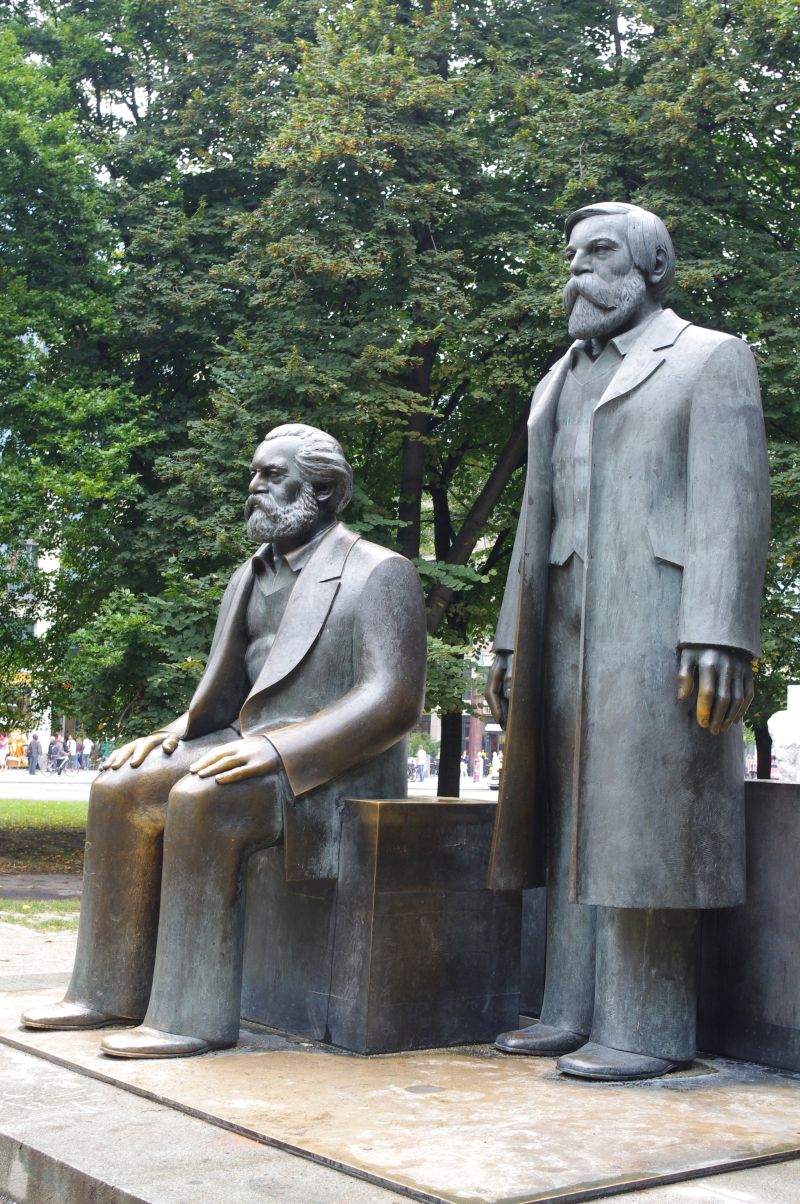
The following day, we ignored the hotel breakfast and ate at the corner café used by workmen in dungarees, regulars with their dogs, and bikers in black leathers, as well as by tourists, where the “small” breakfast included ham, salami, cheese, salad garnish, rolls, butter, jam and a big mug of coffee. Then, armed with our list of fifty-seven museums we could visit over the next three days (it had to be consecutive days), we revelled in the splendours of the Pergamon Museum (finishing in the Islamic Art section), then skirted the baroque cathedral, crossed the river and a park, pausing to greet the sculpted figures of Marx and Engels, and visited the eight-hundred year old Nikolai Church in the restored and quaintified Nikolai Quarter. Back on Museum Island at the Neues Museum, my memories are less of ancient Egypt and the bust of Nefertiti than of the pernickety custodians obsessed with size and position of shoulder bags (correct position is nosebag style), the laments that the glories of Schliemann’s Troy excavations are still in the hands of the Russians, and the flaking remains of nineteenth-century décor oddly incorporated into David Chipperfield’s renovation. Next door, the temple-like Alte Nationalgalerie had equally fussy custodians (despite the fact it would be difficult to knock the large framed paintings off the wall with a bag slung carelessly over one shoulder) and a suite of rooms of Adolph Menzel paintings. That evening we ate at the Toca Rouge, a Chinese restaurant a few doors from our regular breakfast café.

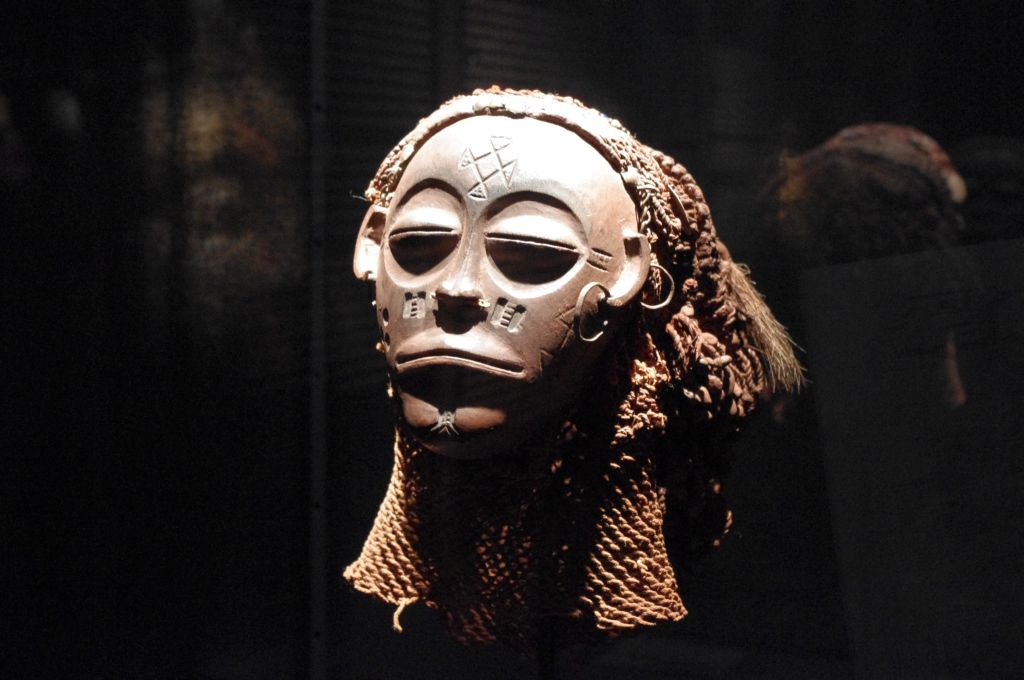
On Saturday our museum trail led us further afield as we caught the S-bahn and then a bus to rediscover the Peruvian artefacts in the Ethnological Museum. John had visited an earlier museum building in West Berlin back in the seventies and returned home with some interesting pictures. The collection is now in a capacious modern building in the leafy suburb of Dahlen, but the Peruvian artefacts were poorly displayed with sparse information as to dates and provenance. And what had happened to the wonderful textiles? The attendant was not helpful. On the other hand, the Pacific collection and the African artefacts, mainly from the Congo and Cameroon, were dramatically presented (though are black windowless walls for the “dark” continent quite p.c.?). But we left disappointed by the pre-Incas and regretting the paucity of information in translation in such an internationally famous museum.
John had to be revived by that Berlin speciality, the currywurst (pork sausage covered with ketchup and curry powder!), from a friendly stall by the bus stop. In comparison with the huge Ethnology building, the Brücke Museum in the woods two short bus rides away, featuring Expressionist artists, was bijou, which was just as well as the current exhibits are mainly painted postcards.

The bus journey back to the centre took us via the Kurfürstendamm (with all its big shops like Oxford Street), where John remembered having seen the solitary bombed belfry tower of the Kaiser-Wilhelm-Gedächtniskirche next to a new church. We had to search hard to find the old tower among the modern blocks as it is currently being restored and is encased by scaffolding and hoardings, while at ground level the previously deserted traffic island was thronging with shoppers, tourists and a sea of stalls promoting facilities and opportunities for the elderly.

Our attention shifted from issues facing the elderly to those of youth as, after a bus ride from the Zoological Gardens to Alexanderplatz, we got swept up in a noisy march of hundreds of black-shirted, arm-pumping young people along the Torstrasse. There was a carnival atmosphere in the afternoon sunshine and slogans on the lorries about Pussy Riot, the counter-culture and GEMA, the German performance rights organization, which is increasing music fees for clubs and events. Reaching our hotel off the Torstrasse we learned that we had been part of the Fuckparade, the annual techno demonstration against commercialisation and the investment groups who are buying up property where the clubs and cheap accommodation have flourished. With rents and prices rising fast in the former East Berlin as areas gentrify, the inhabitants are being forced out and the tourists are flocking in to the new hotels, cafés, boutiques and restaurants. The places we had enjoyed, not to mention our very presence, were clearly a Bad Thing.

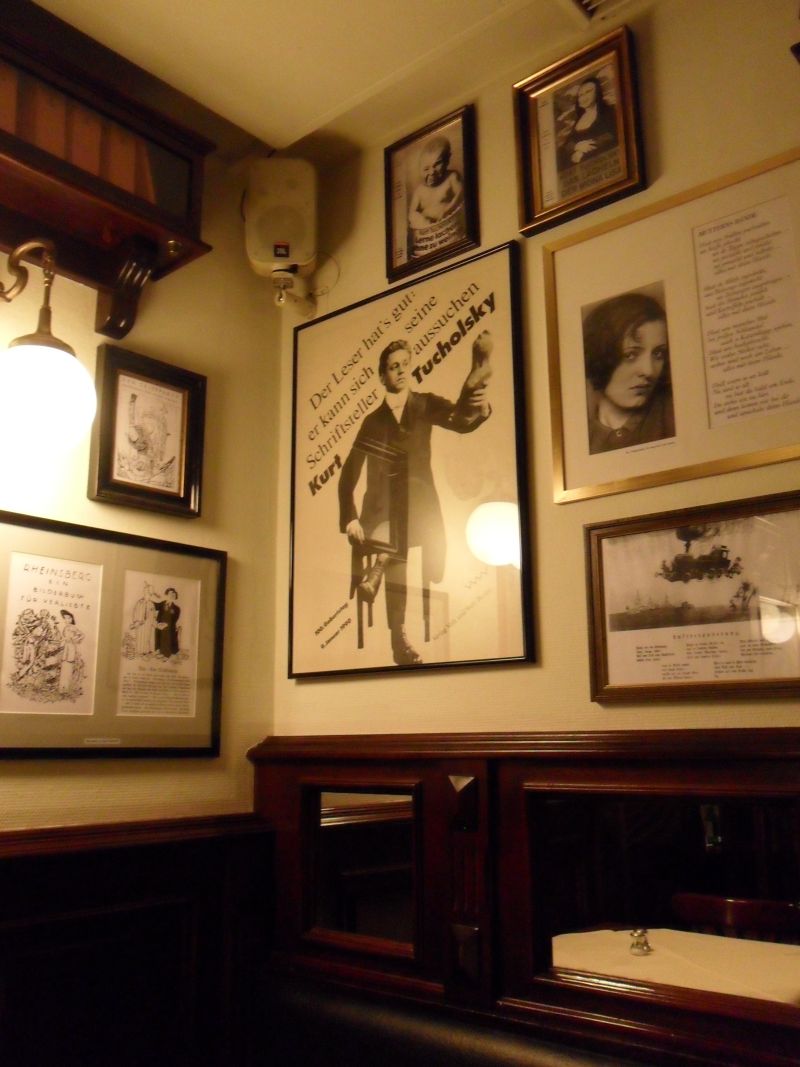
On Sunday Torstrasse was peaceful and the only procession we encountered was a much quieter one of rain-caped cyclists who brought our bus to a halt near the Brandenburg Gate. We later, at traffic lights, saw a splendid double-decker bike (it must have been hazardous stopping where there was no handy resting/dismounting post). We had been to a very good surrealist exhibition in Charlottenburg at the Sammlung Scharf-Gerstenberg and also to see the Art Nouveau, Art Deco and Functional ceramics and furniture at the Bröhan Museum opposite. Disappointingly the Berggruen Museum was still closed for renovations, so we couldn’t see the Picassos, Klees, Braques et al, so we went on to the Bauhaus Archive and then the Hamburger Bahnhof, where Andy Warhol’s paintings seemed positively classical compared with offerings like Cy Twombly’s or the photographs of boring blocks of flats which were dwarfed by the lofty proportions of the converted railway station. We emerged muttering unappreciatively like Grumpy Old Things, but cheered up over a hearty German Sunday dinner at Restauration Tuchlosky on the junction of Torstrasse and Tucholsky Strasse. Round the walls were photocopied newspaper cuttings, cartoons and theatre programmes about the Jewish satirist and critic of the Weimar republic, Kurt Tucholsky, who wrote books, essays, newspaper columns, and lyrics for cabaret songs, – and their calf liver in a rich sauce was the best ever.
On Monday we decided to explore further afield in Berlin in the hope of seeing a bit more of what life in the former east sector might have been like. We strolled north from our hotel to a preserved section of the Wall, in a stretch of no-man’s land next to a busy tram route; behind it lay the church graveyard which parishioners from the west with the correct passes were allowed to visit, despite being separated from their church. A fading wall of photographs was a reminder of those who had died trying to cross the wall and there were detailed information panels. But, unexpectedly, my old memories of the news reports, the permanent dread created by the iron curtain, and the spy stories and films were more powerful than the remains themselves.

We really benefited that day from the freedom of day travel tickets. We caught a tram from the wall, then the U-bahn overhead enticed us to follow its line as far north as our tickets permitted to Blankenburg. It ran at first between grim blocks of flats, but then everything got greener and we passed small plots like allotments with summer-houses; though the houses and gardens were so small, they looked a pleasant contrast to anonymous apartment life. After that we selected a line running south-west, passing a number of deserted railway roundhouses, till we reached Grünau, the last stop in zone B. Through the trees we could see the sparkle of the large lake which rejoices in the Harry Potterish name of Mügglesee. We hopped on a tram heading for the lakeside town of Köpenick at the confluence of the rivers Dahme and Spree, one (or both) of which the tram crossed to reach the old town centre and its attractive, tall, Baltic-gabled, brick houses. That mine of useless as well as useful information, Google, reveals that William Voigt, a jobless and previously convicted shoemaker, popularised Köpenick when, disguised as an officer of the imperial army, he occupied the city hall on October 16, 1906, arrested the mayor, took the city treasury and “accidentally exposed the German subservience of this time”. Apparently theatre plays and films were made about this coup. Unaware of this, we failed to spot his statue as the tram rattled through. To complete the picture, here is another snippet from the same website: As Berlin’s washhouse, Köpenick casted its feathers together with other established industrial companies with more than 50,000 inhabitants before World War I and became the “Headquarter of Berlin’s East”.

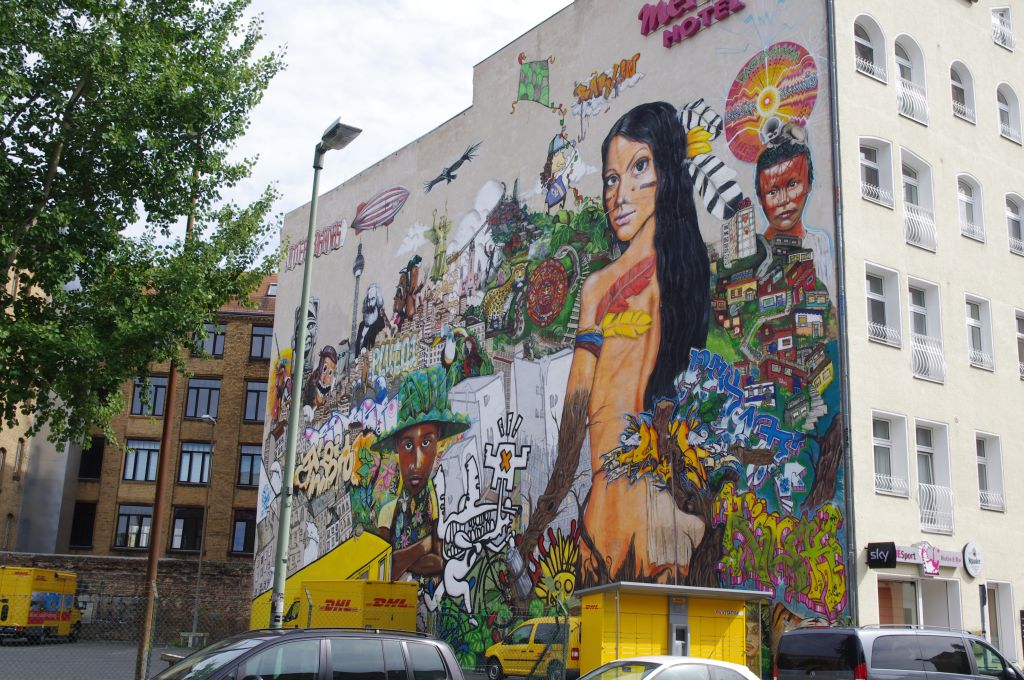
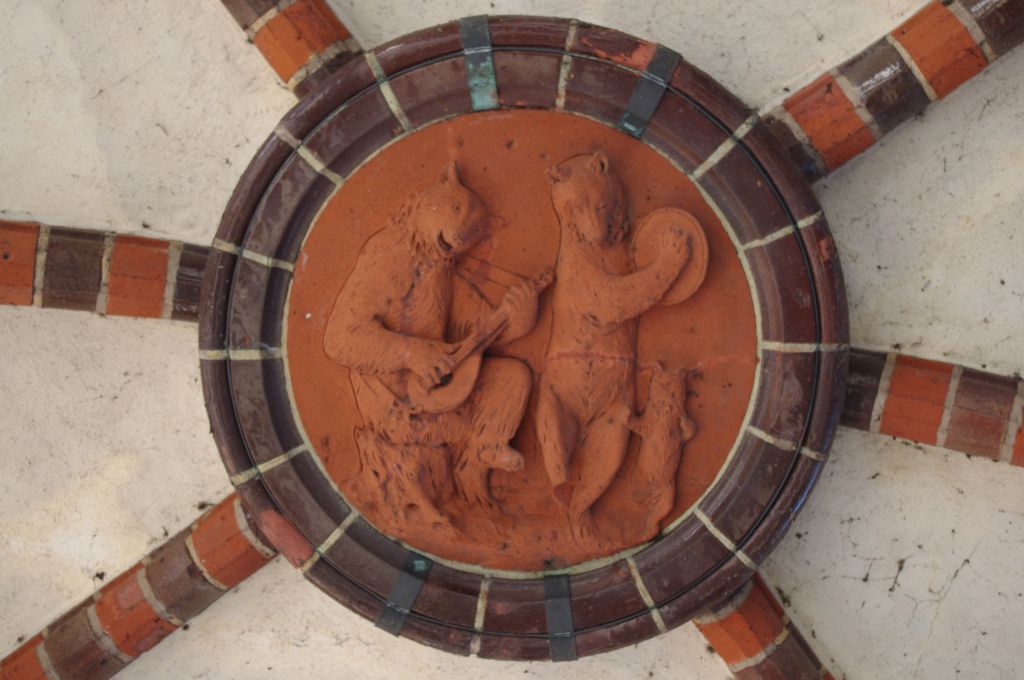
Leaving Berlin’s washhouse, our tram headed for Friedrichshagen and we continued for two stops on the S bahn to the lakeside resort of Wilhelmshagen. The town had probably been bustling with day-trippers in holiday mood over the hot, sunny weekend, but on a Monday it felt as desolate as Margate in winter. We just missed the afternoon boat trip round the lake, which was setting off from a jetty behind the brewery, so we headed back on the S bahn towards central Berlin and walked through the Neukoln area, along Karl Marx Strasse and over the Oberbaumbrücke with John pausing to photograph striking painted walls and the ornate brickwork of the bridge where even the bosses in the gothic cross-vaulting looked like illustrations of fables or folk-tales. We returned to our hotel by tram and in the evening, still having a transport ticket, ventured a little further afield (but only two bus stops) to a shared trestle table outside the popular Monsieur Vouong for his Vietnamese cooking.

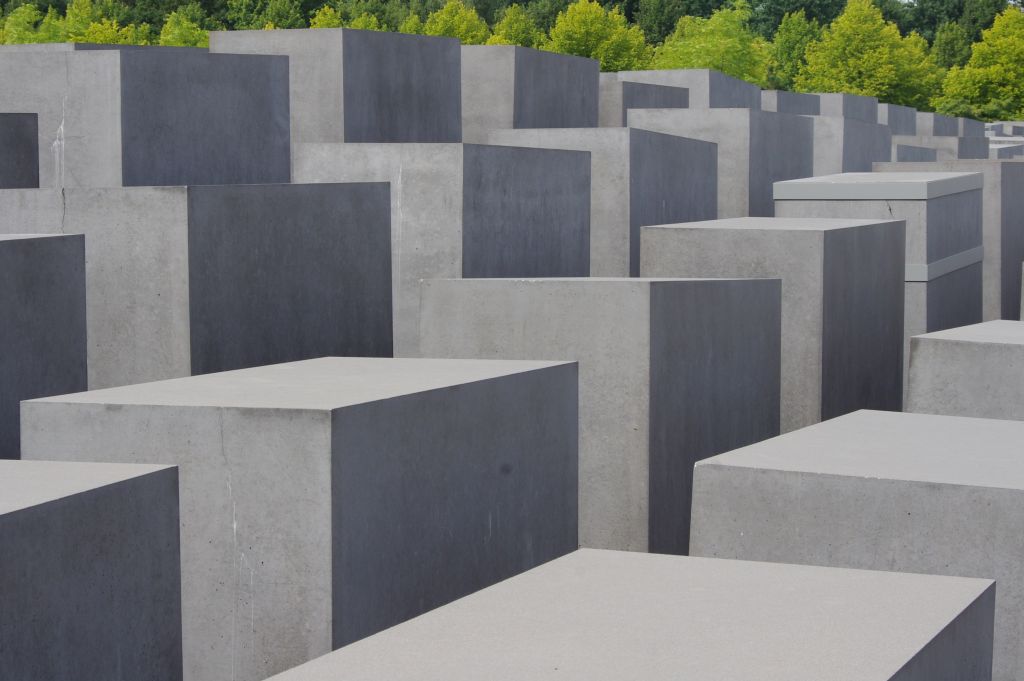
It wasn’t until our last day, Tuesday, that we made our way to the foot of the Brandenburg Gate. Of course the other great change for John in that area was the domination of the skyline by the new glass dome of the Reichstag. More sobering were the undulating alleys of plain slabs of the Holocaust Memorial, whose anonymity was a contrast to the small brass plaques in the pavements of Mitte which recalled by name the people who had lived there before their removal to the camps.

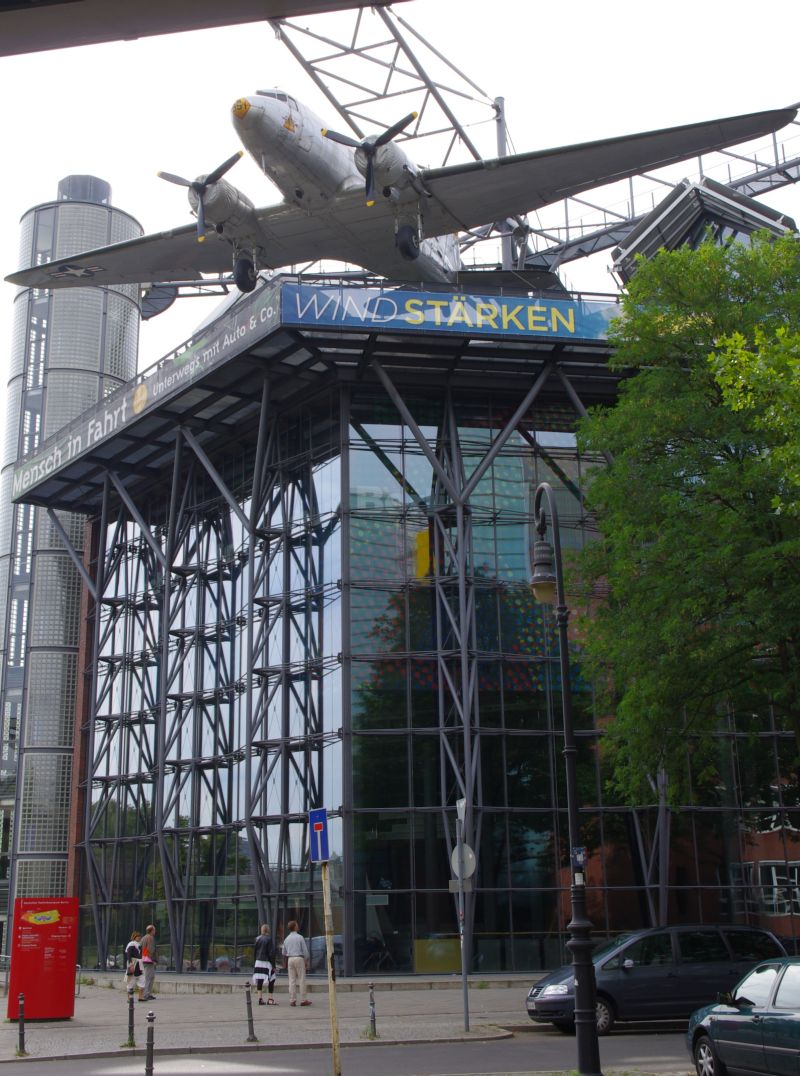
From Potsdammer Platz, possibly tantalised by the abandoned railway roundhouses glimpsed the previous day, we took the U-bahn down to Gleisdreieck, where huge brick factories once served by rail, canal boats, and road now house the Technology Museum. We were keen to see their steam engines, carriages and railway architecture (and even furniture and crockery) in two bomb-damaged reconstructed semi-circular engine sheds, with a restored turntable outside. It included powerful sections on ‘Railways and the swastika’, ‘Armaments’, ‘War and the railways’, and ‘By train to the death camps’. It was also interesting, as our hotel was on Borsigstrasse, to see the earlier section on August Borsig and his locomotives. Although the road transport collection and the brewery were closed, there were so many other aspects of technology to explore. In the factory and office building once used by a pioneering refrigeration equipment company (and complete with spiral staircase for horses and stables for sick horses) we examined pre WWII mechanical and post-WWII electromechanical and electronic Zuse computers and telecommunications, radios, and gramophones; behind the engine sheds there was a photographic equipment display; and in a high modern extension, we cast a look over the shipping, aviation and space exhibits (including some battered rusting fighter planes which looked as if they had only just been pulled out of the river). And if you have ever wondered about the best method of converting your hard cardboard into 1920s style suitcases, this museum provides the answer with its historical machinery and demonstrations of punching, crimping and bending, pressing, nailing, riveting and finishing. And there was still much that we did not see – pharmaceuticals, paper-making, film-making…….

That last evening we walked up to the top of our road intending to eat at the recommended Honigmond hotel, once a meeting place for political opponents of the East German regime (including pastors from the Calvary Church opposite whose rousing bells we heard every day at 4 o’clock) and frequently closed by the Stasi. However, having seen the plates of food already being eaten by customers, we decided to return to the Tucholsky. This time we sat outside, looking down Tucholsky Strasse to the dome of the synagogue, and it seemed very appropriate, given how much railways had featured during the week, that right below our feet the S1, S2 and S25 trains continued to rumble.

It had been a stimulating week, we agreed the following morning, as we sat in the sunshine outside the Hauptbahnhof glass palace waiting for our train back to Entre-deux-Eaux.

Facelift: February–June 2012 in Entre-deux-Eaux

To download a printable PDF version click on this link
E2E2012_issue_2-A.pdf (six A4 pages)
And some links giving more photos than are in the text:
A lot of crépi – day-by-day progress
Restaurant meal photos

A siege mentality sets in as the horizons shrink, with the hills blotted out by low rain clouds like a Japanese painting, and doorways and windows sealed off with sticky tape and polythene. No, we are not being immured due to a bubonic plague outbreak; at the moment we can still get out down the ramp and into the wet field, or out of the back barn door if we are prepared to squeeze round grubby scaffolding poles. The crépi men have arrived! So a good time to retreat to the attic and send an update on the past months here. 

Over the years we have been trying to turn parts of our fields into a peaceful garden and (more ambitiously) an arboretum, whilst the farmers continued to carve deep ruts across the middle of it all with increasingly heavy farm machinery rather than using the little tractors of twenty years ago. With the help of the area conciliator (a gentle legal functionary), a sensible solution has now been reached: to create a new track at each end of our fields to give access to their lower fields and to replace the one close to the house. We phoned de Freitas, who did all the earlier building work here. He was rumoured to be living sullenly in retirement, having argued with his sons, and even (gestures of hand to mouth) drinking heavily. His wife was a little guarded on the phone, but when he came round to see us, he was all smiles and affability and perfectly prepared to use his mechanical digger on a morning’s work for old clients. So his son ordered two 6 metre long pipes to create bridges over the ditch at the bottom of our fields and onto the bottom fields and he duly shifted earth to make a good slope and track to the “bridges”. At one point the digger fell silent and we could see de Freitas standing by the ditch looking gingerly at an object he’d unearthed.

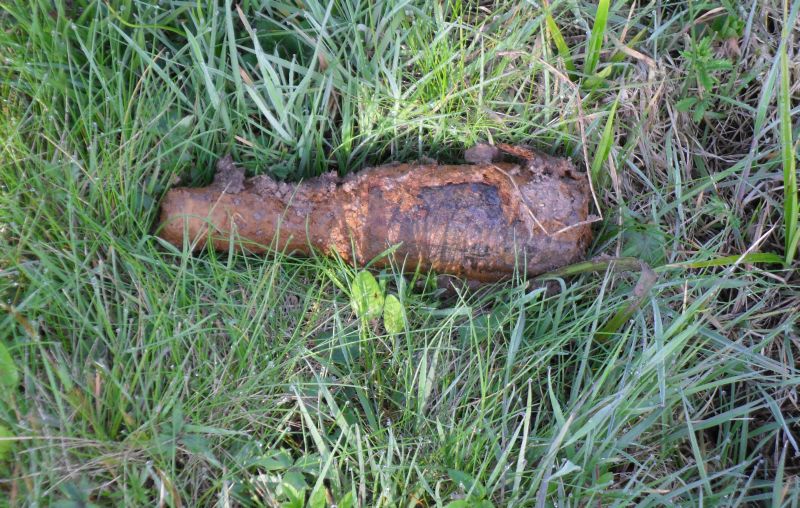
Was this a WWI grenade?

Was this a WWI grenade?

Was the elongated rusty object a grenade from the first world war (after all, soldiers had died in these fields) or was it a bottle-shaped container or bit of agricultural machinery? We did the correct thing for suspect grenades and consulted the mayor, who, unruffled, took it away and wasn’t seen for a few days. No more was said, so we assume it just went in his dustbin!

Anyway (and this is increasingly a shaggy dog story to while away a damp day), we took the opportunity to consult de Freitas about two projects that had been on our mind for a while. Not surprisingly, he has a colleague who would happily tarmac our car parking areas and the narrow strip between the road and house (which got very muddy this winter), and another who renders the outsides of houses, old or new. It would seem that business cannot be discussed without the correct introductions. So one morning he brought over his friend and neighbour, M. Meltz, who could do the re-rendering (crépi) and introduced him. But it would have been impolite to get down to the nitty gritty so soon after introductions. So M. Meltz promised to ring and arrange an appointment to survey the house and discuss the project. That done, an estimate prepared and accepted, M. Meltz was prepared to start work in September, when the weather would be cooler, and expected work to take up to four weeks, depending on the weather.

After this rather leisurely start to the project, we were peacefully showering one morning at the end of May (admittedly at the rather late hour of 10 a.m.) when the doorbell rang. Expecting it to be a delivery (John is always ordering bits and pieces off the internet), I wrapped a towel round me and went down, to be greeted by a rather embarrassed M. Meltz wondering if they could do the crépi work in June rather than September. Had another contract been postponed, we wondered, or was it that the wet, cool forecast favoured June working? Five days later the scaffolding arrived, followed by two days of noisy pneumatic hammers as the old rendering was chipped off and the old stones revealed. 

John has always suspected that the old farmhouse, like most of the other old local buildings, would have originally had a front door onto the road, next to the big barn entrance.

Bricked up farmhouse door

Bricked up farmhouse door

And sure enough, a bricked up doorway was uncovered, next to the present downstairs bathroom window (where the shower now is). Interestingly the stones in that section are pinker, and it looks as if they formed the original building comprising barn and probably a front and back room with the traditional large Vosgian chimney in the middle (above and behind the farmhouse fridge). The stones on the upper storey are larger and more regular than the lower courses, so it may originally only have been a single storey building. Later a grander entrance and rooms were added to the east and a extra barn for animals and a hayloft to the west. We’d been told that our predecessor, M. Fresse had added the third barn for vehicles (and presumably the workshop for his electrical repair business). We of course have extended above his third barn and created a garage between that and his workshop. It has been fascinating to see the sequence in the stones, bricks and breeze blocks. I only wish we could keep the attractive stonework, despite all its blemishes, but the “mortar” holding the stones together is more like dried, crumbling mud at the barn end and definitely needs strengthening and weatherproofing with enduit, a mix of cement and chalk.

They have now applied the undercoat of enduit on the north wall along the road and the east wall by the later front door and are currently working on the south wall, with the west section (third barn, garage and workshop) still to be done. It is a three- (and sometimes four-) man job. The apprentice (who managed to injure his finger with the drill on the first day and needed a large white bandage) stands by the mixer feeding in the bags of powder and water, the foreman wields the nozzle of the long flexible tube, spraying the mix between and over the old stones to a rough finish, which clings remarkably well, and his number one smooths it expertly to a good finish. Everything not being sprayed is being covered in polythene sheeting and orange tape. It’s fascinating to watch, – we stood for ages on the first day, dripping in the rain, to gawk, before clambering back indoors for a coffee. Later (in fine weather) a colour coat will be applied. Over in Alsace you can see lurid raspberry, mauve, turquoise and lemon shades, but we’ve gone for a traditional peasant ochre with a mud grey strip at the bottom to deal with the mud of passing cars, tractors and milk lorries.

Speaking of milk lorries, during the conciliation process (above) we met a delightful old man who used to collect the milk from our little farm in the old days, along with that from the neighbouring farms. He would sell it on to thirty-seven small shops in St Dié, he said, and later to the laiterie until it closed. Now it is collected by a tanker, which has to slow down to get past our scaffolding at present.

But ours aren’t the only major works in the village. New houses continue to be built despite the recession (and lack of reliable water sources). The latest is Farmer Duhaut’s. Since his retirement from active farming (partly due to an accident or two with a bull) he no longer needs his barns and hangers, so most have been pulled down this winter and two new single buildings are spreading out. His mother, Giselle, still lives on the ground floor of the old farmhouse while he and his wife live above, but it sounds as if the stairs were getting a bit much. Work is still not complete on Ludo’s car-repair garage between his house and Granny and Grandpa Laine’s house, but there is no shortage of cars outside awaiting ordered spare parts. Apparently in spring he also had about fifty motor mowers awaiting parts. The Vozelles (the farm where the dogs, hens, geese, chicks and cats spread out over the road as their farmyard) have had the front of their house painted cream and grey. And the house on the road into the village which used to be a small metal factory and which Duhaut’s former farming partner, Olivier, turned into a family house, is now surrounded by a new wall and occupied by a man with a fish delivery business. According to the Vozelles that house was burgled in broad daylight one morning. I wonder if the thieves made off with the usual items or if it was a fish heist.

Mention of fish leads my thoughts to restaurants. Some of you have hinted that we spend most of our days in restaurants, but really, dining out remains an occasional treat for us (it’s just that we tend to harp on about it). We enjoyed seeing Raymond Blanc’s progress through France on TV, especially in Alsace, where he cooked in a restaurant in Riquewihr that we knew. We were rather sad when our favourite chef moved from the Blanche Neige (which is still empty up on its hillside) to a restaurant close to the Rhine, and even sadder when he later moved even further east across the Rhine into Germany. He and his wife now run the Heckenrose Hotel and its restaurant, close to Europa-Park (so rather a different family-based clientèle much of the time). However we made the long trek across the Rhine one Sunday lunchtime in April and had a wonderful five-course meal (no mid-week lunchtime opening as the Germans don’t have the two-hour lunch break so sacred to the French). We made a day of it, stopping at what we thought was just a wine fair en route, but which was an interesting (and unique?) combination of graphic illustrators/publishers and wine producers. And on the way back we took the car ferry across the Rhine. We had asked if their sous-chef was still with them; but, being a Ukrainian his temporary work permit meant he had to stay in France unless he wanted to restart the whole procedure again, so he was now at a restaurant in Ribeauvillé. So, of course, we had to try that too. I was expecting the Restaurant Parc Carola to be very elegant, but it turned out to look like an Edwardian tea house in the small park next to the Carola bottled water factory. But the food was quite enjoyable. The chef had previously had a Michelin star for many years at a restaurant in Colmar but was now starting out on her own. For elegant we had to wait for a trip to a somewhat larger park, the Jardin de l’Orangerie, in Strasbourg (close to the European Parliament) and the Michelin-starred le Buerehiesel restaurant. The son has simplified the restaurant (and reduced prices) since his father’s day, but if you want classic cooking and silent flunkeys attending to your every whim, this is still the place. There were busy tables outside, but we were ushered to an attractive first-floor room with huge glass windows reflecting the trees of the park.

A street of storks in Strasbourg

A street of storks in Strasbourg

We’d been dive-bombed by a stork on our way across the park, but it wasn’t till we were returning to the avenue where Bluto was parked that we noticed that every pollarded tree along the avenue had a stork family in comically detached splendour similar to the detached villas behind.

But the highlight was my birthday meal in a little restaurant on the Rue des Juifs just inside the old walls of Riquewihr. I had been thinking of going back to the Table du Gourmet where Raymond Blanc had cooked until John found the reviews for au Trotthus. This sounded like somewhere that would appeal to all six of us (Leila and a friend, Emma, were over with us for the week and Roger and Dorinda were staying in their Anould house). The Breton chef had worked for twenty years in Japan, Australia and the Caribbean, before deciding to poser ses marmites in Alsace, bringing with him the flavours of the world. Ignoring the chalked plateau gourmand menu of the day we tried different dishes from the more elaborate menus and were all full of praise. The perfect birthday meal! In fact it must be time for a return trip.

Leila planned a busy programme to show Emma the best of both sides of the Vosges, and for once the weather was good for most of her stay. We drove north on their first day to Lunéville for an upmarket vide grenier which included antiques stalls. We had a great time browsing, with everyone finding something of interest. Leila was the first to spot a low table with blue tiles which would look good in her little garden. Despite bargaining, it was a bit pricey. Later she found a slab of more attractive blue tiles (which would once have formed a base for a wood-burning stove) and she got both that and some attractive Moroccan-tiled shelves (for trailing pot plants) for a lower price. Meanwhile Emma rummaged and we haggled for an attractive tablecloth, John noticed an “Alice” (Wonderland and Looking Glass) in French, beautifully illustrated by Dušan Kállay from Bratislava, and I bought a paperback version of Ogden Nash poems produced for the American soldiers in the last war (and presumably left behind during the Liberation). We wandered down to the Lunéville château which is still partially shrouded in scaffolding, though it the fire-damaged section has been rebuilt, and back through the formal gardens, finishing our visit with sausage and chips at the flea market. We had equally enjoyable days in the Alsace villages of Kaysersberg and Riquewihr looking at all the local crafts like earthenware casseroles and embroidered linen and more exotic ones like “vegetable ivory” jewellery; we ate hearty Alsace food at the Auberge Saint Alexis up in the forest as well as more delicate food of au Trotthus. The girls spent a day at the concentration camp at le Struthof, and we had a local tour (the only damp, grey day of their stay) of the tiny Plainfaing antique shop (where Emma bought an enamel jug) and the Confiserie des hautes Vosges where pine, menthol and herbal flavoured boiled sweets are made; Lac de Longemer looked cold and uninviting so we moved on to one of the many linen shops around Gérardmer, lingering over pretty heart-embroidered window panels. After English Sunday lunch (French style) we drove them back to the airport, stopping at a last vide grenier. This was definitely less picturesque than Lunéville’s, but John found an old Photax bakelite camera at a sensible price, I got a new grey sun-hat, and the master stroke was spotting some wrought iron legs for the Leila’s tiled table-top. (We won’t have as much room in the car for wine on our next trip back to the UK!) As we were leaving, John fished an attractive ceramic plate out of a rubbish bin and it now hangs on a previously bare bit of garden wall.

By now you must be asking what about the usual DIY sagas without which no newsletter would be complete. John finally got round to converting a sofa he’d made in the early seventies into an armchair to match the one that he’d made at the same time. We’d bought some foam cushion pads back in Nottingham on our last visit and I made some covers for them. The first set were off-white covers, similar to the original ones. But, after Toby had pointed out a patterned fabric in the Conran exhibition at the Design Museum, which he remembered us having in his youth, I fished out the faded remains of the fabric from one of our many boxes, and had just enough good material to cover the foam for both chairs. So now they’re more practical, but still attractive, russet shades that match our current sofas. The day after Leila and Emma left, I boxed up some of our books and ornaments so we could move their shelves from the wall for the next projects, which were to be accomplished with the help of Alistair, whose annual working visit has become absolutely invaluable. Number one task was to put up the new roller shutters outside above the windows (we didn’t then know how soon M. Meltz’s gang would be taking them down again). Their second task was to create channels behind the plasterboard walls for the electrical wiring to the shutters and then drill through the walls to attach the wires. White plasterboard dust everywhere and much frustration, but eventually it was all done and the roller blinds (when not dismantled) glide smoothly up and down, operated by remote control from inside. Alistair and John also laid more drainage channels across the front of the house, so, when the sloping strip from the road to the house is tarmaced, the surface water will flow to the drains. Across the back of the house and under the drive they sunk another pipe for a trickle-watering system (to be finished later) for the vegetable garden and finished the concrete tiling on the slope and water tank next to the terrace. An instantly attractive effect was gained when Alistair laid a new stretch of curving brick path from the end of the terrace (which they paved last summer) to the previous path through the small flower garden. (Will next year’s projects include a link from the other end of the path to the foot of the ramp? Having got one incorrect batch, we must remember that the correct bricks are apparently called “zebras”) We were sad to wave Alistair off at the end of ten days of hard labour as we missed his cheerful presence, ingenious ideas, flamboyant fungi-related flea market purchases and hard work (not to mention those early mornings and evenings of model helicopter flying).

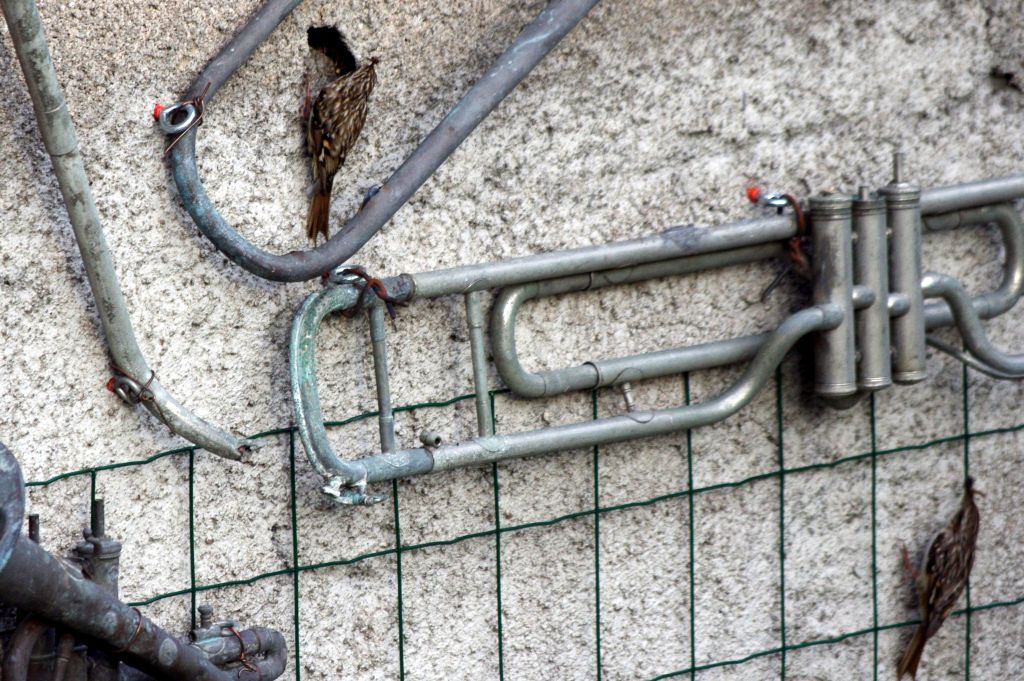
Treecreepers and trumpets

Treecreepers and trumpets

The local wild life will also miss Alistair. He was fascinated to observe treecreepers scuttling up and down the wall above the flowerbed and new path to a tiny hole and he would break off work at intervals to allow the treecreepers to approach their nest. Other birds will also miss the house walls for nesting as all the crevices are filled with enduit. The redstarts have been perching, puzzled on the scaffolding. We shan’t regret the wasps moving out of the crumbling mortar, and hope the new coating will defeat the tunnelling rodents. The very top of the walls under the eaves have not yet been completely sealed to prevent any further stone martens, though John’s initial chicken wire has so far done the trick. The local roe deer are picturesque, though one gave Leila quite a fright as it leapt across the road right in front of Snowy (car) as she was driving. Sadly we haven’t been able to prevent them from damaging the succulent young trees in the arboretum.

And while all this everyday trivia has been going on, there have also been the far more important elections here. Before the first round of presidential voting, the only election propaganda we received was from Marine Le Pen and its lucid, reasonable employment and welfare proposals might well have convinced many locals that this was no racist, far right agenda (though it did lack any indication of how it would all be funded). At the pensioners’ barbecue we went to last week, the main concern seemed to be the unmarried status of their new President’s first lady who wouldn’t be allowed to stay with the Queen, though François Hollande was otherwise seen as a Good Thing. In fact our fellow diners seemed far more interested in our Queen’s Jubilee celebrations than the republic’s elections. An impassioned appeal then arrived in our letter box to support our current UMP Deputé, Gérard Cherpion, in the elections for the National Assembly (in which we can’t vote, either); we were urged not to be seduced by an outsider, – a champagne socialist with no Vosgian heritage, Vosgian experience or concern for the Vosges (though the name of Jack Lang was not specifically mentioned, or his Ministerial experience – or the fact that he was in fact born in the department of the Vosges). The leaflet obviously worked as Jack Lang won only 49.1% of the vote.

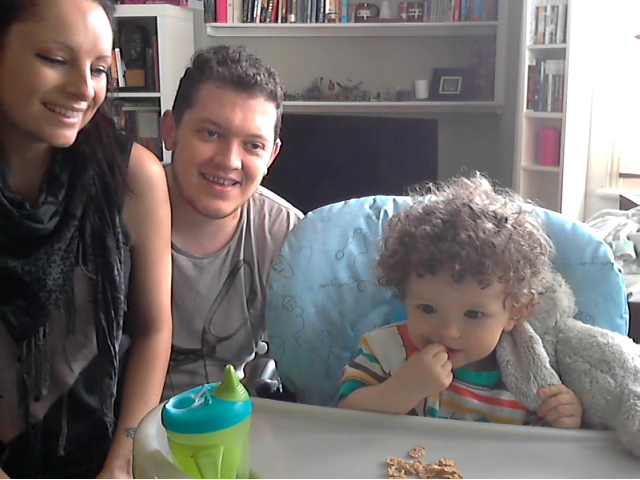
So with France in the hands of Hollande, the Vosges continuing to be represented by Cherpion, and the outside of our house in the hands of the crépi men, we’ll sign off with the latest photo of a far more significant young man. (It seems a long time since we were over for his first birthday in March).  

Stella, Toby and Jacob 17 June 2012

Stella, Toby and Jacob 17 June 2012

A bientot!


Scanning the past – fifth update

I’ve continued scanning my slides over the summer but ran into problems with the Epson V700 slide carrier after I’d scanned 3-4000.

The carrier has little spring tabs which hold the mounted transparencies in place. Unfortunately they proved to be rather fragile, especially with slide mounts from the 1960s and 1970s which were a lot thicker than the slide mounts in later years. Slowly the tabs started to break and I finally had one or both sides of four of the twelve slide carrier holes damaged. They could still be used for old, heavy, rigid plastic slide mounts, but the thin paper and plastic mounts tended to be lifted on one side and the slides could move.

After much searching, I eventually found a supplier for replacement carrier who sold them at a reasonable price and could deliver to France (one well-known scanner supplier wanted 20€ for the carrier and the same again for delivery from Germany). As I still had an estimated 5000 or more slides to scan, I bought two carriers for 6€ each (and 15€ delivery; again from Germany) as I knew it was always possible I’d damage another carrier before I’d finished all my scanning.

The second barn renovation is finished

The work was finally finished in mid-October. We’ve had a good sort through all the stuff that used to be in it and done a lot of rationalisation. The freezers are now back, the washing machine and tumble drier which were sitting unconnected are now connected, and we’ve bought shelving to provide more sensible storage.

I’ve been photographing some of the progress and there are a series of panoramas here: https://www.blackmores-online.info/Second_barn/index.html The last panorama shows the second barn as it was on 13 November.

Scanning the past – fourth update

Having scanned all the negatives in the main cardboard boxes where our print photo folders are stored (although I’m sure there are still some others), I had a break from scanning, partly because of the hot weather and partly to concentrate on the building work.

I recently restarted scanning, this time on the transparencies. Initially they were more difficult with the higher contrast and the different film types. The VueScan program has some in-built correction for different colour negative films but only distinguishes between Kodachrome and other colour slide films (Kodachrome uses very different dyes from other films and was purposely biased for projection with a tungsten light). However, having now scanned twenty boxes (so about 700 slides) I think I’ve resolved many of the difficulties (or at least am getting results which I think are satisfactory).

However the scanning seemed to be taking a lot longer at 10-13 minutes for each slide. I was also saving 48-bit TIFF files as well as JPEG files since the images were much more variable and differing in contrast and I thought I might do more editing on them. So it was taking about 2-2½ hours per slide carrier which contains 12 slides. Realistically that means I could leave the scanner to scan one batch of 12 slides between breakfast and lunch, another batch after lunch and early evening (or afternoon tea if I come in),  another two in the early and late evening, and a batch overnight – so often not even two boxes of 36-39 slides a day.

However I decided, as with the negatives, I could always rescan the slides which were of particular interest so have switched to saving 24-bit TIFF and JPEG files (as they are the quality required for prints) which has reduced the time per slide to about 7 minutes.

Scanning the past – third update

I finished the 150th colour negative film yesterday and the 4650th image.

Although I’ve not finished all the negatives, it seemed time to look back and, as a result, I’ve decided to rescan the first fifteen to twenty films as the quality isn’t as good as the later scans. The main problem was the way the film strip was placed in the holder. I started with the negatives in the conventional way, emulsion-side up, as a scan would give an image the correct way round. However there was a problem. The negative strips all have a slight longitudinal curl. Putting the negatives in the holder emulsion-side up meant the centre of the film was lower in the holder due to the curl. The scanner lamps (the scanner has two, a conventional white lamp for the main scan and an infra-red lamp which is used in the image processing to remove effects of dust) generate quite lot of heat as they are on and off for an hour for set of negative strips. This heat seems to have the effect of softening the film slightly and, as a result the film droops a bit more and pulls slightly at the sides out of the film holder. So quite a few of the earlier scans have a strip of the film edge showing on one or both sides. This also has the result the scanner colour and exposure value software calculation was incorrect due to a white or black side strip or perforations showing and the image quality was degraded.

After those first batches of films, I tried a film with the emulsion side down so the film curved upwards and used a setting in the scanner program to mirror the image automatically when it was processed. That setting was a lot better. Any softening of the film only meant the curve became less pronounced and the film strips all remained well-framed in the holder.

The holder has a height adjustment and I originally tried to compensate for the possible different focus between the lower centre and higher edges of the image by raising the holder. With the film the other way round this was no longer necessary.

I have found some of the strips of film are not cut accurately between the images. The processors must have made the original prints from a continuous film and them cut them to fit in the envelopes/folders, clipping the edge of some images. For important images it should be possible to recover the full image by “stitching” two images together and a little editing. Hopefully there won’t be many.