Saints and Easter Bunnies: Everyday Life in Entre-deux-Eaux, Year 5 weeks 44 – 48

Click on this link e2eyear5weeks44-48.pdf
to download an Adobe Acrobat version
————————–
You can click on the photos to see larger versions
————————–

It being Easter, I feel we should start with a rather strange tale of moral virtue. Today, Easter Monday, we stopped the car in the middle of an unknown forest, to follow on foot a signpost which pointed down a dirt track to St Alexis. Woefully ignorant of my saints, I later looked him up. He lived in the 5th century, ran away from his new wife on his wedding day, lived an abstemious life as a beggar and man of God for many years, including seventeen years living under the staircase at his parents’ palace (they no longer recognised him), praying and teaching the catechism to small children. Should you wish to identify him in church paintings, he is often depicted as a man holding a ladder or a man lying beneath a staircase.

We were on our way home from a flea market in Beblenheim, and trying a new route. On the map I’d noticed a little white forestry road which wound up the mountains behind Riquewihr and along it, in the middle of nowhere, a chapel of St Alexis. Hence our stop. As we got out, John remarked that the sign to St Alexis actually had in smaller letters underneath, the word restaurant.

So chapel or restaurant? We walked 300 metres down the dirt track, till the forest opened into a clearing with densely parked cars, a baroque chapel and a picturesque old farmhouse. There was also a strong smell of choucroute garnie, the popular Alsace pickled cabbage, smoked pork and sausage dish. The chapel of St Alexis was firmly closed, but from the terrace of the farmhouse came the happy buzz of conversation and the clinking of glasses and cutlery. It was a gloriously sunny day and the French were out celebrating Easter Monday in style. The tables outdoors were crammed with diners, and there were probably as many squeezed into various dark rooms inside. Set menus revolved around sturdy Alsace specialities of potage, choucroute, potatoes, ham omelettes, game, smoked ham and fruit tarts. It was a delightful scene to come across in the middle of a forest: a church and a popular ferme-auberge. Shame we didn’t get to see the baroque altar showing the death of St Alexis (apparently he died clutching a piece of paper revealing his true identity).

We’d had our first reminders of Easter a month earlier (just before I returned to Nottingham for a couple of weeks). Dorinda had often mentioned a favourite salon de thé in Villé with good hot chocolate and patisseries. Villé is not one of the quaint vineyard villages. It is situated on the old salt route from Lorraine to Alsace, and suffered the usual fate of Alsace villages (sacking by the alcoholic-sounding Armagnacs, pillaging, plague and famine) during the Middle Ages. The historic highlights of our stroll round the vestiges of the ramparts were the old abattoir and the prison.

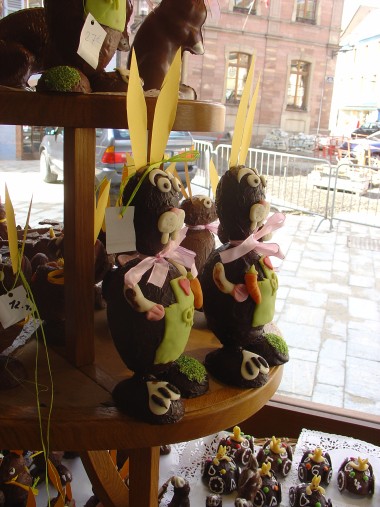
The salon de thé was one of the larger and most prosperous-looking shops in the town. It was doing a steady trade in bread and chocolate Easter hares. Ville Easter bunniesTwo very colourful ladies, in floating pink, gold, black and turquoise garments, were serving more slowly than we expected, until, close-up it was obvious that these ethereal creatures must be in their eighties. John nearly swept the crumbs and debris off our table, until he realised that the heap of broken egg shells were an artistic Easter decoration. There was also a leaflet explaining the origin of the secret recipe for their traditional biscuits, which had been handed down generations of master-bakers after a pilgrim en route to Compostella (via the salt route) had given it to them in grateful thanks for his rescue and shelter one night. One of the colourful ladies gave more orders to a youthful baker for replacements for the rather ugly, lumpy chocolate lambs and hares which had just been sold, then proceeded to tie scarlet bows round the necks of the next Easter victims. She explained that in Alsace the Easter eggs are not laid by hens but brought for the children by the Easter hare. She also revealed that their papa had bought the bakery (and the secret biscuit recipe?) back in the thirties.
A few minutes before mid-day, a steady flow of single elderly ladies and gentlemen passed our table and headed through a doorway for their Saturday lunch in the restaurant in the next room. It was a versatile place. Their elderly hostesses, now transformed into waitresses, must have been exhausted by the end of the day. We left (without a lumpy chocolate bunny) to try to find, further up the valley, traces of the old single track goods line which the Germans had installed during the first world war to supply their troops up on the mountain ridge which at that time formed the border between France and Germany. We parked where the old station must have stood, and walked between high banks which would once have been tunnel walls and followed the course of the old track for a kilometre. (We had just bought, at the annual Amnesty book fair in St Die, a couple of old walking magazines from the nineteen-eighties with an interesting article and diagrams concerning the tacot and the traces of the old line).

Having explored that section, we drove further along the old salt route to the intriguingly named Chapelle de la Jambe de fer. Below the tiny chapel the Germans had quarried and crushed stone for ballast and trenches and had made another railway station for loading and transporting the stones. Before the chapel was built in 1840, there had been for a century a statue of the virgin, which a grateful shepherd had placed in a pine tree after he miraculously found his lost sheep. Inhabitants from both sides of the Vosges used to come from far and wide for the annual Pentecost pilgrimages. They would come pushing handicapped people, and would leave behind walking sticks, crutches and wooden legs in gratitude for healing. The inhabitants of the nearest village even arranged for a harmonium to be dragged up the slopes by two oxen to accompany the worship and torchlight evening procession. But these scraps of information still don’t completely explain the Virgin’s strange name, Notre Dame de la Jambe de fer.

Shortly after our exploration of the Villé valley, we had another encounter with Easter egg-shells. Roger and Dorinda had returned for a few weeks to their house in the next village of Mandray, and we planned a few restaurant trips with them. Because, as you will have gathered, we like the Frankenbourg in La Vancelle, we have always ignored the Elisabeth further up the road. But we decided that the time had come to try it. We walked through their rather dark bar, and were surprised when it opened up into a light and airy restaurant at the back. I won’t go into details of the food, as John now gives a full account (with tantalising photos) on the website. Suffice it to mention that the chef (who has only been running the restaurant for two years, after retiring from business and retraining) had prepared a little something in egg shells with which to greet his customers as they perused their menus. We don’t know if it was the very undercooked egg or the slowly cooked salmon and haddock that upset John’s stomach for a few days afterwards.

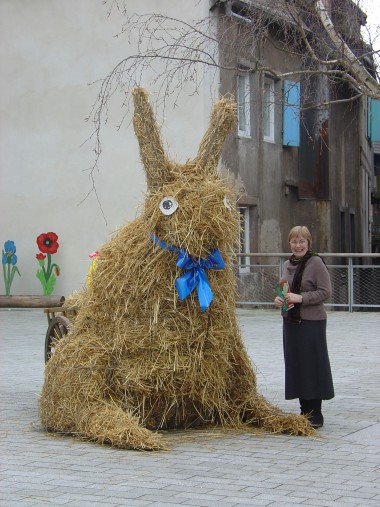
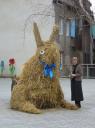
We haven’t been back since. Straw bunny at Sainte Marie aux MinesBut while I was away, John, Roger and Dorinda returned to the Frankenbourg for a reassuringly good meal. As well as the restaurant photos, the event is also commemorated by a photo of Dorinda standing in Ste Marie aux Mines with a straw rabbit towering above her. Apparently they were looking for garden leaflets at the tourist office when they encountered this alarming Easter decoration.
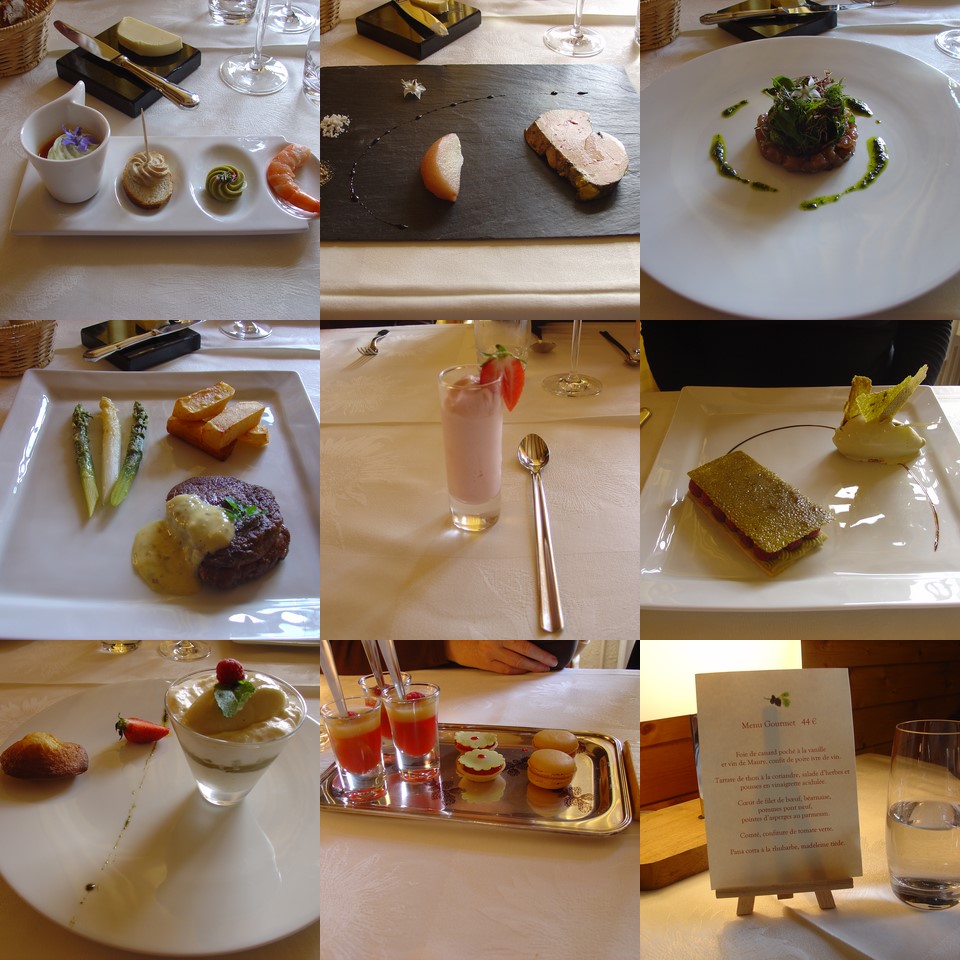
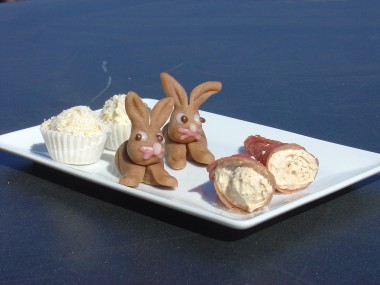
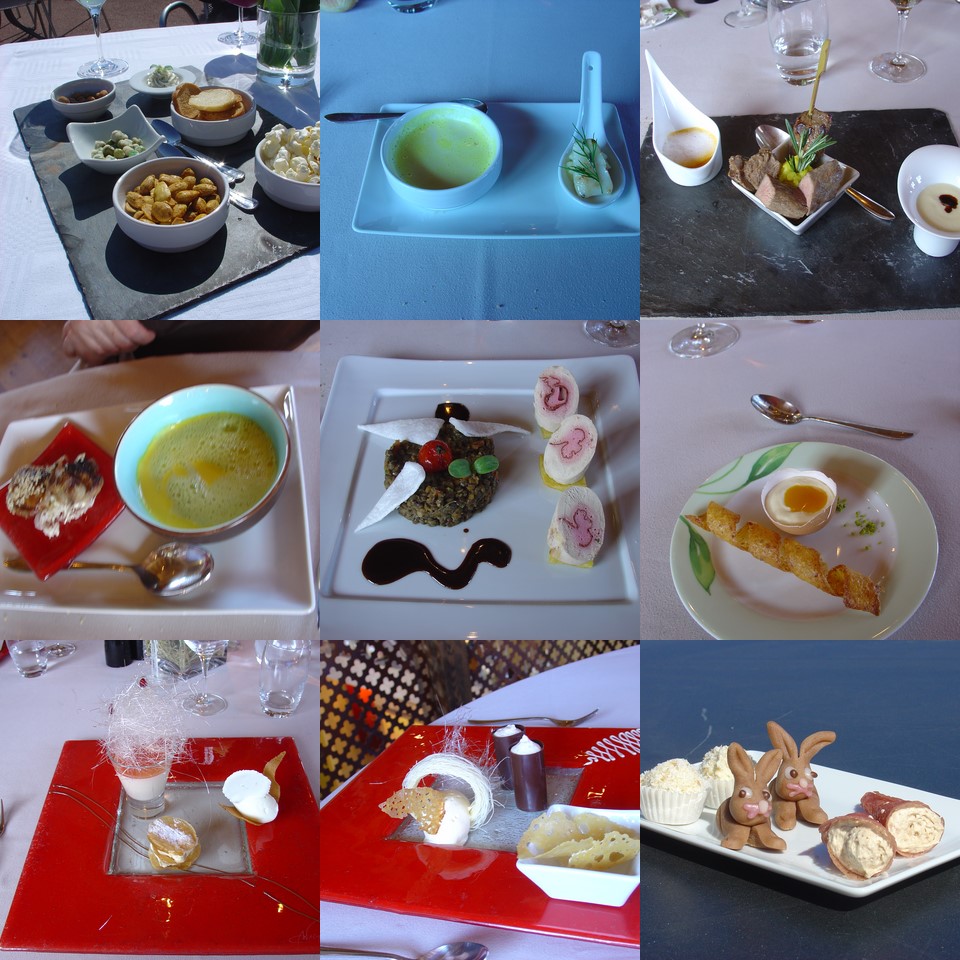
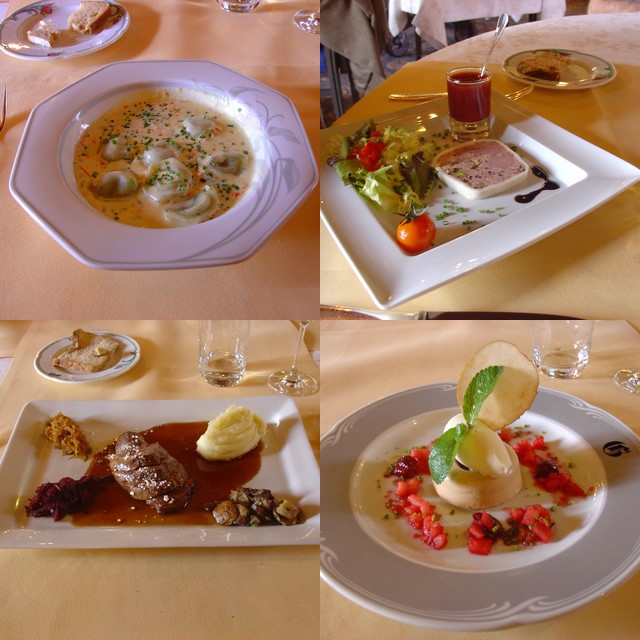
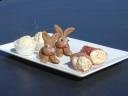
Our latest restaurant trip was a farewell lunch with Roger and Dorinda at the Blanche Neige on Good Friday. Those of you who dined there on John’s birthday, can imagine us first sipping our aperitifs outside in the Easter sunshine. Once inside, we ate our way through the menu in a leisurely fashion. Then after the main course and to soften us up for the dessert, the egg shells arrived! BN marzipan bunniesHowever, unlike the Elizabeth’s under-cooked offering, these contained a delicious white chocolate mousse with a vivid orange mango coulis in the centre. The perfect Easter eggs. We had our coffees outside on the terrace. On the accompanying bonbons trays we found four endearing marzipan Easter bunnies.
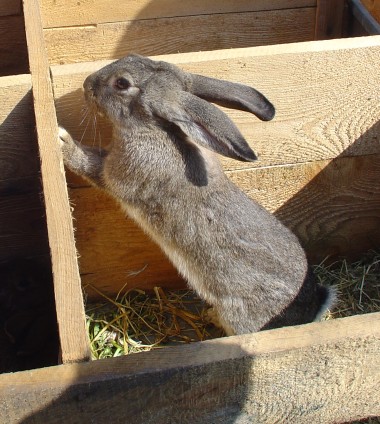
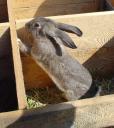
We thought we’d seen the last of our Easter bunnies on Easter Sunday at Plainfang’s 35th Foire aux lapins. This annual event always causes traffic to slow down on the main road from here to the Col de Bonhomme. So we approached it on the back roads. I had forgotten quite how may other things were to be found at the Rabbit Fair. We first encountered the mattress display. Then there were two attractive stalls of hand-woven baskets of all shapes and sizes to hold anything from logs to apples or baguettes. The longest stall held Vosgian bergamot boiled sweets (who buys them all?). A Disney roundabout outside the church would have drowned any music from within, while, to get to the lunch time meal of baekeoffe (a traditional Alsace meat stew) in the town hall, you had to skirt the crashing dodgems. Plainfang bunnyWe could also have bought children’s baseball caps, red plastic sexy underwear, or goats’ cheese. Finally, we came to the cages of rabbits looking for new owners. Presumably they weren’t for instant consumption but for breeding, as there were babies too. I thought the prettiest were the squirrel-red coloured ones. We were reminded of Nicola who would have wanted to rescue them all.
Finally, on Easter Monday, after gobbling up the last of John’s home-made hot cross buns, we set out for the vide grenier at Beblenheim in Alsace. This was not the first flea market of the year for John, as he had gone over to Mandray’s whilst I was away. (Mandray’s is held in the community centre almost opposite Roger and Dorinda’s house. As their front door opens straight onto the road, the cars jostling and queuing to park outside are a great nuisance to them. Entre deux Eaux, of course, is much better organised with a huge field to park on, under the efficient command of our firemen). Anyway,we have been to Beblenheim’s several times on Easter Mondays, notably with Wendy and John one year. It has a satisfying mix of dealers and inhabitants and the sun always shines. There was plenty to look at. I fancied an old advertisement for Moroccan dates. John fingered an Ultrafex camera. He has a small collection of these, which can now be seen on the website. His main criteria for collecting has been that they have to cost less than 4 euros and be in working condition. So he started to play with the camera. “I don’t know anything about cameras but it’s very old”, said the dealer hopefully, “probably from the forties”. “I think it’s about 1961” said John who’d made a study of their development, “you can see that they’re using plastic”. The price came down rapidly. Interestingly it still had a film inside. However, as it wasn’t in full working order and had a broken strap clip, it was rejected. No doubt its price went back up again.

We were approaching the last stalls and were still empty handed when we both spotted a little copper dish with three hares racing round its rim. It was green with age and had dollops of candle wax on it. We couldn’t read the inscription on the base. But we both liked it. “One euro” said the stall holder indifferently. When John cleaned it up at home the base of it read Exposition canine Luxeuil les Bains 16 juin 19?3. The missing digit could be 0 or 6. So what was the connection between the exhibited dogs and the depicted hares? Hopefully not hunting. John’s researches have found that the three hares chasing each other in an everlasting circle form a well known motif and there is even a Three Hares Project tracing their spread along the Silk Route from Ancient China to Devon. However the Project’s theories about fertility and the lunar cycle, not to mention the following quote, hardly provide a helpful link with a dog exhibition:
The theory of the Ancients that the hare was hermaphroditic and could procreate without a mate led to the belief that it could give birth to young without loss of virginity. In Christian contexts, the three hares may be associated with the Virgin Mary in her role in the redemption of mankind. This might explain why a three hares boss is often juxtaposed in western European churches with a boss of the Green Man, perhaps a representation of sinful humanity.

Anyway, putting theories aside, that was how we found the last of our Easter hares. Then on the way home we encountered our strange Easter saint (and meal) in the forest.

We hope you all enjoyed your Easter activities too!
Blanche Neige – 6 April 2007

Blanche Neige - 10 Mar 2006Click on the photo
Amuse bouche

soupe de choucroute et Saint Jacques
Menu Découverte
la déclinaison du baeckeofe revisité par notre chef
ou
la crème de safran, émulsion de petit pois et poitrine de caille au hoi-sin

l’involtini de volaille vapeur, duo de lentilles au garam massala et ses chips de crevettes

mousse au chocolat blanc et coulis de mangue

la mousse yaourt orange sanguine, mille-feuilles croquant au miel Turc et sa glace à l’huile de citron

le cannelloni de châtaignes, glace à « l’Eierlikor » en nid de nouilles, kaitaifi chips de caramel salé

All restaurant photographs https://www.blackmores-online.info/Restaurants/

Auberge Frankenbourg – 24 Mar 2007

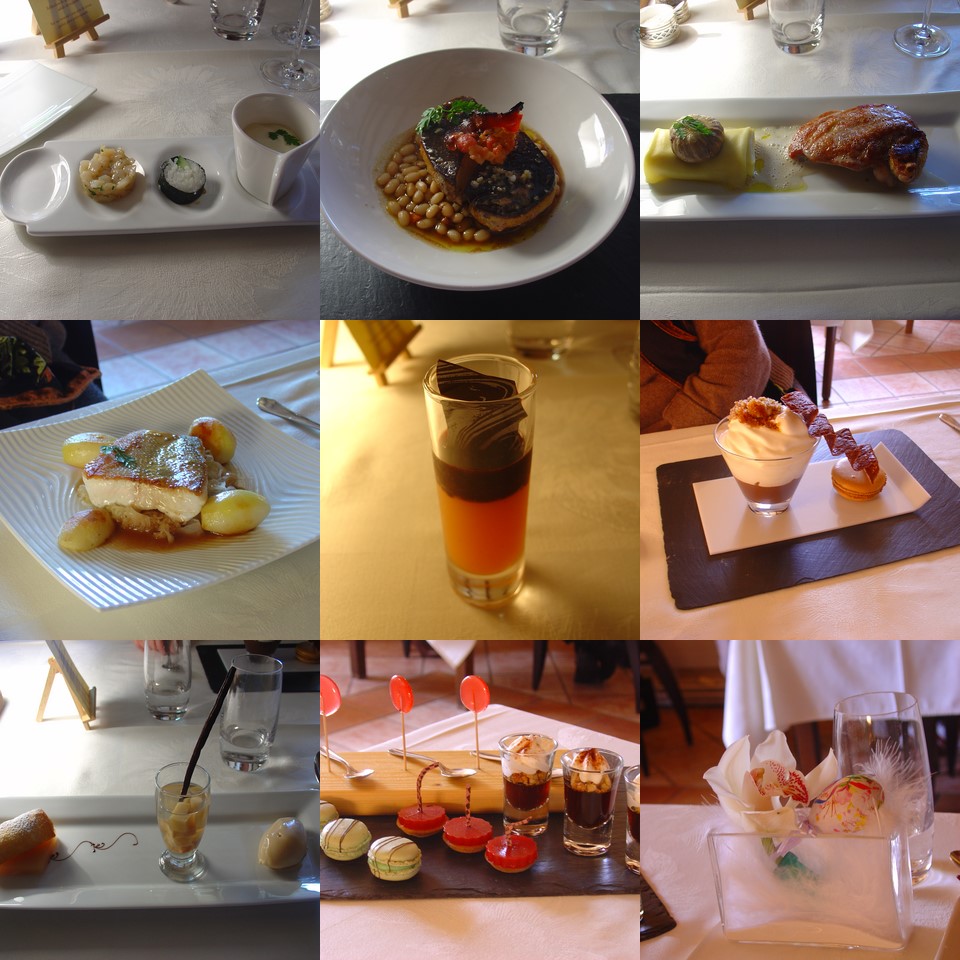
Frankenbourg 24 Mar 2007Click on the photo
Amuse bouche – parsnip soup/cucumber sushi /emince de Saint Jaques
starter – foie gras de canard poêlé, haricots cocos en vinaigrette acidulée, jus perlé à la graisse d’oie
main course – sandre à la pomme de terre or suprême de pintard et ravioli foie gras et truffes
desserts – chocolate mousse or quince in various forms

All restaurant photographs https://www.blackmores-online.info/Restaurants/

La Table du Gourmet – Riquewihr

We had planned to go to the Blanche Neige for lunch. We left a final decision until late morning as there had been snow overnight and in the morning and weren’t sure whether even the main roads would be driveable (this flurry of eating out is because there is only a limited overlap of time with our usual eating companions, Roger and Dorinda being here and Helen going to the UK). We finally decided to go but on telephoning, discovered the BN was exceptionally shut as the chef was giving a cooking course. So, after some discussion we went over to la Table du Gourmet in Riquewihr which R&D had visited once last year.
The trip over the Vosges was snowy but it started to disappear as we dropped onto the Alsace plain and there was none to be seen down in the vineyards. The room was a dark crimson with very low beams – even the waitresses were ducking. There is a panorama of the interior (http://www.jlbrendel.com/table/riquewihr-restaurant-virtuel-m6.html) – and it will then be obvious why the photographs have a pinkish-red hue) After some dithering we all opted for the 38€ meal with a bottle of Pinot Gris from Sipp Mack.

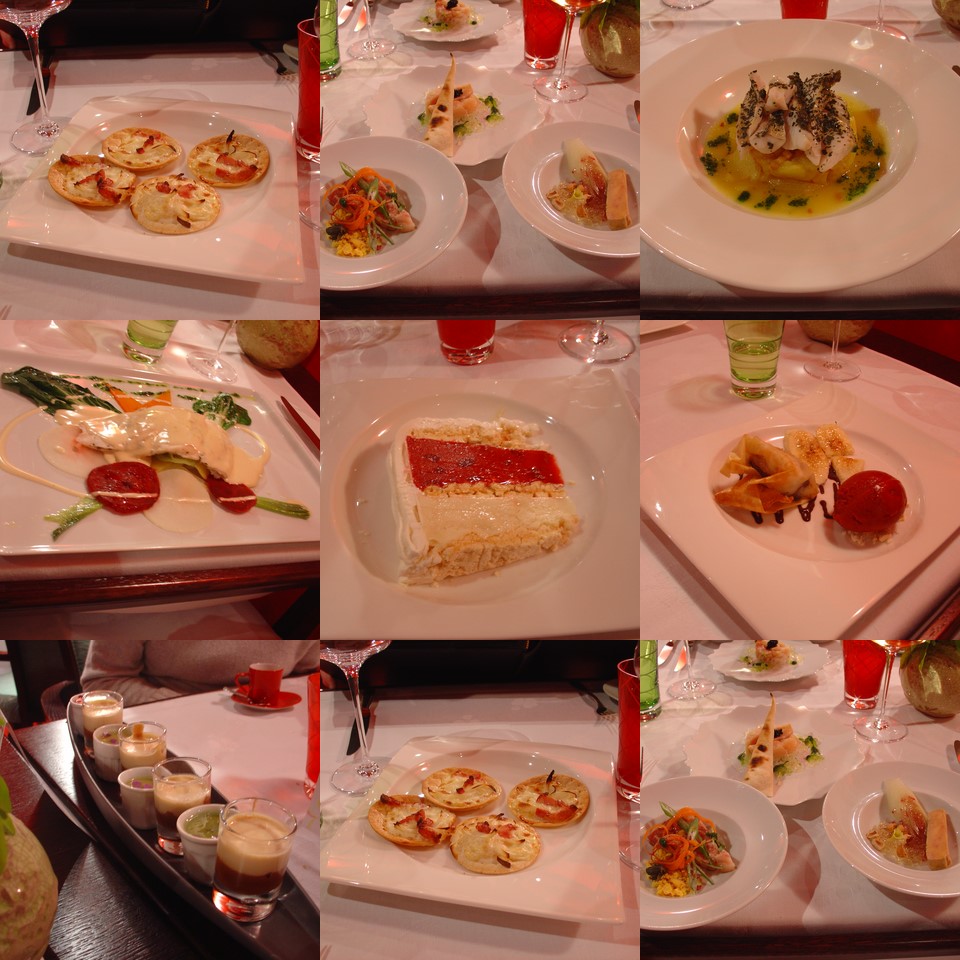
Table du GourmetClick on the photo
Tartelette Flambée en Mise en Bouche
————
Dégustation de
Bâton de Foie gras de Canard sur Asperge du Pauvre, Aigre-doux au Gewurztraminer
et
Presskopf comme la Grand-Mère, Bouton de Fleur de Pissenlit
et
Omble chevalier du Val d’Orbey, un peu Fumé, Feuilles et Fleurs, Crème Battue à la Livèche
————
Sandre masqué de Feuilles aromatiques, cuit à la Vapeur,
Pommes Charlottes « Comme un Baekeoffa »
Huile essentielle de Persil Simple au Lard
ou
Volaille fermière d’Alsace aux Feuilles Aromatiques,
Bouillon Moussé au Gewurztraminer
————
Vacherin glacé au lait Citron et sorbet Fruits rouges Confits à l’eau de Vie

A meal we all found enjoyable and well presented (but not really with the variety of different tastes we enjoy at the BN). My sandre was slightly bland and really needed some well-flavoured vegetables other than the potatoes. A restaurant we will probably re-visit although I have my concerns that the much of the content probably having been preprepared rather than cooked to order.

And afterwards we went to Sipp Mack in Hunawihr and each bought a case of the Pinot Blanc Reserve 2004.

Aux Armes de France, Ammerschwihr

Until March 2005 Aux Armes used to have a Michelin star (the father of the current chef got the first star for the restaurant in 1938). We booked to eat there on my birthday a few years ago. However, all did not go well. It was a Sunday lunchtime. The only menu they had was 80€ with no choices (apart from the à la carte menu). We couldn’t find anything we liked so walked out. Unfortunately by then it was too late to find another interesting restaurant and we ended up having pizza.

Now Aux Armes only has a Bib Gourmand and we thought it time to check it out as the chef might be working really hard to regain customers. The midweek lunchtime menu is now 27€ (or 32€ with a glass of Alsace wine and coffee). There are several choices for each course and of wines (we could select from reisling, muscat, gewurztraminer, and pinot noir). The cooking and presentation were passable but nothing exciting – it would certainly not indicate the chef once had a Michelin star. We won’t be rushing back.auxarmes.jpg
Click on the photo
Ravioles d’Escargots a la Crème d’Ail Persillée et ses Chips
Terrine aux 3 Viandes – Sauce Cumberland
Filet de Canard – Jus aux Épices – Garniture du Moment
Parfait Praline, Glace au Bailey’s et Poêlée de Pommes et Griottes

On leaving we saw a display of newspaper and magazine cuttings. It seems the chef Philippe Gaertner decided that keeping up the high standards necessary to retain the Michelin star was costing him too much money so he gave back his star and indicated he was turning to a more rustic cuisine. “Winning or keeping one’s star status requires not only professional vigilance at all times but a big investment in money and personnel, and you need a big clientèle to support it.” “The pressure to maintain the star rating had led to a slow erosion in the numbers coming to eat at the restaurant and to higher charges for customers.”

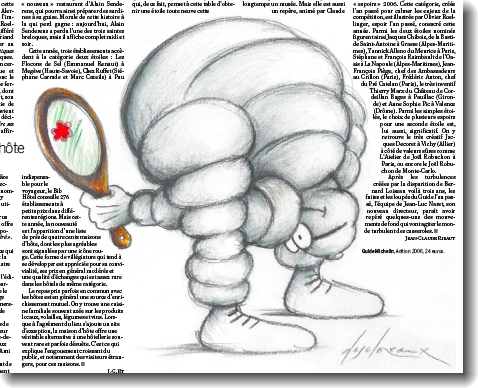
A cartoon by Jean-Pierre Desclozeaux in Le Monde du 23/02/06 accompanying an article by Jean-Claude Ribaut on «le monde turbulent des casseroles» entitled «Le Michelin 2006, avare en étoiles»

desclozmonde.jpgClick on the image

Restaurant Elisabeth – la Vancelle

Restaurant Elisabeth - la VancelleClick on the photo
We finally visited the Elisabeth yesterday. It is only a hundred metres from one of our favourites, the Auberge Frankenbourg. As the AF is shut on Wednesdays, we wondered how many of its customers had gone up the road to the Elisabeth, where the prices are similar. Interestingly, the chef only took up the profession when he was fifty, after many years as a manager. He has been there for three years, and has now acquired a Michelin Bib Gourmand. The 10€ menu of the day was reasonable – celeriac and jambon, pork chop and frites and rice pudding – though judging from the number of half-eaten portions cleared away, the dessert did not gain much approval. The 28€ menu was adventurous – although the chef obviously likes his liquidizer. The appetiser contained liquidized chestnut and bacon; the amuse bouche was liquidized carrots and cumin with a beetroot and melon juice; the foie gras starter was decorated with blobs of liquidized peppers as was the salmon with chopped ham and haddock; and the dessert had layers of creamy chocolate mousse and crushed fruits.

  • Foie gras de canard en mi-cuisson, feuille et garniture façon pizza
  • Pavé de saumon cuit en basse température, ventrèche (french pancetta), fèves au haddock à l’huile de noix
  • Minestrone de fruits exotiques et gelée d’orange, mousse au chocolat blanc, crème d’avocats, sorbet maracudja

 
All our restaurant photographs https://www.blackmores-online.info/Restaurants/

Blanche Neige – Michelin France Guide 2007 – update

28 Feb 2007: The new red Michelin Guide to France came out earlier. There was no mention of the Blanche Neige in the press release of stars awarded which was extremely surprising and puzzling to us.

Late last year the restaurant had indicated they thought they’d had a visit from a Michelin inspector and, based on our experience of starred restaurants in the region, we were expecting the Blanche Neige to be awarded a star. Not even a “Bib Gourmand”. The restaurant was also missing from another guide, the Bottin Gourmand, which came out at last November. Puzzling since it has had a 15/20 rating in GaultMillau for the past two years.

Our other favourite restaurant, the Auberge Frankenbourg in la Vancelle, retained the * it acquired a couple of years ago; it has also had 15/20 from GaultMillau for the past few years.

Hopefully we’ll find out more on our next visit but I wonder whether they were inspected or whether the rumours of guides and back-handers have some truth?

Update 8 Mar 2007: Having now seen a printed copy of the guide I have found the Blanche Neige was awarded two red knives and forks.

Michelin Guide FAQs http://www.michelin.co.uk/travel/downloads/Guide%20FAQs.DOC

Change: Everyday Life in Entre-deux-Eaux Year 5 weeks 28 – 43

Change comes slowly to a village like Entre-deux-Eaux. But when we heard about the death of Mme Colnat, it set me thinking about the last 16 years that we’ve known the village.

For M. and Mme Colnat were the first people we talked to here. We’d idly looked at the shuttered-up old farmhouse that is now ours, then we’d retreated to the cool of the village shop-cum-bar. In those days it was run by the Colnats. M. Colnat had inherited the shop from his father. He’d grown up there. As a young man he’d played his accordion on Saturday nights for the village dances and weddings. Later he’d delivered supplies to the outlying farms. I expect that on that first occasion we met he would have been wearing a thick grey overall or a blue one as he did after he retired. And she would have been hovering, thin, wispy and a little nervous in a floral overall behind the counter.

The shop as it was then seemed very dark. It had huge piles of felt slippers to the left, earthy vegetables in front and a counter with butter, cheese, meats and bread to the right. From the ceiling hung strips of disgusting, encrusted fly papers. And the floor was an expanse of wooden floorboards – well mopped, but unpolished, which stretched out to the back, opening up into an equally dark bar.

They were friendly and interested, but with that Vosgian reserve, as we asked about the farmhouse. Oh yes, they knew the Fresse house. They chatted pleasantly. But M Colnat never mentioned that Mme Fresse was his aunt. Perhaps they took it for granted, as everyone at this end of the village was related to the Fresses. Later Mme Colnat told us that she grew up in a big house right in the forest, over the hills from here. She was the daughter of a Cossack who’d stayed on at the end of the First World War. So perhaps that gave her some sympathy with outsiders coming into the village.

Each time we returned to the village for a week here and a week there, our first trip would be down to the village shop to place our daily order for baguettes and to get a newspaper and a welcome back. The period leading up to their retirement was an anxious one, as no one wanted to purchase a village shop. They even asked in desperation if any of our friends would like to come and own a French épicerie! Eventually the commune purchased the building and renovated it and included four apartments. During renovation the shop shrank in size, and its stocks dwindled as many people now did their main shopping at the St Dié supermarkets. But the bar became much larger, brighter and busier, especially before lunch time. The muscular-legged new lady shopkeeper dashes energetically between the gossip of old ladies in the shop and the loud banter of men in the bar.

And meanwhile M and Mme Colnat moved up the short hill that leads up to the church, to a small bungalow with a walled garden. But even so close to the centre of the village, Mme Colnat missed her daily contact with so many people. She found it very quiet. She had her garden to tend, and would go for long walks; in autumn looking for mushrooms. But as she got increasingly frail and forgetful, her husband got more anxious about her going far afield. Her heavy smoking was catching up with her too.

I remember one scene vividly. A friend, Ann, and I had been wandering round the churchyard, and she’d spotted us from her house and come out for a chat. We sat on the seat under the huge old tree between the steps up to the church and her house, and she introduced a neighbour and we all chatted happily. Suddenly both women leapt up as they’d heard Vozelle’s cows approaching. They stretched out their arms to head off the lean cows (for whom all grass seemed greener) from going into any gardens, including their own. Then they returned to the seat, clucking at the late hour (mid-day) for the cows going out to graze, and at Vozelle’s limp which resulted from a stroke, and now seemed worse than ever.

Apparently for some time now, our mayor has been trying to persuade Vozelle to give up his hand-to-mouth farming existence (not to mention all his debts) and to take his pension now rather than later. But maybe, despite the handicap of his limp (and neighbouring farmer Duhaut used to say maliciously that he only limped when people were around), Vozelle could not imagine a life without his beasts. So it was particularly sad to hear that shortly before Christmas, when Vozelle had failed to pay yet another bill or debt, the bailiffs arrived to take away all his herd. One of the cows managed to evade capture and broke free, but we haven’t heard what finally happened to it. We didn’t see it wandering around afterwards (years ago we’d found one outside our front door one morning, which had failed to make it home for milking in the dark of the night before). His farm machinery now lies abandoned in the mud around their house, and their chickens and dogs still race cars on the lane, which they regard as their property. But we shall miss coming home late at night behind a slow moving herd of cows, or finding blue string stretched taut across the road outside their cowshed.

Farmer Gaunand, by contrast, retired some years ago with dignity, doing land and animal deals with farmer Duhaut. He still lives in his family house, which is the finest house in Entre-deux- Eaux, (on the corner beyond the village shop, opposite Vozelle’s brother’s house with its plaster storks on the gateposts). His mother was reputed to keep the best cellar in Entre-deux-Eaux. His petite elegant wife still tends her garden in her smart clothes and high heels. Two of the family’s smaller houses have been converted into gîtes. If ever the village were to run a best floral decoration competition, Mme Gaunand’s overflowing geranium pots, troughs and window boxes would definitely win.

So the four main farmers who farmed the intriguingly named strips of pasture in and around the village (with names like le rêve pre, les pres des truches) have been reduced to two even bigger farmers during the sixteen years we’ve been here. None of the four have children who wanted to follow in their footsteps, for they have moved away from the village to other occupations.

But the third big change is that other young people are choosing to stay in the village or to move into it. When we first came here there were seven houses on rue du Mont Davaux (though no road names or house numbers to guide you – and according to the phone directory we shared a house number with another family further down the road!) Now there are fifteen houses, our road has a name plate, and, following the renumbering of the subdivided plots, the houses now have a smart brown and beige numbers (we are now 13 rather than 7, but don’t feel any the unluckier for the change). The cheapest way for young couples to acquire their own house seems to be to buy a plot of land and commission a local builder to put up a shell which they then complete using sub-contractors and friends and family. So houses are growing up like mushrooms throughout the commune where urbanisation is allowed (our end of rue du Mont Davaux is outside the zone). One house was built for the present shopkeeper’s daughter, and another by M and Mme Laine’s grandson, Ludo, with help from his Portuguese builder mates. “So handy to have him next door now we are getting old”, the Laines murmur happily, as they bask in the unexpected February sunshine on their balcony. Purple gauze curtains and indoor palms seem to be taking over from sturdy brown shutters and beds of leeks and cabbages. Will we one day be no more than a dormitory village for St Dié?

Of course, a few people are moving away. For us the biggest loss has been Nicola. She first contacted us from Chicago in the mid-90s to see if we were prepared to let our farmhouse to her and two dogs for several months. But as we used our house more often than that, we put her in contact with Mme Gaunand. So she stayed in the very traditional (and cold) gîte next to the Big House until she found a house to rent in Clefcy. She had been a botanical and commercial artist, but soon began to paint local Vosgian landscapes and villagers at work, which she exhibited at the annual St Dié art show and during the local art week. She quickly found her feet as a full-time resident here, and each time we returned would drag us off to flea markets, exhibitions and garden centres she’d discovered. But on her sixtieth birthday she decided she was ready for a change of lifestyle and joined a dating agency. After a whirlwind romance this summer, John from Devon moved in with her, and they began to make plans to move down to the south. And so it was that, in November when we celebrated her ten years in the Vosges, it was a rather dispiriting meal at one of her favourite restaurants. She and John were tired after their house hunting trips and we were sad at the prospective loss. A laden removal van finally left for the Languedoc two weeks ago.

So if any one fancies a bright, airy artist’s house in Clefcy, Nicola’s is now on the market! You might even get a cat to go with it. The move appears to be one change too many for Felix. Despite being born to a semi-wild mother under a pile of old roof timbers below our vegetable patch, he adapted well to a life of creature comforts at Clefcy after Nicola rescued all the litter from being drowned (in our absence). He even put up with the two Chicago cats. But the big move down to the Mediterranean was a change he was not prepared to tolerate. Or was it just his nomadic heritage re-asserting itself? He bolted a week ago.

You may get the impression from these meditations on change, that there have not been many current happenings to write about. That’s largely due to a sedentary lifestyle since my hysterectomy operation in St Dié at the end of January. And the more I hear about UK waiting lists, ambulance queues outside hospitals and hospital infections, the more thankful I feel that I was able to have it done in a calm hospital, with only single or double rooms and immaculate standards of cleanliness. There were a few language problems, but you’ll be glad to hear that following hilarious mime sessions with the nurse I now know the correct French terms for crapping and farting. I also had a wonderful view of the mountains as the hospital is at the top of a steep hill in Saint Dié!

However, since John has also spent the time peacefully at his computer, you too can reflect on our more recent years here, through the new improved website, not to mention some of the latest restaurant pictures. Now who would have thought “le hamburger” would have become quite so trendy at the Auberge Frankenbourg (even if it was hiding a piece of fillet steak)?

I could go on about the changes in the weather – so sunny and mild this winter, compared with the long months of snow last year. But then everyone’s saying similar things about the milder winter and increase in debilitating infections in the UK, so I won’t dwell on that. Perhaps the nicest way to conclude would be with the reminiscences (round a kitchen table) of a man from the adjoining hamlet of Rememont (part of our commune), which really summarise the changes:

“We used to have four cafés in Rememont and 250 cows. Now there are no cafés and hardly any cows.”

Click on this link E2Eyear5weeks28-43.pdf to download Adobe Acrobat version