The second barn renovation is finished

The work was finally finished in mid-October. We’ve had a good sort through all the stuff that used to be in it and done a lot of rationalisation. The freezers are now back, the washing machine and tumble drier which were sitting unconnected are now connected, and we’ve bought shelving to provide more sensible storage.

I’ve been photographing some of the progress and there are a series of panoramas here: https://www.blackmores-online.info/Second_barn/index.html The last panorama shows the second barn as it was on 13 November.

The second barn

Some of you will know the second barn as the main entrance to the west wing (the alternative being the ramp!) and the route to the terrace and fields.

As part of the work projects this year the second barn is undergoing a major refit to make it safer for us as we get older and for our visitors. So the uneven floor with drainage channel from the days when it used to house cattle is no more. Instead will be a tiled floor and plaster-boarded walls, revised lighting with more convenient switches and (hopefully) no more clutter. Without Alistair doing most of the hard work levelling the ready-mix concrete the rest would not have been possible!

I’ve been photographing some of the progress and updating this web site occasionally https://www.blackmores-online.info/Second_barn/index.html

Scanning the past – fourth update

Having scanned all the negatives in the main cardboard boxes where our print photo folders are stored (although I’m sure there are still some others), I had a break from scanning, partly because of the hot weather and partly to concentrate on the building work.

I recently restarted scanning, this time on the transparencies. Initially they were more difficult with the higher contrast and the different film types. The VueScan program has some in-built correction for different colour negative films but only distinguishes between Kodachrome and other colour slide films (Kodachrome uses very different dyes from other films and was purposely biased for projection with a tungsten light). However, having now scanned twenty boxes (so about 700 slides) I think I’ve resolved many of the difficulties (or at least am getting results which I think are satisfactory).

However the scanning seemed to be taking a lot longer at 10-13 minutes for each slide. I was also saving 48-bit TIFF files as well as JPEG files since the images were much more variable and differing in contrast and I thought I might do more editing on them. So it was taking about 2-2½ hours per slide carrier which contains 12 slides. Realistically that means I could leave the scanner to scan one batch of 12 slides between breakfast and lunch, another batch after lunch and early evening (or afternoon tea if I come in),  another two in the early and late evening, and a batch overnight – so often not even two boxes of 36-39 slides a day.

However I decided, as with the negatives, I could always rescan the slides which were of particular interest so have switched to saving 24-bit TIFF and JPEG files (as they are the quality required for prints) which has reduced the time per slide to about 7 minutes.

Hot and cold: Everyday life in Entre-deux-Eaux, January–June 2011

To download a printable Adobe Acrobat version click on this link E2E2011_issue_1-Hot and cold.pdf (four A4 pages).
Clicking on a photo will take you to a larger image.

Jacob 13 Mar 2011

The most exciting event of 2011 for us took place in London rather than in Entre-deux-Eaux.
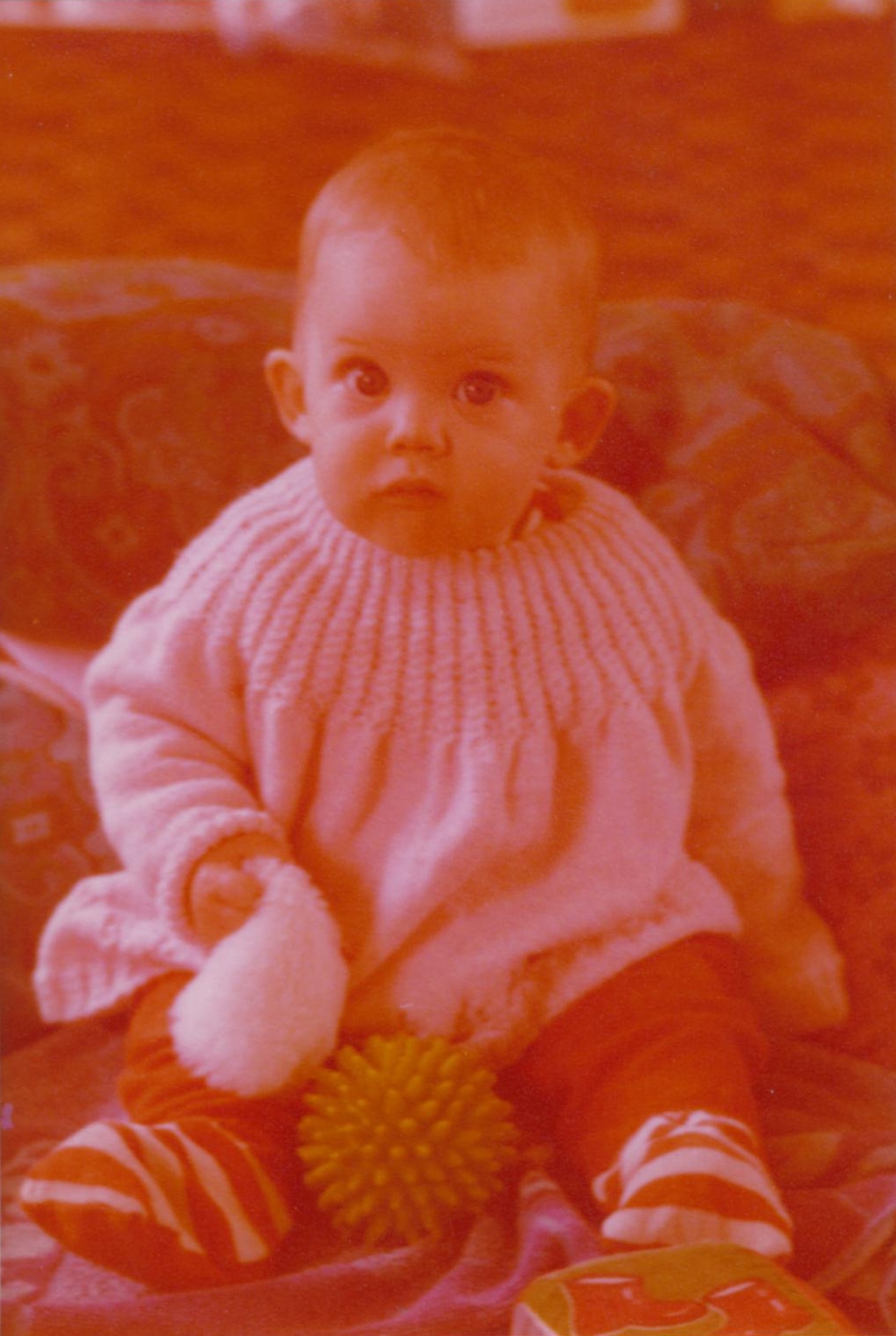
It was the birth on March 11th of Toby and Stella’s son Jacob Toby. He is, of course, absolutely gorgeous, and we enjoyed sharing his early days. We’re looking forward to meeting up with them at the end of July in Antibes and seeing all the changes. The rest of the year seems mundane in comparison, but here’s a summary:

The cold winter did not cause as many problems here as it did in the UK as people are prepared for it. John had bought winter tyres, which many people use here, – but he had the UK problems in mind. Madame Laine had to think quite hard about the weather when we returned in early January from Christmas and the New Year in the UK, but then recalled that there had been snow up to her knees over Christmas, which was a bit of a nuisance when going out to feed the hens. The roads had suffered in the cold weather, and on our return journey there were plenty of notices announcing “trous en formation”, which always (quite irrelevantly) conjure up images for me of the trous/holes lining up solemnly for a bit of formation dancing – or even a can-can. Unfortunately our fridge freezer had given up hope while we were away; with minimal heating left on, the room temperature went below the climate class rating, so we came back to the freezer contents in a sticky pool on the kitchen floor.

The dull January days outside passed quickly indoors thanks to a Christmas present of a huge jigsaw puzzle, John’s ongoing project of scanning all his negatives and transparencies, and Helen’s attendance at AGMs, which can include protracted lunches (the oldies of E2E) or interesting old films (the local history group). We had toyed with the idea of travelling to Tunisia where Jessica’s sister and brother-in-law were over-wintering on their sailing boat (another retirement lifestyle). But as we listened to January news bulletins, February seemed a very bad time to visit (though Jessica and Mark had a good time there in March, when things were settling down).

However, February was put to good use when John finally cleared his wardrobe of old shirts which I dismembered and turned into a patchwork quilt for Jacob with other bits of hoarded fabric. There was an amusing trip to the amateur theatre group over the mountains in Saulxures. After a large lunch, the audience, drinks in hand, settled back from the long tables to watch a play about a local council election. If that sounds boring, the plot was sheer French farce, – with one of the mayoral candidates desperate to maintain his respectable reputation after having sex in a ‘plane toilet with his long-lost brother (who had undergone a sex change operation). The audience found it hilarious, though my A-level French didn’t quite cover all the vocabulary! February was also notable for a trip to the Auberge de la Ferme Hueb restaurant, one of our favourites. The night before had been a special St Valentine’s meal, and I think we were the beneficiaries of their left-overs. The meringue swans were exquisite. The muscat aperitif was so good that we drove home via the producer in the small village of Hunawihr. On learning that we lived over in the Vosges department, he regaled us with Alsatian jokes about Vosgiens, and their poorer climate, such as, “Why do Vosgiens have big ears?” “I don’t know, why do Vosgiens have big ears?” “Because when they are small, their parents lift them up by their ears to show them how much nicer it is over here on the other side of the mountains in Alsace.” Maybe he was bored and we were his only clients that day. Out in the yard a mobile bottling machine was clanking away, – presumably rented for a day or two. We tasted a few more wines (he was anxious that we should try his medal-winning crémant) and departed with boxes of his pinot gris and gewurtztraminer as well as muscat.

We also had a trip in early March to a Colmar restaurant, L’Atelier du Peintre, which is fast joining our list of favourites. It was harder to book than previously, as it had just been awarded a Michelin star, and everyone wanted to be there. The two portly men at the neighbouring table, who were working their way through some expensive-looking wines, sounded as if they had been local politicians. I ironically asked Madame if Gordon Ramsay had congratulated them on their star, having once featured them on his Kitchen Nightmares when they were running a restaurant in Inverness; Loïc and Caroline had been plucked from the south of France by a Scottish tycoon to create a restaurant capable of getting a Michelin star. Ramsay hadn’t.

Any trip to the UK, even one for the birth of a grandson, involves stocking up with wine from France for family and friends and then, on the return trip, with a weird assortment of goods that are cheaper or easier to purchase in the UK. This time, on our return, the back of the car contained an upright Dyson vacuum cleaner (the French don’t seem to do upright ones), garden netting (woven for a very reasonable price in an industrial estate in Huddersfield very close to where distant ancestors had once owned weaving mills), pesticides, fertiliser, seeds (all very expensive in France), second-hand books, and a wedding hat (no, not for the royal event). It was beautifully sunny as we crossed France and the white blossom of blackthorns and damsons was splashed across the fields south of the champagne slopes. Back home we found fritillaries in flower under the plum tree and the peonies bursting out of their winter wrappings.

April was notable for the glorious sunshine, so it was tempting to start sowing seeds a bit earlier than usual, whilst John got busy constructing a large (12m x 4m) walk-in fruit cage from posts, wire and the above netting. As so often here, even visitors got involved in a bit of gardening. Jessica brought various plants from their Putney garden when they stayed at the end of April, and Mark christened us Natasha (Jessica in her scarlet patterned headscarf wheel-barrowing compost) and Vanessa (Helen in her floppy straw-like hat bending over weeds and seeds). While they were here we also got in some good walking on the mountain ridge (spectacular views down into Alsace without our ears being stretched), a trip to see le Corbusier’s lovely church at Ronchamp, a birthday lunch in Saulxures, a rhododendron garden, and the royal wedding (on TV). The French, despite their vehement denials, remain strangely interested in other countries’ royals. Throughout April we had been asked jokingly if we had been invited to the wedding. At Ronchamp the baker had treated us to a half hour discourse about Le Corbusier, the royal wedding, strikes and the superiority of the republic over the monarchy. At a book-sale, the secretary of the local history group and her assistant had a long discussion with me about the wedding outfits and the hats, – “such a disgrace, that princess Beatrice and that Eugenie. How could the couturier have permitted it?” Even the mayor of Entre-deux-Eaux had joked, as he led a walk along local footpaths, about whether we’d be attending the wedding!

The mayor’s walk was as a result of one of the January AGMs, that of the Entre-deux-Eaux oldies. Before lunch various radical proposals had been made including adding walking to the more sedentary monthly activities of cards, gossip, cakes and crémant (a proposed trip round a brewery in Alsace had also gained vociferous support from the men). The mayor’s walk was idiosyncratic, with throw-away comments about residents past and present. He inspected the dustbins of some German week-enders – “he’s an advocate, but thinks he can do what he likes over the border. But all I have to do is threaten to call the gendarmes (not that they’d come) – that always stops a German.” As we climbed up to an isolated farm two km from the village shop and café, – “the old man was a drunkard; he walked down every night to the bar, and faced an uphill struggle back!” Outside a picturesquely ramshackle farm, – “no running water – see the hose pipe coming down from the spring in the fields, across the road and into the house – no legal sewerage and that muck heap’s now illegal under EU regulations.” EU rulings lead to great expense for the commune too; a whole area round the pipes leading from a spring to one of the village reservoirs has had to be cleared of forest and fenced off to prevent contamination by deer and other animals. Then he led us past a World War I defensive bunker (the Germans had occupied the village below for a while) to a house buried in the forest, so we could see the finest stone carving in the commune (ironically it is now occupied by Germans). In the middle of the forest peace, a fellow-walker’s mobile phone rang. “Reception is usually impossibly in the forest. Have you been contacted about the new mast? Someone near you is organising a protest. I don’t understand them. People here want all the modern technology like mobile phones, but not the consequences.” Later we heard that the protesters had organised a meeting and succeeded in convincing the mayor not to allow a mast.

April was also when the flea markets started. We still go as an enjoyable Sunday outing but buy fewer things these days (we have enough already). However, occasionally we can’t resist. At the St Remy Foire au Lard, which has a lot of stalls selling chunks of smoked pork, we spotted (in a separate section from the lard) a pile of Art Nouveau magazines in English. They were issues of Studio from 1902-1905 with fascinating illustrations of houses and paintings; even the advertisements were beautifully lettered and designed. You wouldn’t have thought there was a big potential readership at a Foire au Lard, and indeed the price was reasonable. We bought the whole pile. The bare walls of our small flower garden have long been in need of some ornamentation. Old farm implements or wrought iron deer are the usual local wall decorations. However in another small village fair, John spotted a box of corroded brass instruments, – fragments of trumpets and trombones which looked as if they had festered in a damp outbuilding after the members of some long ago village band had died. A musical garden will be a bit different. At the same village we also saw rusted weapons of the WWI found with a metal detector (presumably illegally) in the hills above. At the Entre-deux-Eaux flea market I bought some plants, including geraniums. And at nearby Corcieux, Alistair spotted a replacement blade for a nine-inch angle grinder which he was sure John would need.

Alistair came over in May (it is becoming an annual event) to help John with various large projects. He laid paving slabs over the whole area that they’d cemented last year (panorama of the completed new terrace). The slabs proved difficult to cut and Alistair finally persuaded John to invest in a nine-inch angle grinder. So the cheap (but brand new) replacement spare blade was a good purchase! One day the ready-mix cement lorry blocked the road outside our house (we had warned the neighbours the night before) and as the wet mix was hosed into the barn, Alistair and John spread and levelled nearly eight tonnes of it until we had a smooth new floor. They also created ramps and steps down to the terrace and garden. That was an impressive day’s labour. John is currently re-wiring the barn, tiling the floor and putting plasterboard on the old stone walls. In the end the barn that used to have the cattle stalls (and still has a water trough) should make a more elegant entrance area for the “West Wing”. It should also be a lot safer with a level floor, without cracks and without gulleys for swilling out the stalls and pens. In some ways it’s sad to change things, and it doesn’t comply with energy-inefficient heritage conservation ideas, but will be more practical (as local farmers always were).

After the hot dry days of April and May people here, as in England, were fearing for farms and gardens. But June is making up for it with its heavy showers and thunder storms. Our underground water tanks have filled again. But the gardeners’ good news was bad news for all the barbecues, Bastille Day fireworks, St Jean bonfires, school fêtes and open air craft fairs traditionally held before the long school holidays start on 1st July. Men with marquees have been kept busy. On Sunday it was the Fête du Pain with a barbecue at the farm museum at Sainte Marguerite. Everyone arrived in anoraks and warm pullovers, to find the sturdy trio of old fashioned marquees well tethered (after one had landed in a neighbouring garden in a previous year). At the back of the old farm the lamb gigot was being grilled over a barbecue whilst in the tents the mayor of Entre-deux-Eaux was presiding over the bar and a young accordionist was playing as the aperitifs and then the home made foie gras paté were served. Later Mme Presidente and a group of friends brought out some old musical instruments and played before we were served cherry clafoutis cooked in a wood burning oven. Later, in the tombola, the agreeable Dutch couple at our table won a miniature sledge wine bottle holder carved by an old man at the next table. And the rain miraculously held off between 11 and a couple of minutes after we got home. We were equally fortunate with the Sainte Marguerite pensioners’ barbecue by the pond of Monsieur Nicolas. The men had put up the more lightweight and modern marquees that morning and were barbecuing the pork slices and sausages, whilst the women served the sangria, the salads and the desserts. For some reason the usual accordionist was not there, but that didn’t stop the dancing to taped music and the very jolly conga I got swept up into. We beat a strategic retreat as the skies darkened and were home just before the rain heavy rain started.

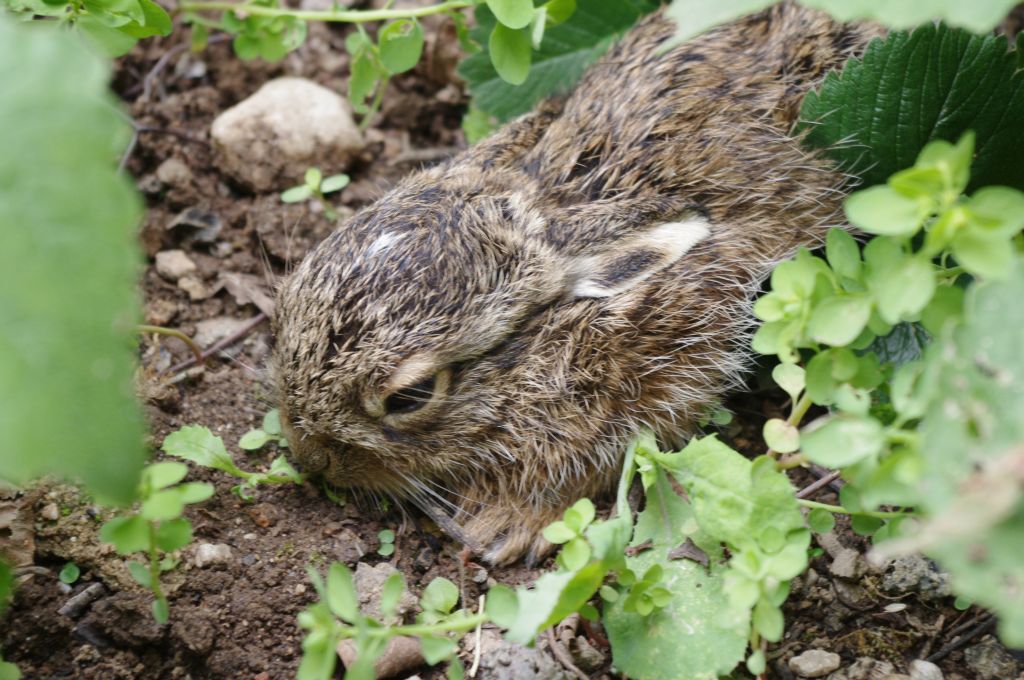
And to end where we started, – with a baby, this time a furry one. From our window we have in the past seen deer, buzzards and a stray stork. A few days ago we saw two shapes in the field, the usual cat hunting and something with longer ears, – a cat-sized hare.
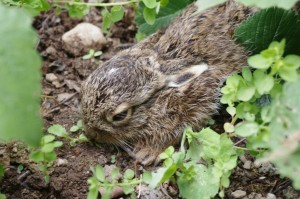
Leveret – 10 June 2011

A bit later, as John was walking to the back door to his workshop the hare shot out of the flowerbed. As John was showing me its footprints, he spotted its baby, eyes wide open, fearless and adorable. Sadly, shortly after he took its picture it must have been removed to a place which felt safer and we haven’t seen parent or baby since.

Au revoir!
Scanning the past – third update

I finished the 150th colour negative film yesterday and the 4650th image.

Although I’ve not finished all the negatives, it seemed time to look back and, as a result, I’ve decided to rescan the first fifteen to twenty films as the quality isn’t as good as the later scans. The main problem was the way the film strip was placed in the holder. I started with the negatives in the conventional way, emulsion-side up, as a scan would give an image the correct way round. However there was a problem. The negative strips all have a slight longitudinal curl. Putting the negatives in the holder emulsion-side up meant the centre of the film was lower in the holder due to the curl. The scanner lamps (the scanner has two, a conventional white lamp for the main scan and an infra-red lamp which is used in the image processing to remove effects of dust) generate quite lot of heat as they are on and off for an hour for set of negative strips. This heat seems to have the effect of softening the film slightly and, as a result the film droops a bit more and pulls slightly at the sides out of the film holder. So quite a few of the earlier scans have a strip of the film edge showing on one or both sides. This also has the result the scanner colour and exposure value software calculation was incorrect due to a white or black side strip or perforations showing and the image quality was degraded.

After those first batches of films, I tried a film with the emulsion side down so the film curved upwards and used a setting in the scanner program to mirror the image automatically when it was processed. That setting was a lot better. Any softening of the film only meant the curve became less pronounced and the film strips all remained well-framed in the holder.

The holder has a height adjustment and I originally tried to compensate for the possible different focus between the lower centre and higher edges of the image by raising the holder. With the film the other way round this was no longer necessary.

I have found some of the strips of film are not cut accurately between the images. The processors must have made the original prints from a continuous film and them cut them to fit in the envelopes/folders, clipping the edge of some images. For important images it should be possible to recover the full image by “stitching” two images together and a little editing. Hopefully there won’t be many.

A new Michelin star

The Atelier du Peintre in Colmar received an étoile (also known as a “macaron“) in the 2011 France Guide, published earlier this week. We have dined there several times in the past few months and it has become a favourite.

A few years ago the chef Loïc Lefebvre and his partner Caroline Cordier were hired, from a restaurant in the south of France, by a Scottish business millionaire to start a new restaurant in Inverness, with the aim of getting a Michelin star. Somewhat unsurprisingly the locals didn’t visit it in any numbers and it lost money. The restaurant got the attention of Gordon Ramsay in his Kitchen Nightmares television series (La Riviera, Inverness 14 June 2005 – after our first visit we found the programme on YouTube). There were several makeovers and a change of style with a more bistro-style lunchtime restaurant and a continuing separate evening restaurant – not really those suggested by Ramsay. With the changes, the bistro style became more successful and another restaurant in the same style, managed by the couple, was opened in Edinburgh. In 2007 there seems to have been a row between the French couple and the businessman and they walked out. They started their own restaurant, the Atelier du Peintre, in Colmar in summer 2009.

Slightly more surprising was the lack of any recognition (or even a mention!) in the new Michelin guide for the Auberge de la Ferme Hueb in Marckolsheim run by the former chef of the Blanche Neige (it has a similar ranking to the Atelier in the Gault Millau guide). But that is probably the ambience not being up to Michelin standards; the quality of the food certainly has been on all our visits. The chef, Mike Gemershausen, has picked up several awards in the last year. It will be interesting to see what happens in the coming year and whether he spreads his talents too quickly and thinly. He has now bought a hotel-restaurant just across the Rhine from Selestat in Germany and also become a partner in another hotel-restaurant across the Rhine from Strasbourg. The Ferme Hueb is rented but there has been no indication it is closing so presumably he will put in another chef.

Photographs of some of our meals at the Atelier du Peintre and the Auberge de la Ferme Hueb

Scanning the past – second update

I scanned the 4000th negative this morning.

Unlike digital camera images, the scanned images do not have any rotation data to allow viewing programs to turn them to the correct landscape or portrait orientation. All the photos in landscape mode on the 35mm negatives need rotating through 90°. Because of the way the film has been cut into strips and the need for a small blank inter-image strip at one end to go under a clip so the whole of the first image is scanned, the negatives might be loaded either way round into the holding frame adding to the possible need to rotate portrait images through 180°. Although Picasa can be used to rotate images in the viewer it does not store the image rotation information so if the image is opened in another program it appears un-rotated (even re-saving in Picasa does not seem to work unless you also edit the individual images in some way). Having looked at several programs which can rotate an image without loss or change to the JPG file, I have chosen a program called EXIFPro. It allows images to be displayed in a wide range of sizes which can be useful when trying to decide which way an image needs to be rotated. It is easy to rotate multiple images at the same time and has several other useful functions.

I also need to add various information to each of the individual JPG files to aid identification of the photo in the future (how I wish all the photos I’ve inherited or even our photos had something written on the back!) and to allow searching of all the photos e.g. for those containing particular individual or of a place. Again, I could have used Picasa to add a “caption” and tags but it does not use a comprehensive set of fields for the data and the fields it uses are not completely compatible with some other programs. So I have opted to use a program called iTag which allows me to add information (title, description, date, author, copyright, and an unlimited number of text tags) to the IPTC section of the JPG file. iTag has a tag manager so allows better control of the tags and it should be possible to label the images in a more standardised manner than is possible with other programs. At present I’m mainly adding text tags (including date, if I know it); again these can be added to multiple images at the same time using iTag.

Scanning the past – first update

It took several days to get used to the new Epson V700 scanner, to sort out the best settings for the scanner, and to decide how the scans would be named and saved. I ended up abandoning both the Epson and SilverFast SE software which came with the scanner as they both seemed inflexible and the SilverFast has one of the worst user interfaces I’ve seen. Instead I bought a copy of the well-respected VueScan; something I’d anticipated I’d probably have to do after all my readings of reviews.

I decided to start by scanning the colour negatives. Helen had previously done a good job of labelling many of the envelopes and sorting many into year bundles so identification will be easier than many of the boxes of slides.

One problem I have found is with the plastic tape used by the processors to join the individual films before they pass through the processing machine. In some cases, after many years, the adhesive on the tape has “bled” and, when the film strips were stored together rather than in individual strip wallets, stuck to the next negative strip. I’ve usually managed to unstick the strips and to remove traces of the adhesive with very gentle rubbing but in some cases it is firmly stuck to the image side of the negative strip and I suspect I’d damage the image trying to remove it. I’m now cutting off the plastic strip off all films before the negatives go back into storage.

Another problem has been dust! It seems to appear all the time. I bought several microfibre cloths to wipe the negative strips and the glass plate of the scanner but, even so, there is usually a sprinkling of dust on the glass plate after scanning a set of negatives. I’m not sure whether lint-free gloves would also help. I’ve also dug out my old Zeepa “electronic static eliminator” which I originally bought to eliminate dust-attracting static on LPs.

The scans are being made at 3200dpi which, for a 35mm negative, gives an image of 4473×2960 pixels with the settings I’m using; I’m saving them as JPG files at 96% quality giving a file of 3.5-5.8Mb (equivalent to about a 12Mb digital camera). I have the option of saving as 16-bit TIFF but those files are over 80Mb; As the majority of the photographs are snapshots I decided I could just rescan and save those images with more merit as TIFF files at a later date.

After a month I’ve now scanned over 3400 images (115 films), so I’ve probably done at least a third of our colour negatives. There have been more 36 exposure films than I thought (I’d originally remembered using 20 or 24 exposure films) but there seem to be fewer films per year. Where the original photographs were very sharp, the scans are also very good and show fine detail; it seems the scanner settings I’ve got are working well (click on the images to see larger, but not full scan-size, versions).

For backups I’ve bought a ReadyNAS Duo network storage device with two 1.5Tb disks configured as mirrored RAID disks. The disks are synchronised and store exactly the same data. If one disk fails the other will continue to allow backups; when the failed disk is replaced it will be synchronised automatically with the good disk. I’ll make further backups from the ReadyNAS to external USB disks and keep one in the safe and one elsewhere. Had we had a fast broadband connection I would probably have opted for one of the online storage systems as they seem very cost-effective. I tried one, Diino (because it allowed you to back up multiple computers to the same account without incurring additional per workstation charges), but our internet upload speed is so slow (68kB/s = 0.68Mb/s) it would have taken about six months just to backup all our current data!

I’ve also added a gigabit (1000 Mbit/s) network switch to speed up the Ethernet connections between computers and to improve backup speed. It connects at 100 Mb/s to the broadband router (wired/wireless routers only run at 100 Mbit/s). Without the switch our network ran at 100 Mbits/s as all data went through the router. Now all our local network traffic goes through the gigabit switch and only the internet traffic goes through the router.

It was interesting to look back at how much data I created in the past when I reorganised the backups. I bought my first PC in 1990 and have kept backups ever since. The snapshot for 1990-Sept 2003 period (pre-digital camera) shows my total data backup was about 300Mb. My current backup archive, which is updated daily, is now about 300Gb (excluding program files); the scans are adding 300-500Mb/day.

Scanning the past

I bought my first 35mm camera when I was about sixteen (a Werra 1C) and used B&W film developed both as negatives and as positives. Colour film was rather a luxury but I did use some slide film at university and for holidays. I switched completely to slide film from B&W in the late 1960s. And I started using 35mm colour negative film for the majority of my general snapshot photography rather than colour slide film in the late 1970s although I continued to use slide film for major trips, e.g. to southern Africa, Peru and India.

We don’t really look at the old prints, except those in albums, as they aren’t really accessible, being stored in boxes with only rudimentary labelling. And the slide projector doesn’t come out very often!

A couple of weeks ago, after experiments a few years ago with my Canoscan 3200F scanner to check the feasibility and after reading many reviews, I finally opted to buy a high-resolution Epson V700 flatbed scanner to scan all our negatives and transparencies (and any prints we have where the negatives no longer exist).

Scan of the 6 x 4 faded print from July 1980

Scan of a 6″ x 4″ faded colour print from July 1980

I’ve no definite idea how many images there are to scan. However,  even if I used only one colour negative film a month between 1980 and 2004 (when I got my first digital camera) there could be about three hundred 24 or 36 exposure films equating to 6000-10,000 negatives. I estimate there are possibly over 8000 transparencies. And then there are also my B&W negatives and positives from the early 1960s onwards together with some colour negatives from our parents (we also seem to have the 110 and 35mm negatives from some films taken by Toby and Leila). So I guess the total could be near to 20,000.

Unfortunately, many of the colour negative prints from the time Toby and Leila were born now have more of an appearance of orange-sepia prints than colour prints. This must be due to poor processing by one particular processor; prints made by other film processors have negligible fading. But fortunately none of the negatives I have looked at have faded or show significant loss of colour.

Epson V700 3200dpi scan from negative

Low resolution Epson V700 scan from the negative

The Epson film holders take four strips of negatives or twelve slides so, since it takes about 4 minutes for each high definition image scan (at 3200dpi – approximately equivalent to a 12MP digital camera image – although some of the earlier colour print film is rather grainy so the quality isn’t really that good), I can just load a set of images and leave it to process for an hour or so.

As it is not very easy to identify which are good or bad images from the negatives it is not really feasible to be selective in the images to scan. So I have decided to scan them all. And, since disk space is cheap I’ll probably scan all the slides as well, even though the quality is more easy to recognise, and then keep all the scanned images since all the images will only use around 100Gb disk space (I’ll also have multiple backups both here and elsewhere). Using other software it will also be possible to label/index the individual images either in bulk or individually to allow searches.

Hopefully we’ll then have a good digital archive. We, the children, and others will be able to relive their past through full sets of images rather than just the few prints that are stuck in albums.

But scanning could take a while ….. given the winter weather there is little incentive to venture outside so I’m currently managing about 80-100 image scans a day.