As well as the highlighted links in the text,
there are comprehensive sets of photographs
– Noyers-sur-Serein and Flavigny-sur-Ozerain –
– Dijon –
– Auxerre –
The printable PDF of the text is E2E2025no3a.pdf (six A4 pages)
Commune employees have been stringing their illuminated Christmas decorations between lampposts in neighbouring villages. But Entre-deux-Eaux’s roads have no lampposts. After nightfall pedestrians rely on starlight, moonlight or a good torch to navigate its dark roads with dark shuttered houses. But in recent years the village competition for the best decorated house has led to strings of lights appearing in late November along the fences of vegetable patches, under eaves and along balconies, along with illuminated Bambis grazing on lawns. This weekend the communal hall will probably be blazing with lights from the traditional November thé dansant, and a tall Christmas tree by the steps will be gaudy with baubles.
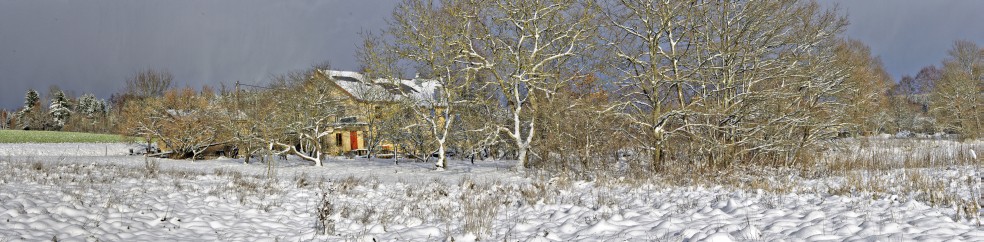
As if entering into the pre-Christmas spirit our first snow fell last week. We returned from a 9.30 am hospital hearing check in Saint-Dié-des-Vosges to find our new gardener, hooded and gloved, shivering among the pruned saplings in our field and rushed to revive him with hot coffee. It felt cruel to have him slaving away outside in the cold, especially as he had toothache and left shortly after for the dentist in Saulcy-sur-Meurthe. But sympathy faded later when he sent us a larger bill than expected.
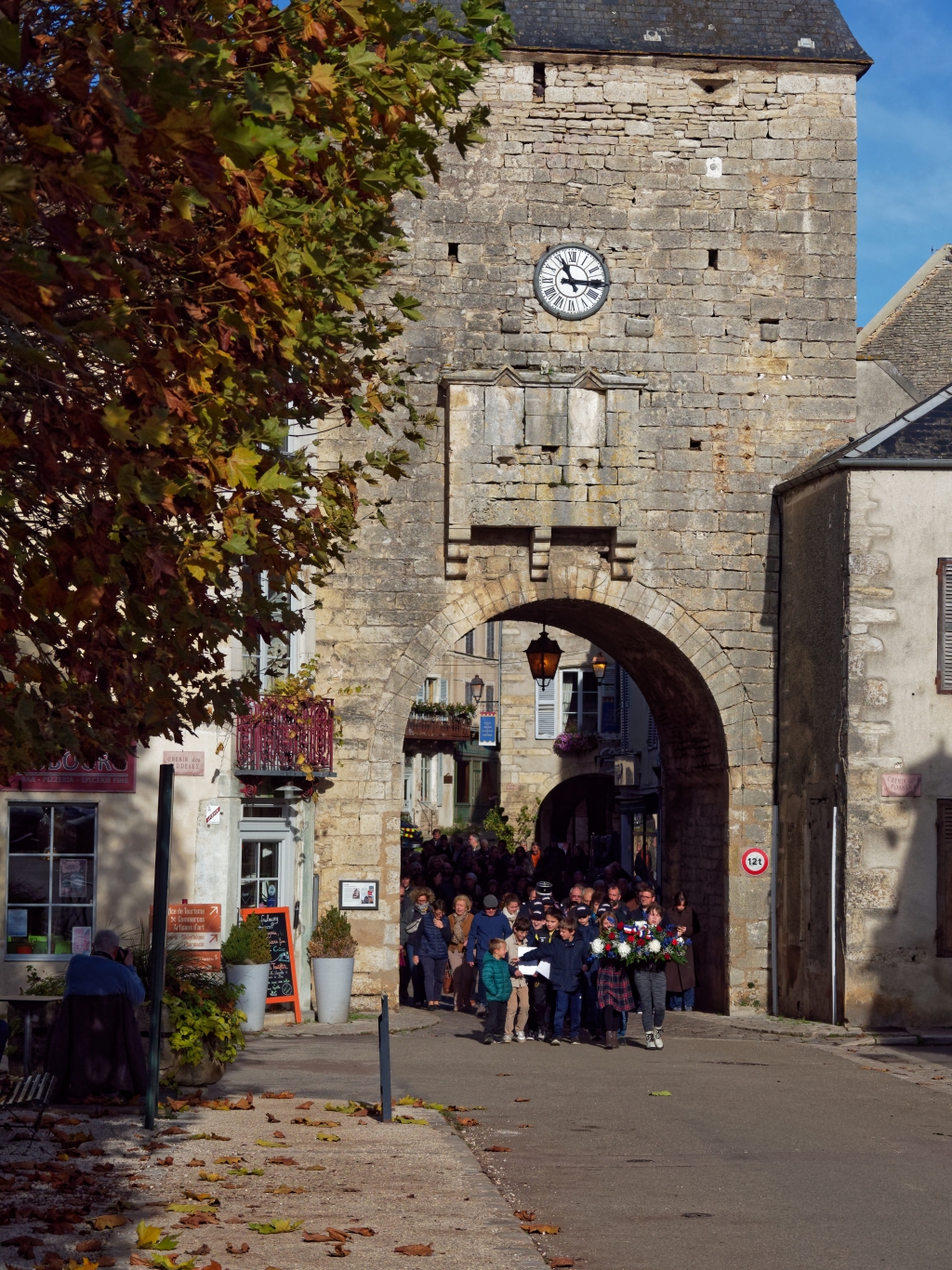
Noyers-sur-Serein
Much as we like Entre-deux-Eaux, it is never likely to be listed among the most beautiful villages of France. On 11 November, which is a public holiday in France, while we were taking a short break in Burgundy, we parked outside Noyers-sur-Serein which is a member of Les Plus Beaux Villages de France Association just before two girls with wreaths of red and white flowers led a procession of officials and inhabitants out through the old gateway to the war memorial. The emptied mediaeval village with its cobbled streets, timbered houses, wrought iron and ceramic signs and carved beams was a photographer’s paradise, with a couple of old Renault 4 cars thrown in for picturesque effect. After climbing uphill towards the site of the old castle and admiring the view, we descended a steep passageway gingerly, followed a backstreet, looked round the church and its misericords, then headed for a coffee. The Mairie door was invitingly open, and from the festive sounds within, we deduced that the procession had returned and was drinking to the village’s war-dead. We sat down outside Mimi’s cafe facing the Mairie. Mimi patted his shaggy dog, adjusted his slouch hat and disappeared into the bar to make coffees. 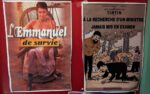 The walls of the tiny WC in one corner of the small bar were covered with rude cartoons, mainly with sexual innuendos. A rare political one showed Tintin, Captain Haddock and the Thom(p)son “twins” scanning the ground with the caption a la recherche d’un ministre jamais mis en examen. It was hard to know whether the cartoon of President Macron in frilly skirts, boots and a pearl necklace labelled L’Emmanuel de survie was a sexual or political comment.
Toilets also featured, as they inevitable do when travelling, in the next Burgundian village where we stopped. Flavigny-sur-Ozerain is a hilltop mediaeval village, famous for the pea-sized aniseed sweets it produces in the former Benedictine abbey. The streets of stone houses (with red roses still flowering in November) were calm, the church was closed for renovations, and shops like the book seller and the épicerie were closed on this public holiday. But people were sitting at trestle tables outside the ferme-auberge which is run by a group of enterprising farmers wives to showcase their farm produce. The women were just sitting down with friends and family for their own late lunch when we went inside, but cheerfully served us coffees. Afterwards, as there was no discreet WC sign, Helen asked if they had a loo. Amid appreciative laughter from her friends at her wit, one of them replied in mock-horror that they were not angels and directed Helen outside to a cellar doorway and their immaculate facilities. We read later that in 2001 seven weeks of filming took place in the village for Chocolat with Juliette Binoche and Johnny Depp, but we saw no chocalaterie tourist signs or souvenirs in the sleepy village.
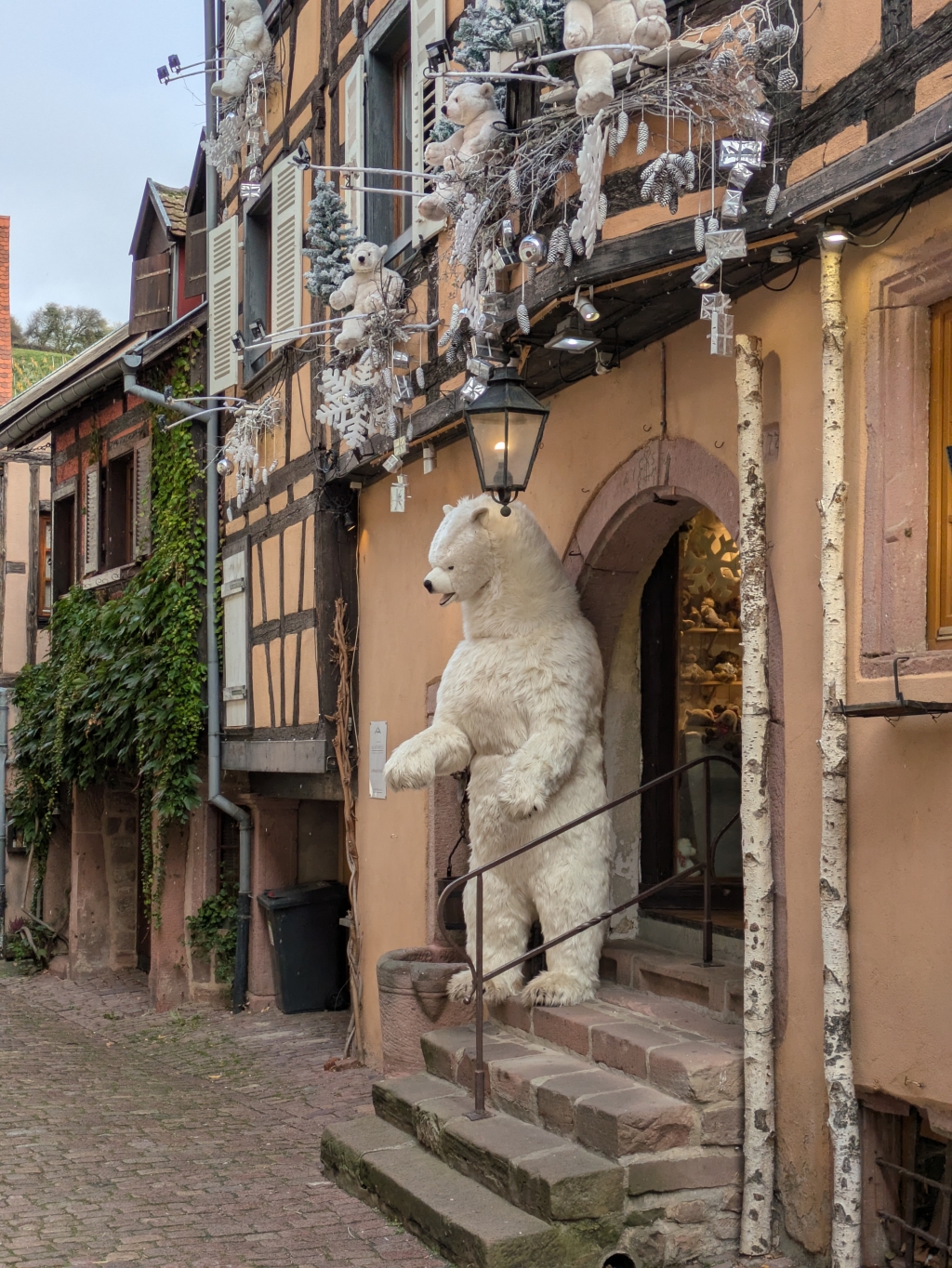
Riquewihr bear shop
In October we celebrated John’s birthday closer to home in the picturesque and touristy village of Riquewihr in Alsace. As we drove over the col de Bonhomme from Entre-deux-Eaux, the forest colours were yellow, ochre and gold against the dull sky. Then, as were driving along the Alsace wine route, a huge rainbow appeared over the black branches and yellow leaves of the vineyards. We parked outside the walls of Riquewihr (glad of our reserved hotel place as visitors had parked everywhere else) and strolled through the gateway and down the cobbled main street of craft, food and gift shops, one with an eye-catching upright polar bear outside, and out through the far gate to the quirky restaurant we have visited before with the unmemorable name of AOR la table le gout et nous. We climbed the steps to the closed wooden door of the restaurant and John pulled the doorbell which clanged noisily. The website describes the chef as a traveller, chef, poet and rocker (so AOR – Album-Oriented Rock – with LPs and CDs as place mats). He’s worked in Hong Kong, South Africa, USA and Qatar (as chef to the wife of the Emir) so uses interesting flavours in all his dishes.
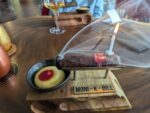
Moni-K-Bill smoking chocolate cigar
We were served a tasty surprise five-course lunch with local Alsace wines. The most exotic-sounding course featured Patagonian tooth fish and the dessert was his signature Moni-K-Bill smoking chocolate cigar.
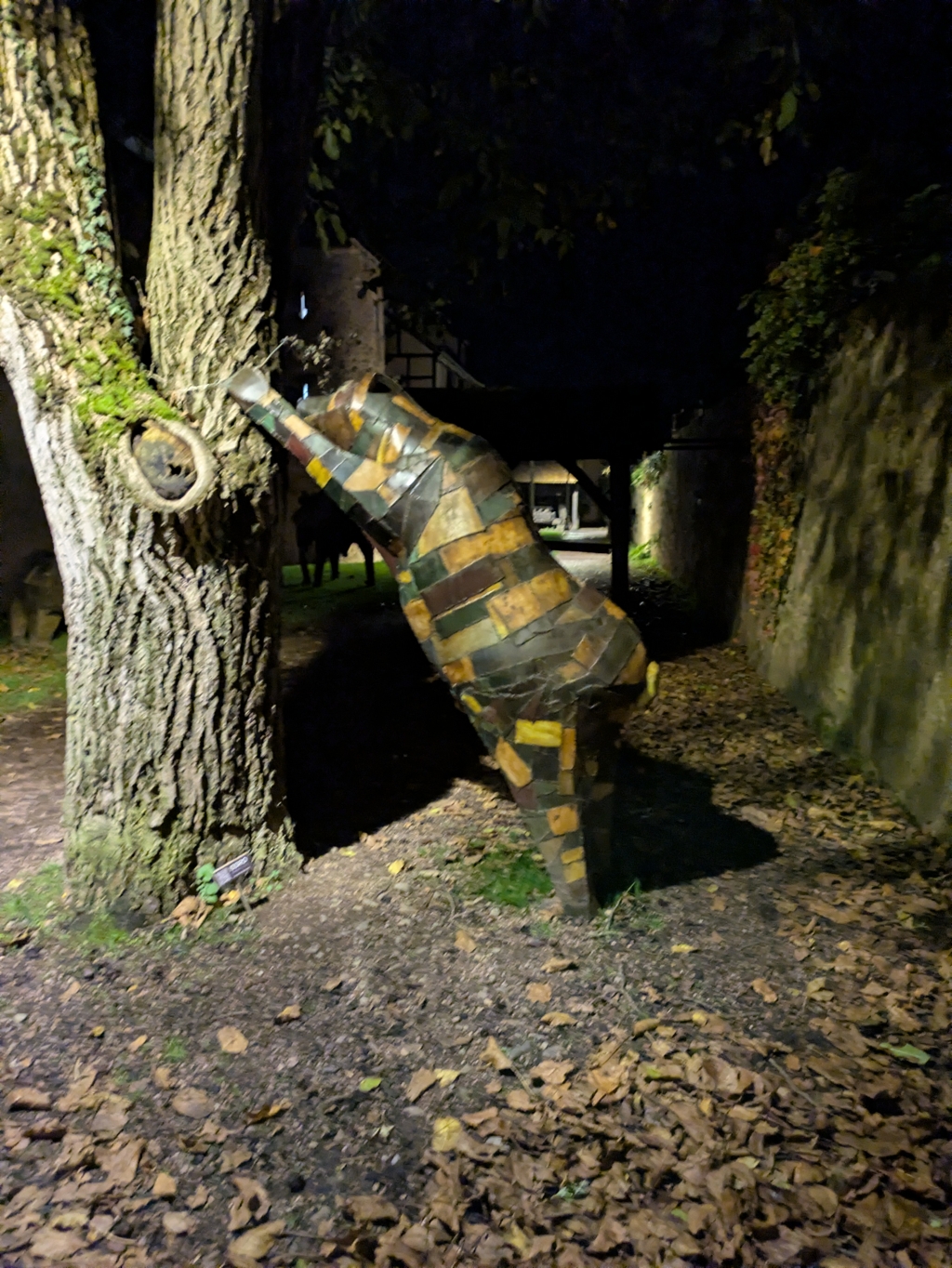
Riquewihr metal sculpture
We stayed overnight in a comfortable traditional hotel, the Saint Nicolas, within the walls of Riquewihr. When the rain lifted in the evening we had a pleasant stroll round the quiet cobbled streets (all the daytime tourists had magically disappeared). The metal animal sculptures outside the walls looked surprisingly menacing in the dark. After breakfast next morning (the croissants ran out – unheard of in France!) we paid a short visit to the famous Christmas shop on the corner of the street. No-one wants an angel without arms, and our glass angel for our Letchworth Christmas tree had broken beyond repair. We surveyed the arrays of angels in glass, straw, terracotta and faïence, with trumpets, cymbals, violins or harps, and selected a simple one, before driving home to E2E in heavy rain.
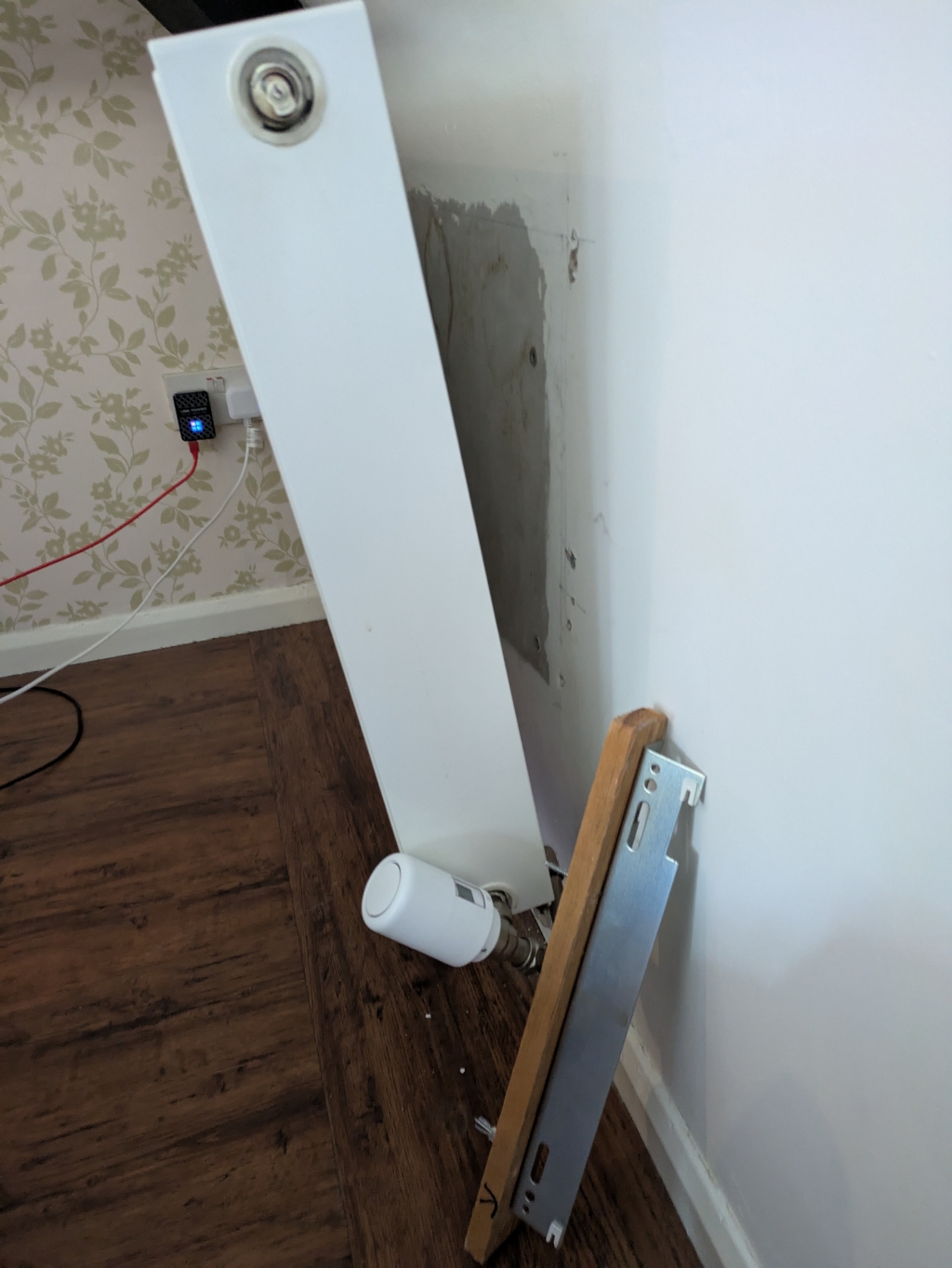
damaged radiator
We had spent from mid-August to the end of September in Letchworth, which was longer than usual, but enabled us to do a lot of useful things like repainting the dining room (such alluring colour names – chinoise and elderflower) and arranging boiler maintenance and the reattachment of the radiator which we found had mysteriously leapt off the bedroom wall and was leaning at an angle – perhaps due to the shock of a lorry accident on the nearby road as various items in the workshop had also fallen to the floor.
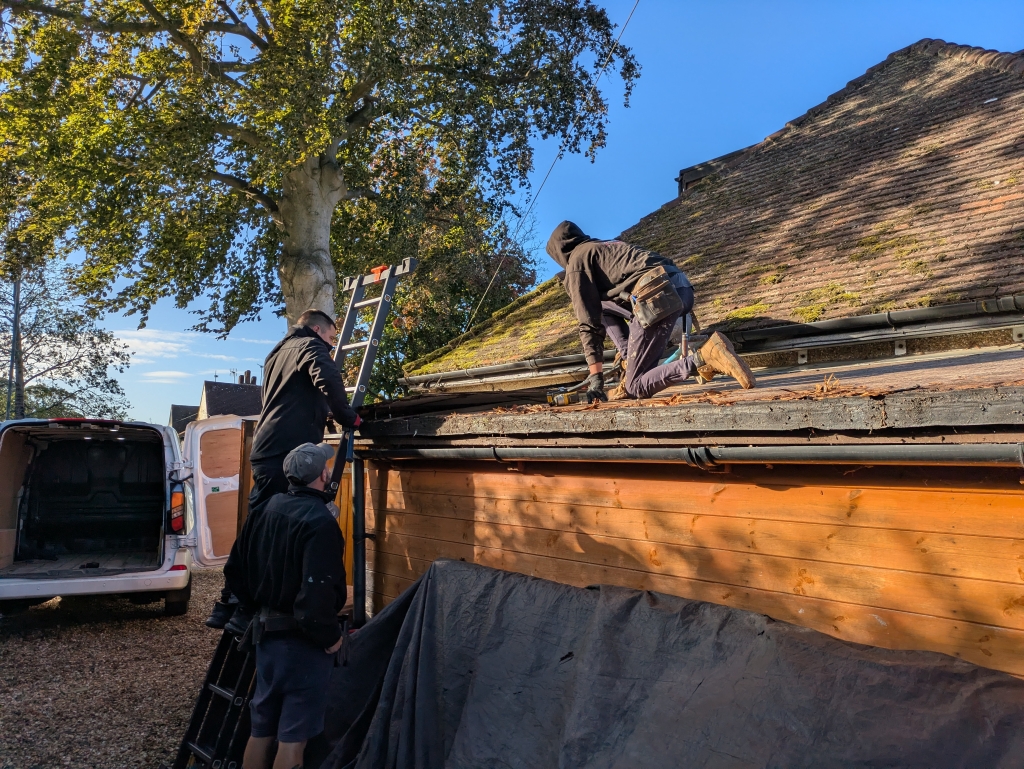
workshop roof
John hopes that the thermostatically-controlled condensate trace heating wire he inserted in the external boiler condensation pipe, together with insulation, will stop the freezing condensate this winter. While he was overseeing the replacement of the workshop roof by three energetic men from a Stevenage firm, Helen was gallivanting in the Lake District with Jessica and Sue, the sadly diminished Train Gang of three.
Sue lives in the old school house of High Lorton village. You get to see a village when you dog-walk, and stop to chat with neighbours. First stop the village church (and its excellent book exchange) and last stop the village shop. It sounds as if Sue and her husband Hugh have played or sung in choirs in most of the surrounding villages, including at Christmas Nine Lessons and Carols. There were no choirs of angels in September, but Sue was booked to play the grand piano one afternoon for visitors to a stately home, Mirehouse, on the edge of Lake Bassenthwaite. The sound of her music rippled from the music room through all the downstairs rooms as Jessica and Helen walked round and chatted to the charming woman on the desk without realising for quite a while that she was one of the owners who still lived in the upstairs rooms. In the nursery (which had been moved downstairs for the public to visit) there was a copy of a poignant letter from two of the earlier children, “Dear President Kruger”, it began, then begged him to stop the Boer war which was killing so many young men. It had not been allowed through by the censor. The traditional train element of the reunion was a surprise visit to the former Bassenthwaite Lake railway station (the line had closed in 1966) where we had coffee and cake in the stationary replica French steam train used in the 2017 Murder on the Orient Express film. The finale of the re-union was an interesting talk in the village hall about a couple of archaeological sites.
There are no choral involvements for Toby and Rachel in their much smaller village outside Melton Mowbray. The small thirteenth century church has been closed after the theft of lead from the roof, but Toby has been roped into the Holwell Church restoration/fundraising committee. When we visited them at the end of August with Leila, Ann and Derek, another group of volunteers were hard at work in the nature reserve along the disused Holwell Iron Company mineral track. We did not see any orchids as we walked along it, but there were plenty of blackberries and the bushes were dripping with elderberries, and we returned to the magnificent Sunday lunch that Toby had cooked.
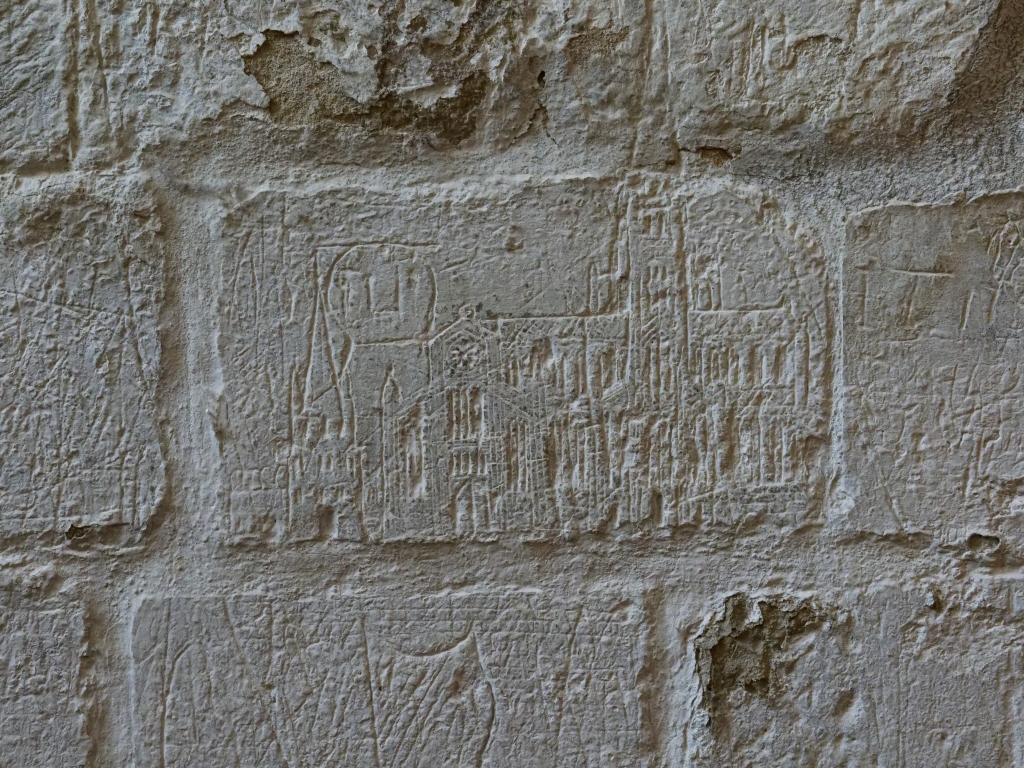
Ashwell church graffiti
Back in Letchworth we spent a morning with Ann, Derek and Leila in Ashwell village. Their spacious fourteenth century church has some remarkable graffiti from the 1300s including one about inhabitants surviving the Black Death, a sketch of Saint Paul’s London before the Great Fire of 1666 and a grumble in Latin, presumably from an architect or clerk of works, “The corners are not jointed properly. I spit on them”. Some of the congregation of the Wednesday service which had just finished lingered to chat with us, before we headed for coffee at “Rhubarb and Mustard”.
City life has provided an occasional contrast to village concerns during the last four months. The main reasons recently for driving an hour north from Entre-deux-Eaux to Nancy have been to visit not its art nouveau or late baroque splendours but either the hospital or the Honda car showroom. The hospital has reassured John that all is well after his melanoma removal, but the showroom was less convincing, if not misleading, in the information it provided on a Honda we were considering.
We ended up with a more useful test-drive of the Honda in Colmar last week and as a result are reflecting on purchase in the New Year. We had already visited the Nissan deal in Colmar but had been unable to test drive their offering as the person with whom we had an appointment was not known there. (It turned out it was a new appointee who had not yet started work there!) Rather than waste the journey we drove into the centre and walked round the attractive Petite Venise area. Unfortunately John stumbled on a two-level edge of the riverside pavement and fell flat on to the cobbles, to the consternation of other tourists who tried to haul him to his feet. Fortunately his wrist was all he had damaged, and he was able to enjoy a meal at a nearby restaurant Bord’eau. We had eaten there years ago when it was JY’s with its showy chef, but this time we enjoyed the calmer atmosphere and good food. The wrist took longer to recover.
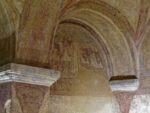
Auxerre crypt fresco
Our November break in Burgundy had started in Auxerre, where we sampled the annual Saint Martin Fair (which we did not know about before we arrived), had an interesting tour of the Abbey and its ninth century crypt frescoes (some of the oldest in France) and ate Kosovan and Indian meals. But it was the city of Dijon that we fell in love with. We had enjoyed lingering in the two villages described above en route to Dijon but we were glad that we had booked a hotel and parking on the edge of the historic, and largely pedestrian centre of Dijon, even if it meant driving through the extensive outskirts and criss crossing a tram route. Our Ibis Styles Hotel Central turned out to be an elegant 1928 art deco building, renovated in 2021, with a super polite, smiling, efficient staff, and comfortable rooms. Their breakfast spread was lavish and we lingered over it, finishing with coffee and nonnettes, round spice cakes filled with orange jam and coated with honey, a speciality first produced in Dijon by the monks of the abbey of Saint Benigne. Sometimes one wonders if all the monks and nuns did was producing alcohol and cakes to sell. The fancy épiceries we later passed in the pedestrian streets, with their goods temptingly arrayed outside, offered fancily packed little nuns, or nonnettes along side expensive jars of Dijon mustard.
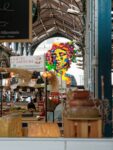
Dijon Les Halles
Our hotel was just round the corner from the picturesque 1845 Boutique Maille with its earthenware jars of mustard, but we didn’t visit that or the Moutarderie Edmond Fallot. Supermarkets are cheaper. The best arrays of cheese we saw were in the covered market, whose impressive iron framework was inspired by Dijon-born Gustav Eiffel (even if another planner and construction firm were used).
 We spent most of our visit to the Beaux Arts Museum looking at their magnificent mediaeval altarpieces, paintings and tombs which we knew little about. Leaving the intervening centuries unvisited, we then struggled to find the right staircases or working lifts to the nineteenth to twenty-first century galleries. A different art experience was the Musée Magnin private collection of two amateur art lovers in their still partly-furnished former mansion.
And of course there were all the churches – the splendid portico of Notre Dame with its three rows of expressive nineteenth century gargoyles and highly venerated little statue of Notre-Dame de Bon-Espoir who twice liberated Dijon (in 1513 from the Swiss and 1944 from the Germans); Saint Michel with the golden reliquary of Dijon’s Carmelite nun, Elisabeth de la Trinité, who was beatified in 1984; and the Cathedrale Saint-Benigne whose interesting-sounding Romanesque crypt was unfortunately closed when we visited. Walking past the north transept doorway of former Église Saint‑Étienne we were amazed to see monumental figures which turned out to be plaster casts of Le Départ de 1792 (or La Marseillaise) taken as a precaution in the second world war from the sculptures on the Arc de Triomphe in Paris which had been made by Dijon sculptor Francois Rude. Excavations in the choir showed the remains of the castrum of Dijon and its gateway. Not to be outdone, the nave housed the municipal library, but it was closed for renovation and surrounded by hoarding. We did however come across another library, the beautiful reading room in the former Jesuit College des Godrans. with its long tables of silent readers of all ages and strings of overhead silver fairy lights.
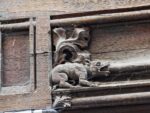
Dijon house wood carving
But we were happy just wandering round the streets of timber-framed houses with their wooden carvings and arcades or their stone mansions with sculpted lions’ heads and huge gates opening into courtyards. In tiny shops we could see woodwind instruments being repaired, chocolates, pianos, a distillery, or antiquities (if a paint-blotched step ladder and piles of old magazines really count as antiques). We encountered fountains and statues (like the surprising Compteur du temps by Gloria Friedmann), and a carousel from 1900. We saw a memorial to a resistance hero, but no plaque marked the six-storey former Gestapo headquarters. We would have missed the tiny stone owl on a cathedral buttress had it not been for the passers-by touching with their left hand and lifting up children to have their wishes granted; over the ages it has been polished and worn till it is almost unrecognisable as an owl.

Pompon bear (replica)
But a replica of Pompon’s statue of a white polar bear in the park was very recognisable, despite the children climbing on it.
After the breakfast spreads, we were not hungry till evening. Our first evening’s Sublime restaurant (contemporary French/Italian) was not mis-named, the second evening’s L’un des senses struck us as having more of a sense of its own worth than of flavour, and on our last evening the more modest Grand Café cheerfully served us their 29 euro Burgundy menu which (especially the jambon persillé and boeuf bourguignon) brought back memories of other visits over the years to Burgundy (though we were glad of a comfortable hotel rather than a tent). As we ate our last breakfast and nonnettes, we were sad we had no longer than an evening and two days to spend in Dijon this November.
Now, as Christmas approaches, the windows, houses and shops in Alsace will be decorated with white bears of all sizes, joining October’s large furry polar bear in Riquewihr. Village friends tell us that nonnettes are a Christmas delicacy here as well. And we must not forget to pack our angel from the Christmas shop in Riquewihr before we set out on December 12 for the UK.
With increasingly ridiculous postage costs, do not worry if you do not receive a Christmas card from us, but accept our very best wishes through this newsletter for a peaceful and happy Christmas and for year ahead in 2026.
